Radio Bands

Thread Starter

biferi

Joined Apr 14, 2017
529
I do not know if anybody can help me with this but I thought I would ask?

If you are using a Shortwave Radio and you are Turning the Dial going from Station to Station every Station is spaced apart in 10 kHz increments.

Can anybody tell me what increments Stations on these Bands are spaced apart at?

VLF Band LF Band SHF Band EHF Band.

Thank you for all your help.
 

MrChips

Joined Oct 2, 2009
34,807
It depends on what you are transmitting and what sidebands are transmitted.
If your modulating frequency is 5kHz then you need 10kHz bandwidth on double side bands or 5kHz on single side band.
 

Ya’akov

Joined Jan 27, 2019
10,235
The spacing of channels in various bands is controlled by local regulatory authorities and international treaties. To know what the spacing is for any given band you will have to determine the service that it is allocated to, then read the regulations about channel spacing for that service.

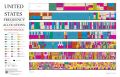
There are a lot of services. This chart covers US allocations under the FCC. You will have to zoom in to see the text. Each service will have channelization, frequency band, and sometimes international agreements.

View attachment 1667497660511.jpeg
 
Last edited:

Externet

Joined Nov 29, 2005
2,631
'Shortwave' 3 to 30 MHz receivers can show AM, USB, LSB, DSB, FM, CW, FSK, AFSK, digital modes. Each can have its spacing. Amateur radio and military is not 'channelized' at fixed intervals.

Edited : Sorry; just noticed :
VLF Band LF Band SHF Band EHF Band.
VLF = 3 to 30 KHz
LF = 30 to 300 KHz
SHF = 3 to 30 GHz
EHF = 30 to 300 GHz

As above said, each service has its regulations.
1667506253697.png
 
Last edited:

WBahn

Joined Mar 31, 2012
32,823
But...but...what about spread spectrum where all of the channels can be piled on top of each other and separated by means of their coding?
They still have regulations that govern spectral content.

In the U.S., in the ISM bands, unlicensed intentional transmitters were required to use spread spectrum, which is why the original 802.11 WiFi standard was based on frequency hopping and direct sequence spread spectrum (and also infrared). The same was true for 802.11b. But then the FCC the spread spectrum requirement, so 802.11g used OFDM.
 

Thread Starter

biferi

Joined Apr 14, 2017
529
Well let say I had a Radio that can Tune in VLF Band.

As I move through the Band what will the spacing be between FREQ. this I what I should have asked?
 

WBahn

Joined Mar 31, 2012
32,823
Well let say I had a Radio that can Tune in VLF Band.

As I move through the Band what will the spacing be between FREQ. this I what I should have asked?
VLF is too broad as it encompasses everything from 3 kHz to 30 kHz and is used for a variety of services, thus there is no single "channel spacing". Transmitters are given assigned center frequencies and bandwidths.

Try reading up on the things you are asking about:

https://en.wikipedia.org/wiki/Very_low_frequency#List_of_VLF_transmissions
 

Thread Starter

biferi

Joined Apr 14, 2017
529
I think I understand how this works?
So LF Band would be the same?

The LF Band does not have Set Spacing as well am I Right on this?
 
Top