Quick Question on SuperNode

Kermit2

Joined Feb 5, 2010
4,159
Yes. IF The current that enters the super node will be the same as the current leaving, then solving the individual nodes is not required, and one can use that as a super node.
 

Thread Starter

Digit0001

Joined Mar 28, 2010
100
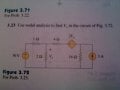
ok the following circuit has the exact circuit i have described above. I am having trouble trying to get the correct answer which is Vo = 22.34.

DSC00065.JPG
This is what i have done

1st equation using KCL

528=24V1 + V2

2nd Equation using KVL

-4i + 2Vo + V2 = V1

where i = V1 - 2Vo-V2

where V1 = Vo

-4(V1-2V1-V2)+2V1+V2=V1

7V1+5V2=0

V1=-5V2/7

sub back into 1st equation and we get

528 = -120V2/7 + V2

3696 = -113V2

V2 = -32.707

V1 = (-5*-32.707)/7

So V1=Vo=23.36volts
 

jegues

Joined Sep 13, 2010
733
ok the following circuit has the exact circuit i have described above. I am having trouble trying to get the correct answer which is Vo = 22.34.

View attachment 30969
This is what i have done

1st equation using KCL

528=24V1 + V2

2nd Equation using KVL

-4i + 2Vo + V2 = V1

where i = V1 - 2Vo-V2

where V1 = Vo

-4(V1-2V1-V2)+2V1+V2=V1

7V1+5V2=0

V1=-5V2/7

sub back into 1st equation and we get

528 = -120V2/7 + V2

3696 = -113V2

V2 = -32.707

V1 = (-5*-32.707)/7

So V1=Vo=23.36volts
I'm not seeing how you get your equations.

Writing a super node at the top with the 4Ω and the dependent voltage source(labeling left node Vo, right node Vx),

\(\text{KCL:}\quad 3 = \frac{3}{2}V_{o} - 30 + \frac{1}{16}V_{x}\)

But from the supernode,

\(V_{o} - V_{x} = 4 \left( \frac{-1}{2}V_{o} + 30 - V_{o} \right) + 2V_{o}\)

\(\Rightarrow V_{x} = 5V_{o} -120\)

Into my KCL,

\(33 = \frac{3}{2}V_{o} + \frac{1}{16}\left( 5V_{o} - 120 \right) \)

\(\Rightarrow Vo = \frac{81}{2} \times \frac{16}{29}\)

Hopefully that clears up your confusion.

Next time tell us what nodes you are labeling what, your equations aren't clear at all.
 
Top