Quick question on Multi meters.

Ya’akov

Joined Jan 27, 2019
10,283
I kinda take issue with that statement because a battery can do both. A solar panel ok fine but a battery takes charge then dispates wash repeat. Not trying to be nit picky electronics are confusing enough though eh.
First you were trying to measure the current coming from the battery, so in this context, @MrChips is talking about that. If the battery became a load (no longer a voltage source) it would be because a different, higher voltage source was in the circuit, and then you would be measuring the current from that one. That is, being a battery doesn't determine whether it is a source or a load.

Second, you can certainly put current into a solar panel, though that's not what they are designed for. What you get shouldn't be so surprising...

Similarly, an LED will produce a voltage if light is shined on it. Things tend to work in both directions. The laws of physics are very symmetrical.

[EDIT: I wanted to add the photo below because it's pretty cool, and I found it after I wrote this.]

1644340677939.png
 
Last edited:

Thread Starter

Teljkon

Joined Jan 24, 2019
267
Voltage sources output voltage.
The amperage is dependent on the load for which you need to apply Ohm’s Law.

I = V / R

Yes, you need resistance in series with the ammeter.

You can also wire a known resistance across the voltage source and measure the voltage across the resistor. Use Ohm’s Law to calculate the current.
So really what I need to do is mesure resistance/ohms of the of the circuit in parallel. Then get my current to drive the circuit via formula? Even if I am correct about that it still won't tell me what my battery can do though, so yeah theres that.
 

MrSalts

Joined Apr 2, 2020
2,767
I kinda take issue with that statement because a battery can do both. A solar panel ok fine but a battery takes charge then dispates wash repeat. Not trying to be nit picky electronics are confusing enough though eh.
If electrics are confusing for you, you should respond by saying, "I take exception to that...". Maybe you could say, "my understanding is x, could your please explain what you mean by 'voltage sources output voltage', Mr electronics expert?"
 

MrSalts

Joined Apr 2, 2020
2,767
Also, remove your 10amp fuse and measure the resistance of that fuse with your meter on the ohms setting. Do the same with the 400mA fuse.
The 10a fuse is likely blown to give an "OL" reading. If it was zero, when nothing is connected in amps mode, it would read 0 if the fuse is good and the meter is working.
 
Last edited:

MrChips

Joined Oct 2, 2009
35,059
To clarify, let us use a battery as an example of a voltage source.

You can measure the voltage output of a battery with no load.
You can measure the voltage output of a battery with a load.

You cannot measure the current output of a battery with no load.
With a load applied to the battery you can measure the current flowing through the load.

The current is determined by Ohm's Law

I = V / R

and varies with the load applied. It does not tell you the max current that the battery can supply.
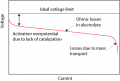
The voltage output from a battery will vary depending on how much current is being taken.
The voltage drops as the current increases.

1644414507835.png
 

BobKenney

Joined Jan 1, 2014
1
Essentially what has been stated here several times is that there is NO current flow without a load (no open circuit current). Current is always measured with the meter in series with the load. Battery VOLTAGE can be measured open circuit (probes across the battery).
 

drjohsmith

Joined Dec 13, 2021
1,635
So really what I need to do is mesure resistance/ohms of the of the circuit in parallel. Then get my current to drive the circuit via formula? Even if I am correct about that it still won't tell me what my battery can do though, so yeah theres that.
MrChips had a good answer,

You ask about the battery capability, as its not marked on the battery and / or its old.

The output of a battery is neither constant over time, nor constant with varying loads,
have you seen the lights on the car dim when you start the car, and a heavy load is taken from the battery ?
this is because the battery can not provide such a high voltage at a heavy current

Batteries have an effective internal resistance in series with the terminals
so as the current goes up, this resistance consumes more power,

also chemical reactions have an optimal rate for a given battery
Its called the C number,

So if you had a 100 Ah 12V battery,
you "could" discharge it at 10 amps or at 1A
in theory one will last 10 times longer than the other,
In reality, the rate you discharge at has an effect on the time till the output voltage drops to an un usable point,

The way to test a given battery , is to fully charge it, and then discharge it across a constant current load,
till the terminal voltage is at a "to low a voltage"

The common way to test, is to charge and then put a resistance load on the battery , of the order you are expecting your load to be , and measure the terminal voltage

so if you have a 12 v battery and was expecting to draw 1 amp , you would use a 12 Ohm , 12 Watt resistor,
 

k1ng 1337

Joined Sep 11, 2020
1,038
I prefer to use shunt resistors to measure current as I've blown quite a few fuses and have left the meter on current mode when measuring a voltage which of course blew the fuse. The current through a resistor will always be proportional to the voltage across it and this voltage is useful for determining current when using a microcontroller or device not in series with the test load.

A good example is a battery in series with an LED and a resistor. Sure you could measure the current with your meter, or you can measure the voltage across the resistor and since you know the resistance of the resistor it's a quick ohm's law calculation. Your meter is basically performing the same calculation as far as I know.
 

Thread Starter

Teljkon

Joined Jan 24, 2019
267
If electrics are confusing for you, you should respond by saying, "I take exception to that...". Maybe you could say, "my understanding is x, could your please explain what you mean by 'voltage sources output voltage', Mr electronics expert?"
I see why they call you mr salts. Wee bit salty. Electronics are not confusing to me. Applied theory can be a little bit of a minor issue but that is a very different problem. I do appreciate everyone's feedback. My intention was never to be obtuse. However if something feels inconsistent I am going to point at it.

Sadly the answer I received, while undoubtedly accurate, is consistent with the problems we face in re-use and extending longevity of components.

My battery is almost a useless black box without buying several other tools. I would almost have to set up a lab just to figure it out. The time and cost would be almost as much as just getting a new battery/batteries.

Thanks for the feed back I understand the method better now and I will chalk back to basic here when i play with the project again.
 

drjohsmith

Joined Dec 13, 2021
1,635
I see why they call you mr salts. Wee bit salty. Electronics are not confusing to me. Applied theory can be a little bit of a minor issue but that is a very different problem. I do appreciate everyone's feedback. My intention was never to be obtuse. However if something feels inconsistent I am going to point at it.

Sadly the answer I received, while undoubtedly accurate, is consistent with the problems we face in re-use and extending longevity of components.

My battery is almost a useless black box without buying several other tools. I would almost have to set up a lab just to figure it out. The time and cost would be almost as much as just getting a new battery/batteries.

Thanks for the feed back I understand the method better now and I will chalk back to basic here when i play with the project again.
you say " without buying several other tools"

just a thought, would you work on your car without the right tools ?


As shown above,
simple first test of a battery capacity , needs but a volt meter, and a fixed resistance load,

Assuming you are working on electronics, I assume you have a volt meter, a few dollars,
and if you dont have any resistors around,
they are a few dollars,
 

k1ng 1337

Joined Sep 11, 2020
1,038
It's not a name, it's a warning label.
I see why they call you mr salts. Wee bit salty. Electronics are not confusing to me. Applied theory can be a little bit of a minor issue but that is a very different problem. I do appreciate everyone's feedback. My intention was never to be obtuse. However if something feels inconsistent I am going to point at it.

Sadly the answer I received, while undoubtedly accurate, is consistent with the problems we face in re-use and extending longevity of components.

My battery is almost a useless black box without buying several other tools. I would almost have to set up a lab just to figure it out. The time and cost would be almost as much as just getting a new battery/batteries.

Thanks for the feed back I understand the method better now and I will chalk back to basic here when i play with the project again.
You might be surprised of the treasure trove of knowledge these guys posses and if they are stern it's usually from a place of experience. I did laugh about the salty comment and yes some of these guys are covered in NaCl haha probably due to being old which is just a matter of time for us..
 

Reloadron

Joined Jan 15, 2015
7,921
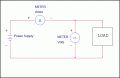
Using a multi-meter we measure voltage across a load and current in series with a load. Here is a cartoon illustrating that.

Meters.gif

That's all I got. :)

Ron
 
Top