Facebook
 Google
 GitHub
 Linkedin
Hi everyone,
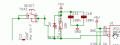
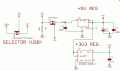
I'm looking at the schematics of the Arduino Micro and some things are not very clear to me.
1. How does the P-Channel MOSFET T1 work, assuming only USB is connected?
Here is what I think happens, please tell me if I'm correct - when USB is connected, Vusb is 5V, and the parasitic diode of T1 has some voltage drop, meaning there is now a potential on the source. Now, since Vin = 0V (NC/floating, is it the same as 0V?), Vgs is now negative and now the MOSFET is in saturation so that the +5V net now has 5V from the USB. Is this true?
2. What's the point of diode D2? And are C10 and C11 bypass capacitors?
Thank you!
I'm looking at the schematics of the Arduino Micro and some things are not very clear to me.
1. How does the P-Channel MOSFET T1 work, assuming only USB is connected?
Here is what I think happens, please tell me if I'm correct - when USB is connected, Vusb is 5V, and the parasitic diode of T1 has some voltage drop, meaning there is now a potential on the source. Now, since Vin = 0V (NC/floating, is it the same as 0V?), Vgs is now negative and now the MOSFET is in saturation so that the +5V net now has 5V from the USB. Is this true?
2. What's the point of diode D2? And are C10 and C11 bypass capacitors?
Thank you!