Questions about RC (time constant)

Thread Starter

TsAmE

Joined Apr 19, 2010
72
I have a couple of doubts on the RC (time constant):

*Why is it that it takes 5RC to fully charge a capacitor and not RC (since total time = RC)
*Say you wanted to double or half the output pulse duration, how would you know what Vc you must apply to pin 5?

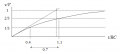
Could someone please explain by referring to my attached diagram.
 

Attachments

Ghar

Joined Mar 8, 2010
655
The time constant is not 'total time'. It is simply a coefficient in the exponents you get:

\(v_C(t) = V(1 - e^{-\frac{t}{RC}})\)

When t = RC you get:

\(v_C(RC) = V(1 - e^{-1}) = 0.63V\)

When t = 5RC you get:

\(v_C(RC) = V(1 - e^{-5}) = 0.993V\)

You can figure out your second question by going through the capacitor charging equation (which I just used) though the question is a bit vague.
 

t_n_k

Joined Mar 6, 2009
5,455
I have a couple of doubts on the RC (time constant):

*Why is it that it takes 5RC to fully charge a capacitor and not RC (since total time = RC)
In relation to either a rising or falling simple first order exponential function ....

If you consider what is the basic definition of time constant - it is the time at which the extension of line of slope of the curve at zero time intersects the final value.

The time constant simply denotes the apparent initial trend to final value at t=0. It's not the time it actually takes to reach the final value.

Not sure about your second question - pin 5 of what?
 

Thread Starter

TsAmE

Joined Apr 19, 2010
72
In relation to either a rising or falling simple first order exponential function ....

If you consider what is the basic definition of time constant - it is the time at which the extension of line of slope of the curve at zero time intersects the final value.

The time constant simply denotes the apparent initial trend to final value at t=0. It's not the time it actually takes to reach the final value.

Not sure about your second question - pin 5 of what?
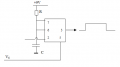
Sorry, perhaps if I attach a diagram and further info it will become more clear.

Attached is a monostable, where by default the output is 1.1RC (as it goes high for this time once). Now if I wanted to double the duration of this high time it would obviously be 2.2RC right? But now I want to know what voltage you must apply to pin 5 in order to do this?
 

Attachments

t_n_k

Joined Mar 6, 2009
5,455
This is presumably a 555 timer question.

Have you searched this forum for more info on the 555 timer?

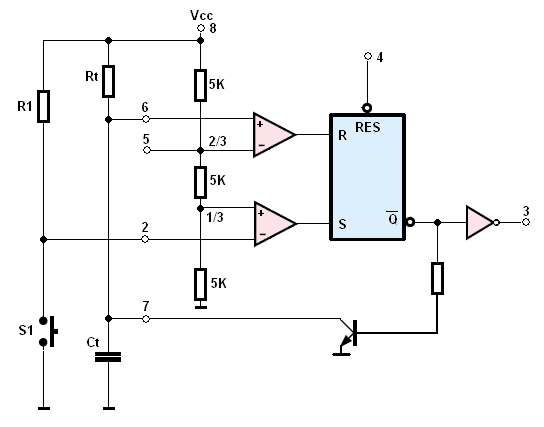
In any case, pin 5 of the "555" timer is a means of varying the reset & trigger points for the capacitor discharge and charge threshold levels. These are normally preset inside the 555 timer as 2/3Vcc and 1/3Vcc respectively. Imposing an external input on pin 5 changes these levels according to the value of the control voltage you apply. The source resistance of the control voltage will also come into consideration if you don't have a low resistance source - compared with the "555" internal divider chain values ~ 5kΩ.

You might want to do a bit more reading on the "555" and look at some specific application notes on the web. Then you will hopefully have a better idea on how to design for the values you need.

Some more generous forum member might do the design for you ...... I'll pass on that.
 

Jony130

Joined Feb 17, 2009
5,599
Look at simplified diagram of a "555" circuit


And you will note that threshold voltage is equal 2/3Vcc and if you apply a voltage to node 2 you will change the threshold voltage level.

And also you need ask yourself a question to to which the voltage capacitor will charge after 2.2RC
 
Last edited:

KL7AJ

Joined Nov 4, 2008
2,229
In reality, the 5 time constant rule is a somewhat arbitrary "rule of thumb." 99% "there" is good enough for 99% of any practical application.

Eric
 
Top