OK, in the truck case it was a very low impedance power source that could sink as well as source current. Most supplies are not intended to do that. A direct battery connection is the one common exception.
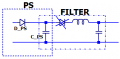
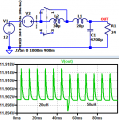
Diode should be not incorporated in the middle of the filter, as RF functional, but should be connected before filter.hat's interesting ... L1 and C1 are there for obvious reasons. But the diode is (supposedly) there in case the power supply falters for a moment, so that C1 feeds the load (in your diagram, shown as R1) and does not discharge itself back into the power supply.

You were absolutely right, Danko. I visually inspected the wall wart's circuit (power supply) I'm using, and sure enough, it had a diode and a cap at its output as you've shown. So a diode in my circuit is really of no use, and only causes a detrimental voltage drop. But the capacitor it has is rather small. 470 µF to be precise. And it has no inductor at its output, although it does have a common-mode choke at its input.Diode should be not incorporated in the middle of the filter, as RF functional, but should be connected before filter.
Such diode already exists - D_PS.
View attachment 185047