Question About The Correct Use Of Bit Position DIP DIL Toggle Switches

Thread Starter

Michael Knight

Joined Nov 5, 2015
90
I have a project I'm working on and I'm a little curious about if I'm using the:
Bit Position DIP DIL Toggle Switches correctly in my somewhat messy Photoshop layout of a circuit I'm attempting to build.

Over on the far left top corner you can see I have two switches illustrated connecting ground.
Is it OK to use these sort of switches in this manor?
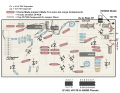
KITT_CPU_Mockup.png
 

Thread Starter

Michael Knight

Joined Nov 5, 2015
90
Purpose of switches ?

How much current do the switches have to carry ?

Regards, Dana.
Thanks Dana,
The switches just connect the ground for two circuits on the PCB, one switch connects the ground for the 9V (-) of the LED Bar Chaser circuit and the other switch connects the ground for the 9V (-) of the 12 LEDs Random Flasher circuit.
 

AnalogKid

Joined Aug 1, 2013
12,077
The 7805 and 7809 pinouts are reversed.

It looks like you have GND going to the anode of at least one of the LEDs.

The 4017 and 4060 outputs are not designed to drive an LED to any real brightness. At 12 V, the 4017 typical output current capability is around 6 mA, and your circuit has a 1K and 1LED to GND. The output will be overstressed.

The switch current looks OK, but note that DIP switches are not rated for very many operating cycles.

This is not your first thread regarding this board. Can you post your schematic?

ak
 

Thread Starter

Michael Knight

Joined Nov 5, 2015
90
The 7805 and 7809 pinouts are reversed.

It looks like you have GND going to the anode of at least one of the LEDs.

The 4017 and 4060 outputs are not designed to drive an LED to any real brightness. At 12 V, the 4017 typical output current capability is around 6 mA, and your circuit has a 1K and 1LED to GND. The output will be overstressed.

The switch current looks OK, but note that DIP switches are not rated for very many operating cycles.

This is not your first thread regarding this board. Can you post your schematic?

ak
Thanks,
Yeah it just looks like the 7805 & 7809 are backwards, I labeled the pins on the 7809 just so I know to get them right but didn't label them on the 7805, but I've wired those up before and they work fine.
Nope, as near as I can tell the LEDs for the 12 Random LED flasher are OK. ??
The 4017 & 4060 are running on 9V

Sorry, The only actual schematics I have are the originals for the two separate circuits, but they've been modified.
 

Bernard

Joined Aug 7, 2008
5,784
I believe that the 4017 is frequently abused successfully. Measurements at 12 V supply .
Load R_____V out___ I out mA
4048_______11____2.7
2221_______10.5__4.7
872________ 9.5__10.9
439________7.7__17.5
I can't suggest 10 mA, but I would do it, also for 4060
 

Thread Starter

Michael Knight

Joined Nov 5, 2015
90
What a mess.

Look for 0 ohm resistors. They are used for jumpers. They usually have a single black band in the center.
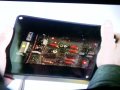
lol Yes I know, it's just my way of trying to arrange the parts on the board to look sort of like this:
The Jumpers are just to mimic those big fat older style capacitors.... at least I think they are capacitors in he picture.
20170104_171719.jpg 20170104_171719.jpg
 

Thread Starter

Michael Knight

Joined Nov 5, 2015
90
I'll see if I can create a more typical schematic, that Photoshop illustration is more for me to keep track of how I want to arrange my parts onto the Proto-type board.
 

Thread Starter

Michael Knight

Joined Nov 5, 2015
90
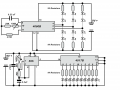
OK I made a diagram that shows the two separate circuits, the one for the LED 10 segment Bar Chaser Circuit and the one for the 12 "Random" flashing LEDs.
I have not included the DIP switches or the 12V to 9V converter part just to keep it as simple as I can.

KITTbrainEffectsBoardV1.png
 

AnalogKid

Joined Aug 1, 2013
12,077
For the 4017 circuit, only one LED is on at any given time. Therefore, you need only one current limiting resistor; not 10. Connect the LED anodes directly to the 4017 outputs, keep all of the cathodes connected together, and have one 1K resistor from the cathodes to GND.

Change to a CMOS 555 (LMC555) to increase battery life.

A 100 uF decoupling capacitor for the 555 is unusually large, and not as effective as a smaller cap. I recommend changing it to 2.2 uF (same as the timing cap). Also, add one across the 4017 power supply pins and one across the 4060 power supply pins. These caps should be as close as possible to each chip's power supply pins, with the shortest possible leads and trace lengths. Capacitors associated with the three terminal regulators are separate devices.

ak
 

Thread Starter

Michael Knight

Joined Nov 5, 2015
90
For the 4017 circuit, only one LED is on at any given time. Therefore, you need only one current limiting resistor; not 10. Connect the LED anodes directly to the 4017 outputs, keep all of the cathodes connected together, and have one 1K resistor from the cathodes to GND.

Change to a CMOS 555 (LMC555) to increase battery life.

A 100 uF decoupling capacitor for the 555 is unusually large, and not as effective as a smaller cap. I recommend changing it to 2.2 uF (same as the timing cap). Also, add one across the 4017 power supply pins and one across the 4060 power supply pins. These caps should be as close as possible to each chip's power supply pins, with the shortest possible leads and trace lengths. Capacitors associated with the three terminal regulators are separate devices.

ak
Thanks,
One of the diagrams on the page I found the circuit originally shows the single Resistor connection you are talking about, I actually don't mind the extra resistors, it add's more stuff to the top of the PCB board which for "Looks" is OK for our purpose... so I don't mind the extra components. ;)
About the other stuff you mentioned,
Would you be willing to whip up a simple diagram just so I can see better what you mean?
I have a typical Artist brain, seeing it in context always makes it clear ;)


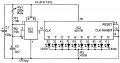
Oh, this is the diagram I was talking about that showed the single Resistor connection on the LEDs.
NV_0400_Marston_Figure08.jpg
 

Thread Starter

Michael Knight

Joined Nov 5, 2015
90

takao21203

Joined Apr 28, 2012
3,702
I have often read about keeping the capacitor leads so very short as to put great efforts if you could shave a millimetre.

Its simply wrong information. You wont see ANY effect until you get 30cm wire + reasonable large currents as well.
For low frequencies any capacitors work. You dont need one per chip. One per circuit board usually does it.
If you have a lot of ICs put one per 5 ICs.

0.1uF is quite standard but upto 0.47uF
Larger capacitors are also good if they are modern kinds, otherwise may not have as much of an effect.

Mind the ICs here are around for 40 years or more and well known.

If you have 2x 40xx one NE555 and one LM78xx regulator, you only need one buffer capacitor for all. As long as your wires traces are smaller than 30cm!

I dont get the TS topic, about the DIP switches. They are just switches after all. They are not lets say for front panels or lets say as the light switch in your room. Theres other small slide swiches for instance, they may even be cheaper than DIP switch.

Of course, 2.00 for a single capacitor, 2.00 for a dip switch, 2.00 per IC, and so on, you end up with 40 or 50 for a small circuit.
Its all genuine parts but your schematic is not so good so theres malfunctions of some kind and fast battery drain.

I mean the circuit doesnt do anything, is just for show? TS puts the DIP switch question to get the ball rolling or is it?

Usually they are for configuration, something changed once, or sometimes. Otherwise theres many kinds of small slide switches, some with 2mm pins. They are more durable and can carry larger currents. The DIP switch are not good even for 100mA as the contacts inside are tiny. So if you switch a circuit with a 1000uF capacitor youll get punctures on them pretty soon.
 

Thread Starter

Michael Knight

Joined Nov 5, 2015
90
I have often read about keeping the capacitor leads so very short as to put great efforts if you could shave a millimetre.

Its simply wrong information. You wont see ANY effect until you get 30cm wire + reasonable large currents as well.
For low frequencies any capacitors work. You dont need one per chip. One per circuit board usually does it.
If you have a lot of ICs put one per 5 ICs.

0.1uF is quite standard but upto 0.47uF
Larger capacitors are also good if they are modern kinds, otherwise may not have as much of an effect.

Mind the ICs here are around for 40 years or more and well known.

If you have 2x 40xx one NE555 and one LM78xx regulator, you only need one buffer capacitor for all. As long as your wires traces are smaller than 30cm!

I dont get the TS topic, about the DIP switches. They are just switches after all. They are not lets say for front panels or lets say as the light switch in your room. Theres other small slide swiches for instance, they may even be cheaper than DIP switch.

Of course, 2.00 for a single capacitor, 2.00 for a dip switch, 2.00 per IC, and so on, you end up with 40 or 50 for a small circuit.
Its all genuine parts but your schematic is not so good so theres malfunctions of some kind and fast battery drain.

I mean the circuit doesnt do anything, is just for show? TS puts the DIP switch question to get the ball rolling or is it?

Usually they are for configuration, something changed once, or sometimes. Otherwise theres many kinds of small slide switches, some with 2mm pins. They are more durable and can carry larger currents. The DIP switch are not good even for 100mA as the contacts inside are tiny. So if you switch a circuit with a 1000uF capacitor youll get punctures on them pretty soon.
Thanks,
Yeah the DIP switches are more again for show, but I figured if I could get some simple actual function out of them as for the most part KITT's brain / CPU will be tucked in under the Knight Rider dash, most times unless you are pulling it out for show you'll never really see it so I figured the DIP switches could shut off the ground connections to the LED's circuits, one switch for each circuit, that way when you have it under the dash you could switch off the top effects board. And turn them on just for show if you had the brain pulled out.

Because they are just switching the ground would they not be OK though?
 
Top