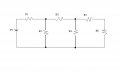
then you got to solve it matricial way and you get the I(1,2,3) current, and after you use Ohm law(U=RI) to solve each voltage drop along each resistor..
For a really simple 2-resistor potential divider, you can calculate the voltage dropped across each one without ever knowing or thinking about the current. The same goes for more complex systems like this.
The electrician is right - you start by simplifying the circuit so that it consists of just two resistors - R1 in series with whatever the combined resistance of R2, R3, R4, R5 and R6 is.
Then you have a simple 2-resistor potential divider for which you can calculate the voltage across R1. Work on from there for the remaining resistors.
One way to do it is to combine all the resistors in one,find the total current and then start extracting the resistors again and use the voltage and current divider rule to find what you want.

 Facebook
 Google
 GitHub
 Linkedin
 13.3 KB Views: 50