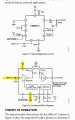
I'm in need of adding an audio compressor (https://www.analog.com/en/products/ssm2167.html) to a mixer board. The mixer uses 4565 OpAmps galore with Dual Supplies (+/- 15V) which makes sense to me, but the compressor circuit shows an capacitor-coupled signal with the lower power supply being Gnd and I can't seem to wrap my head around how this work with an AC signal centered around Gnd. What am I missing?
The capacitor blocks the DC level of the signal into the compressor. Obviously the circuit on the single supply uses an input signal reference that is above ground potential - usually about half the available supply voltage.
A circuit diagram would help.
My question isn't about the mixer and the dual-supply opamps. It's about the addition of a compressor that isn't dual-supply and how it handles audio signals centered about gnd.
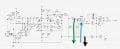
Here's the Mixer schematic and where it inserts itself into the audio bus (via the Insert functionality which sends mono audio on the T and receives the processed mono audio on the R).
My question isn't about the mixer and the dual-supply opamps. It's about the addition of a compressor that isn't dual-supply and how it handles audio signals centered about gnd.
The compressor biases the input after the input capacitor to some DC level (likely somewhere close to 1/2 the supply voltage) for proper operation of the circuit (not shown in the diagram).
The AC signal thus goes plus and minus relative to some DC bias level as it goes through the circuit.
The DC bias is then blocked by the output capacitor and returned to ground level by the output resistor to give a plus/minus AC signal around ground.
The compressor biases the input after the input capacitor to some DC level (likely somewhere close to 1/2 the supply voltage) for proper operation of the circuit (not shown in the diagram).
The AC signal thus goes plus and minus relative to some DC bias level as it goes through the circuit.
The DC bias is then blocked by the output capacitor and returned to ground level by the output resistor to give a plus/minus AC signal around ground.
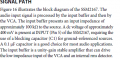
It does and my misunderstanding was probably with this part of the datasheet which I *assumed* they were talking about the actual level of the audio signal (I should have realized it when they said DC) but is likely the DC offset you mentioned, in this case it's 400mV which is pretty normal at this point in the audio path.
Edit: It makes even more sense as they promote the part as being usable for battery-powered applications to avoid the hassle of split-supplies.
OK, and the DC bias on the compressor IC is internal, and it is included to make using it simpler. AD will do things like that to make their products easier to use and avoid frustrating designers.

 Facebook
 Google
 GitHub
 Linkedin