Query on current flow

Thread Starter

Banana Leaf

Joined Sep 6, 2017
5
Hi guys,

just trying my luck here hopefully some experts can clear my doubt.

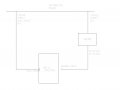
I was given a scenario per attached. In the event of gouging torch touching the metal structure, will the excessive current flows through the wall socket ground lead back to the distribution board?

Cheers.
 

Attachments

WBahn

Joined Mar 31, 2012
32,823
Depends on if the DC welder's output is tied to the distribution's ground. I believe most welders have the DC output floating, but you are supposed to separately ground the workpiece or the table. If the work clamp is connected to the work table, then if you touched the metal enclosure with the electrode the current would flow from the electrode, to the metal structure, then through the grounding path to the work clamp (which should NOT involve going through the distribution ground) and back to the welder.

Note that I'm assuming that the situation for a "gouging torch" is the same as for a typical arc welder. I could easily be wrong.
 

BR-549

Joined Sep 22, 2013
4,931
You also have a ground/work lead from the welder, right? Why would any current feed back thru socket circuit ground?
 

Thread Starter

Banana Leaf

Joined Sep 6, 2017
5
In the event that the welder is grounded to the work table instead of the metal structure (which is not grounded), will touching the gouge torch to the metal structure (let's just assume there is a short circuit) complete the loop and current flow through the socket circuit ground?
 

WBahn

Joined Mar 31, 2012
32,823
In the event that the welder is grounded to the work table instead of the metal structure (which is not grounded), will touching the gouge torch to the metal structure (let's just assume there is a short circuit) complete the loop and current flow through the socket circuit ground?
How can it if the metal structure is not grounded?
 

BR-549

Joined Sep 22, 2013
4,931
We can only consider the information given. So our suggestions and answers can be wrong.

Does your welder/cutter have a floating output? Most do.

This means the current from the active probe/lead.....does not want to go to ground or to the distribution panel.

It wants to go to the work(ground) probe/lead.

If the work probe is grounded to the distribution ground.......then yes....the current would try to return via socket ground. It(the active probe), does not have to touch.

But that ground circuit can only carry 15 amps(wire size). Ground is not usually on a breaker......so it might melt.

Are you following any of this?
 

WBahn

Joined Mar 31, 2012
32,823
Hi, I am not sure whether the welder has a floating output but there is only 1 cable so I assume it does?
Only one cable?

The electrical current has to flow between from the torch and the metal being gouged. Surely you secure the work clamp of the welder to the item you are working on. That's the second connection.
 

BR-549

Joined Sep 22, 2013
4,931
If this is just a theoretical(paper) question......and that is all the information given........and after the posted replies.....what do you think...........would the socket ground wire exceed it's current rating?

If this is a real question....with a real welder........get an electrician before you turn it on.

Some people put real world problems in the homework section once in a while. If that was a real homework question......it makes a lot of assumptions that we haven't heard.

It's obvious that you don't understand.......so if it's real machinery......get an electrician.
 

Thread Starter

Banana Leaf

Joined Sep 6, 2017
5
Sorry I might have misunderstood. I believe there is another cable as you mentioned. let us say the work (ground) clamp is attached to a different structure which is grounded to the distribution board ground, is it safe to say that the above will happen, that the current will travel back through the socket ground (and melt the wire)?
 

Thread Starter

Banana Leaf

Joined Sep 6, 2017
5
It is a real world problem but in a case study so I assume it is related to homework section? I am sorry if it doesn't, please direct me to the correct forum. thanks.
 

BR-549

Joined Sep 22, 2013
4,931
Yes....it will melt somewhere above the current rating of the ground leg conductor. IF the ground conductor is connected to the metal building.....AND the building is NOT connected to the distribution ground. No touching required with torch......just an arc. Touching will melt it.

According to your picture ONLY......yes...it will melt.

Your case study needs to define the grounds of everything, including the structure. Especially if this was a real life situation.

This is why I don't trust studies.

The answer to your question remains conditional. Which one will you pick for your study?
 

WBahn

Joined Mar 31, 2012
32,823
Sorry I might have misunderstood. I believe there is another cable as you mentioned. let us say the work (ground) clamp is attached to a different structure which is grounded to the distribution board ground, is it safe to say that the above will happen, that the current will travel back through the socket ground (and melt the wire)?
Are you now introducing yet another structure (this "different structure") that is different from the one that the torch is accidentally touching?

Is this "different structure" electrically connected to the structure that the torch is accidentally touching?

The bottom line is that the current from the torch must make it to the work clamp (calling it a ground clamp is usually a poor name because it usually does not provide a ground connection -- instead it is usually connected to something that is otherwise grounded). If there is no viable path between the two, no current will flow. If the only viable path is through the distribution ground (which is probably not the case, but could be) then that is the path the current will take. If there are multiple viable paths, then current will flow in all of them in proportion to the conductance of the various paths.
 
Top