Query method to eliminate spike during AC signal triggering on

ebp

Joined Feb 8, 2018
2,332
I really have to either pay no attention to a tread or pay closer attention.

The initial spike in the simulations never really made any sense to me. Now that I've looked more closely, I see that the spike in the simulations is not really what I would regard as a spike at all. It is simply the peak voltage of a sine wave from an exceptionally high impedance source, and exists entirely because the inductance of the load forces the current through it to start at zero, meaning the source impedance is a small fraction of the loop impedance at turn-on. This is completely unrealistic if the source is AC mains.
 

ebeowulf17

Joined Aug 12, 2014
3,307
I really have to either pay no attention to a tread or pay closer attention.

The initial spike in the simulations never really made any sense to me. Now that I've looked more closely, I see that the spike in the simulations is not really what I would regard as a spike at all. It is simply the peak voltage of a sine wave from an exceptionally high impedance source, and exists entirely because the inductance of the load forces the current through it to start at zero, meaning the source impedance is a small fraction of the loop impedance at turn-on. This is completely unrealistic if the source is AC mains.
Wow, you're so right! I really should've noticed that before proceeding with sims... but I just copied the exact parameters from the earlier sims as a starting point and then played with RC values some. Should've known better. You know what they say about assumptions... :oops::(:rolleyes:

This makes a lot more sense now, but doesn't get any closer to sorting out TS's (thread starter's) problem. Hopefully the TS will respond with answers to my three questions a few posts ago and maybe we can get a better understanding of what's causing the spike in the first place... or now the odd, blocky step changes in the latest post from the TS. I really don't understand what's going on in those scope traces, but I'm hoping a little more info on the load might illuminate the situation.
 

Danko

Joined Nov 22, 2017
2,175
That looks really nice!
Thank you very much!:)
It is simply the peak voltage of a sine wave from an exceptionally high impedance source, and exists entirely because the inductance of the load forces the current through it to start at zero, meaning the source impedance is a small fraction of the loop impedance at turn-on. This is completely unrealistic if the source is AC mains.
Yes it is. They have poor power supply, something like wall wart or feed circuit by long control cable .
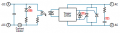
For modeling this situation I entered in sim #6 parameter Rser=20 for voltage source V2.
 

ebp

Joined Feb 8, 2018
2,332
We really do need more info. At #3 the source is said to be 100 VAC, so the normal peak of the sine seen at #1 is as expected for a low ratio of source to load impedance.

Still, I think all of this has been interesting, even if it is solving what I consider likely to be "not a problem" in the first place.
 

ebp

Joined Feb 8, 2018
2,332
'... or now the odd, blocky step changes in the latest post from the TS. ..."

Yes, those are quite bizarre. I suspect they are the product of some sort of resonance. Just what excites the resonant circuit is not at all obvious. Current through the load could be revealing - I'm thinking about the typical current waveform in a capacitively-filtered rectifier, where the current drops to zero quite rapidly when the instantaneous input voltage falls toward and below the capacitor voltage.

It's unfortunate that current probes for scopes are so expensive.
 

Danko

Joined Nov 22, 2017
2,175

Thread Starter

kw chong

Joined Apr 14, 2016
8
What is the nature of the load? (Inductive motor, resistive heater, something weird like an SMPS?)

What is the load current? An approximate estimate is fine. 100mA, 1A, 10A...?

What is the control signal and how is it being handled? Is it still 5VDC? Is it on constantly when you want the load active, or is it pulsed in some specific phase angle relationship? (You mentioned before that you were using zero-crossing control, although your scope traces at that time showed TRIAC firing at 90 degrees.)

Hi,
The load is hair dryer product (heater load+motor load).
When heater load off,only motor load on, ac current about 1.5A,
When heater load on, motor load on, ac current about 7.5A.

Still pulse in signal to the solid state relay input.
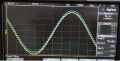
The waveform glitch attached in post#18 is solid state relay turned on, heater load off, motor load on.
 

ebp

Joined Feb 8, 2018
2,332
I would consider a snubber across the triac (small capacitor, probably at least 100 ohms in series) to avoid turn-off problems when running just the motor, however there are many modern triacs that would work perfectly well without a snubber.

I would not be concerned at all with either the spike at #1 or the odd "stepping" at #18. The spike would be of no consequence whatever to a heater or motor. The stepping in #18 might be associated with some RFI generation, but that would probably be solved with capacitor of a few tens of picofarads in series with a resistor of something in the 10 to 100 ohm range. If the motor has brushes, RFI countermeasures would probably be necessary in any case.
 

Danko

Joined Nov 22, 2017
2,175
I would consider a snubber across the triac (small capacitor, probably at least 100 ohms in series) to avoid turn-off problems when running just the motor, however there are many modern triacs that would work perfectly well without a snubber.
TS's SSR contains not triac, but SCRs and already has snubber:
SSR.png
 

Danko

Joined Nov 22, 2017
2,175
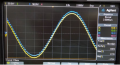
Had do some study using different triac/ssr/relay/instrument to get smoothen ac output waveform. (Refer attachment)
Looks like using triac/ssr with build in snubber also will had distorted ac output waveform.
Seems SSR contains 7 kHz short pulse generator, which is trying to open thyristor every 1/7 ms.
Inductance of motor is big enough and motor current can not be increased for thyristor full opening in short pulse duration.
Therefore thyristor is open every 1/7 ms for very short time only (while current goes through snubber).
We can see it on yellow waveform (main voltage?) as short pulses.
So, for solving this problem, you can use for motor MOSFET SSR, Random Type, like AQG22205, $5.06, Datasheet .
Edit:
If you can not use individual SSR for motor, try snubber 10 Ohm wirewound resistor in series with capacitor 1uF...2uF (selected experimentally). This snubber should be connected in parallel with your device (after SSR), as shown in post #6 .
Edit:
Using SSR, feed your setup directly from mains, not from Extech 6730, because electronics of Extech 6730 (with 100 us response time) and electronics of SSR definitely can play each with other (2-nd version of distortion origin).
 
Last edited:

kwchong

Joined May 2, 2017
2
Seems SSR contains 7 kHz short pulse generator, which is trying to open thyristor every 1/7 ms.
Inductance of motor is big enough and motor current can not be increased for thyristor full opening in short pulse duration.
Therefore thyristor is open every 1/7 ms for very short time only (while current goes through snubber).
We can see it on yellow waveform (main voltage?) as short pulses.
So, for solving this problem, you can use for motor MOSFET SSR, Random Type, like AQG22205, $5.06, Datasheet .
Edit:
If you can not use individual SSR for motor, try snubber 10 Ohm wirewound resistor in series with capacitor 1uF...2uF (selected experimentally). This snubber should be connected in parallel with your device (after SSR), as shown in post #6 .
Edit:
Using SSR, feed your setup directly from mains, not from Extech 6730, because electronics of Extech 6730 (with 100 us response time) and electronics of SSR definitely can play each with other (2-nd version of distortion origin).
The MOSFET SSR, Random Type, like AQG22205 you recommended load current rating too small, my application motor running with heater will take around 7.xx Amperes. Any other suggestion?
Snubber RC had tried connected before together with triac but result seems not improve much.
Client site might using different isolated AC power source(eg: Extech 6730) for this application, so might need to consider it too.
But had tried directly setup from mains power, waveform results better than post #31, but not yet totally smooth sine wave.
 

Danko

Joined Nov 22, 2017
2,175
Last edited:

Danko

Joined Nov 22, 2017
2,175
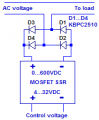
These SSR are really MOSFET, because they have parameter On-State Resistance:
AQAD171DL 0...600VDC, 10A, $115.86, On-State Resistance (Max) 200 mOhms.
SCM040600 2...600VDC, 40A, £165.00, On-State Resistance (Max) 0.14 Ohms.
Both relays should be used with diode bridge:
Bridge KBPC2510 - $2.18 & free shipping.
How to connect them:
Mosfet_SSR.PNG
 
Last edited:
Top