Facebook
 Google
 GitHub
 Linkedin

Evening all,
FTP, so excuse any rubbish formatting.
TLDR: I have an issue at the moment where a BLDC driver i am making isnt drawing anywhere near the current it requires from a battery.
so i have 3 half-bridge set up running a 3 phase BLDC motor, you know the type...
I have code written up an verified to be working for the arduino, and its suppose to turn on the respective logic-level mosfets for each phase depending on the motor position (i can use the hall sensors or BEMF as i have a couple sets of code).
The logic-level Fets state i can use the 5V from arduino digital pins to turn on the Fets, allowing current through to turn the motor.
HOWEVER.If i use a lead acid battery, it only draws about 0.5A into the circuit (fair enough ,its only rated for 1.05A initial), but i do get resistance if i manually turn the wheel whilst the driver is running. If i use the battery i want to use (ebike/hoverboard battery - stated below), then it doesn't draw at all, whereas i know these are working as i can pull them right off and plug them into their proper devices, and they work (hoverboard and e-scooter), and they work no problems. i have multiples of each battery i can use.
now, ive looked at the devices ive pulled these from and had these batteries working, and confirmed charged. the main boards and ebike controllers have the v+/v- from the batteries connecting straight to the high and low sides of the gates, so i know that they should work.
thinking it is an issue with how im controlling the Fets?
Any ideas how i can resolve this to draw what its meant to be using?
Thanks to all who can help me...im stumped on this, i may be an amateur, but i know my stuff, or not as it seems!
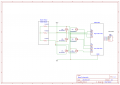
see attached for schematic, excl. all sensor components.. excuse my appauling use of the software, still learning it.
components used are:
Hoverboard BLDC Motor - 350W BLDC
only working source - Lead acid battery - ''6fm3.5'' - 12V/e.5Ah - 1.05 initail current (stated) -http://images02.cdn86.net/kps01/M00/6A/4A/wKiAiVWZ5sLPAerCAA2ljvtaRgc979.pdf
desired Hoverboard Battery pack- 36V/3.4Ah/122.4Wh - (basicly 7x 18650 cells)
desired ebike battery pack - 36V/3.4Ah/144.4Wh - (basicly 10x 18650 cells with BMS)
Logic level Mosfet - RFP30N06LE - https://www.sparkfun.com/datasheets/Components/General/RFP30N06LE.pdf
FTP, so excuse any rubbish formatting.
TLDR: I have an issue at the moment where a BLDC driver i am making isnt drawing anywhere near the current it requires from a battery.
so i have 3 half-bridge set up running a 3 phase BLDC motor, you know the type...
I have code written up an verified to be working for the arduino, and its suppose to turn on the respective logic-level mosfets for each phase depending on the motor position (i can use the hall sensors or BEMF as i have a couple sets of code).
The logic-level Fets state i can use the 5V from arduino digital pins to turn on the Fets, allowing current through to turn the motor.
HOWEVER.If i use a lead acid battery, it only draws about 0.5A into the circuit (fair enough ,its only rated for 1.05A initial), but i do get resistance if i manually turn the wheel whilst the driver is running. If i use the battery i want to use (ebike/hoverboard battery - stated below), then it doesn't draw at all, whereas i know these are working as i can pull them right off and plug them into their proper devices, and they work (hoverboard and e-scooter), and they work no problems. i have multiples of each battery i can use.
now, ive looked at the devices ive pulled these from and had these batteries working, and confirmed charged. the main boards and ebike controllers have the v+/v- from the batteries connecting straight to the high and low sides of the gates, so i know that they should work.
thinking it is an issue with how im controlling the Fets?
Any ideas how i can resolve this to draw what its meant to be using?
Thanks to all who can help me...im stumped on this, i may be an amateur, but i know my stuff, or not as it seems!
see attached for schematic, excl. all sensor components.. excuse my appauling use of the software, still learning it.
components used are:
Hoverboard BLDC Motor - 350W BLDC
only working source - Lead acid battery - ''6fm3.5'' - 12V/e.5Ah - 1.05 initail current (stated) -http://images02.cdn86.net/kps01/M00/6A/4A/wKiAiVWZ5sLPAerCAA2ljvtaRgc979.pdf
desired Hoverboard Battery pack- 36V/3.4Ah/122.4Wh - (basicly 7x 18650 cells)
desired ebike battery pack - 36V/3.4Ah/144.4Wh - (basicly 10x 18650 cells with BMS)
Logic level Mosfet - RFP30N06LE - https://www.sparkfun.com/datasheets/Components/General/RFP30N06LE.pdf