Quality vacuum pump and chamber?

Thread Starter

Michaelangelo1214

Joined Jul 18, 2024
35
Hello, I was wondering if anyone knows of a cheep, but decent vacuum pump and chamber? Preferably one under $150.00. I'm not really educated on measuring vacuum strength, but I want it to be able to de-bubble stuff like high voltage transformers, voltage multipliers, etc., in epoxy.
 

joeyd999

Joined Jun 6, 2011
6,204

jaclement

Joined Apr 15, 2009
60
The Amateur Scientist section of Scientific American magazine had an article on a serious vacuum pump system . It started the pump chain with a used refrigerator compressor motor. That would certainly get you down enough to debubble. your parts before potting. Be aware of implosion risks of your vacuum chamber.
 

nsaspook

Joined Aug 27, 2009
16,250
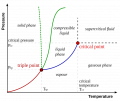
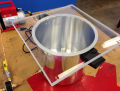
You can use a pressure cooker as a vacuum chamber in the low hundreds of mili-torr (typical oil vane pump vacuum range) range. Gentle heating of the part is recommended as the water vapor in air will freeze during the vacuum process and will take forever to pump out to the base pressure of the vacuum system as the ice sublimates back to vapor.
1734284579635.png

https://www.instructables.com/Pressure-Cooker-Vacuum-Chamber/

1734282225696.png
The trick is the lid vacuum seal and fittings must be reasonably leak tight. Always wear some sort of eye protection with these types of DIY chambers.

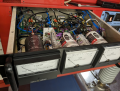
One of my work specialties is Ultra High Vacuum systems, so ask any questions.
1734282503246.png
1734282601604.png
1734282699602.png
1734282543319.png
 
Last edited:

LowQCab

Joined Nov 6, 2012
5,101
Generally de-Gassing Epoxy doesn't need to be a "precision" operation,
unless You are specifically instructed to follow certain procedures and meet certain criteria.

A standard Air-Conditioning-System Vacuum-Pump is perfectly adequate, and probably over-kill.

The Viscosity of the particular type of Epoxy being used is probably the most important consideration.
.
.
.
 

Reloadron

Joined Jan 15, 2015
7,855
I'm not really educated on measuring vacuum strength, but I want it to be able to de-bubble stuff like high voltage transformers,
I always called the process "impregnation" where windings (motors, transformers and like) went in a chamber with resin and we pulled vacuum and applied pressure over and over again. It was normal to see the resin actually boil when pulling a vacuum. As mentioned your choice of resin is likely the most important and your timing of suck/blow cycles. :) We only used a roughing pump for vacuum. Pump size depends on the volume of your tank and how quick you want a pull down.

You can use a pressure cooker as a vacuum chamber in the low hundreds of mili-torr (typical oil vane pump vacuum range) range.
I like that suggestion.


Ron
 
Last edited:

nsaspook

Joined Aug 27, 2009
16,250
I always called the process "impregnation" where windings (motors, transformers and like) went in a chamber with resin and we pulled vacuum and applied pressure over and over again. It was normal to see the resin actually boil when pulling a vacuum. As mentioned your choice of resin is likely the most important and your timing of suck/blow cycles. :) We only used a roughing pump for vacuum. Pump size depends on the volume of your tank and how quick you want a pull down.
Basically the same procedure for roughing out a chamber for (ultra) hi-vacuum. Pump, backfill with a dry gas like ultra pure N2 to become the carrier of residual water vapor from melted ice (and to scrub the chamber walls of weakly attached gas molecules) for the next pump cycle. WIth each cycle, the total amount of water vapor/residual gas decreases until the base level of rough vacuum is reached, then we switch to hi vacuum pumping with turbo molecular or cryogenic pumping systems.

Vacuum technology and applied physics.
 

Attachments

Reloadron

Joined Jan 15, 2015
7,855
We used dry pumped nitrogen. Anyway the only time we worried about milli-torr was when doing helium leak testing and then we used a roughing pump followed by a turbine to pump down product. Our go-to was MKS Vacuum systems for gauges and complete calibration standards. However, while really cool stuff I doubt the thread starter wants or needs a $2K vacuum transducer or pump. :)

P.S. I really liked your GUI for your system.

Ron
 
Top