Facebook
 Google
 GitHub
 Linkedin

TL;DR: Affordable, performant, convenient, quad-coax connector for RG-174 in high-density applications?
We have been successful building TTL<-->LVDS and TTL<-->RS422 translation boxes such as the following:
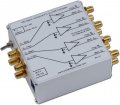
Each silver module is either a 4-channel, single-ended TTL to differential translator or a 4-channel, differential to single-ended TTL translator. Our standard module has 4 SMAs on the TTL side and 8 SMAs on the differential side:
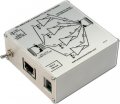
With the high density required for this application, we chose to use color-coded Cat7 cabling for both the differential signaling and for the single-ended TTL signaling, and 10Gb-rated RJ45 jacks on the modules:
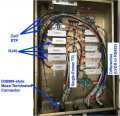
So 2 Cat7 cables can replace 12 coax cables. The signals enter and exit the chassis on very dense, mass-terminated connectors, similar to D38999, using standard size 22 socket contacts. The single-ended signals come in/out on left-most mass-terminated connector, and the differential signals come out/in on the other 3.
As expected, the double-shielded Cat7 works perfectly for differential signaling, whether LVDS or RS422.
For the single-ended signaling, it's just Ok. We're tying the "negative" wire in each pair, plus the per-pair foil shield, to GND wherever possible, and running the signal over the "positive" wire. We've done some reflectometry to show that the single-ended impedance of this construction is around ~54 Ohms:
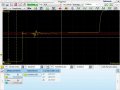
It's more than good enough for the data rates required by this particular application, but I wouldn't want to go faster than about ~50 MHz. Cross-talk, in particular, is not great on the single-ended signals.
For a higher-speed application, I'd want to use true coax down the middle aisle, terminated in 38999-stye Coax contacts like these:
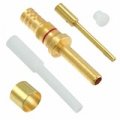
at the mass-terminated connectors.
This would require a lot of connectors and a lot of cabling. Those 11 Cat7 cables would be replaced by 44 coax cables and 44 SMA connectors down the center aisle, unless there were suitable mass-terminated coax connector that's performant, affordable, and convenient.
I found these quad-Fakra connectors, which are almost exactly what I need. These PCB-mount quad-Fakra jacks could be designed into each of my silver modules down the center aisle, and a single quad-Fakra jack is far less expensive than 4 SMA jacks:
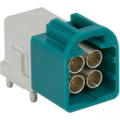
and then cable assemblies can be made with four lengths of RG-174 coax, a quad-Fakra plug on one end, and four 38999-style coax contacts at the other end.
Quad-Fakra-to-SMA cables are readily available and affordable:
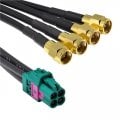
so swapping out the SMAs for 38999-style coax contacts should be affordable.
So what's the problem? The retention force on these Quad-Fakra connectors is way, way too much! I have to pull really, really hard to unplug these. In an ideal world I'd only have to do this once, after individual module test and before integration, but in the real world I need to consider trouble-shooting and maintenance. In a dense application like this it would be very difficult to depress the release tab and pull with enough force to unplug these connectors.
Of course this is by design, as Fakra is for automotive applications, and my application is a test rack in a lab.
Is there anything similar to a quad Fakra connector, but with lower retention force?
Thanks!
We have been successful building TTL<-->LVDS and TTL<-->RS422 translation boxes such as the following:
Each silver module is either a 4-channel, single-ended TTL to differential translator or a 4-channel, differential to single-ended TTL translator. Our standard module has 4 SMAs on the TTL side and 8 SMAs on the differential side:
With the high density required for this application, we chose to use color-coded Cat7 cabling for both the differential signaling and for the single-ended TTL signaling, and 10Gb-rated RJ45 jacks on the modules:
So 2 Cat7 cables can replace 12 coax cables. The signals enter and exit the chassis on very dense, mass-terminated connectors, similar to D38999, using standard size 22 socket contacts. The single-ended signals come in/out on left-most mass-terminated connector, and the differential signals come out/in on the other 3.
As expected, the double-shielded Cat7 works perfectly for differential signaling, whether LVDS or RS422.
For the single-ended signaling, it's just Ok. We're tying the "negative" wire in each pair, plus the per-pair foil shield, to GND wherever possible, and running the signal over the "positive" wire. We've done some reflectometry to show that the single-ended impedance of this construction is around ~54 Ohms:
It's more than good enough for the data rates required by this particular application, but I wouldn't want to go faster than about ~50 MHz. Cross-talk, in particular, is not great on the single-ended signals.
For a higher-speed application, I'd want to use true coax down the middle aisle, terminated in 38999-stye Coax contacts like these:
at the mass-terminated connectors.
This would require a lot of connectors and a lot of cabling. Those 11 Cat7 cables would be replaced by 44 coax cables and 44 SMA connectors down the center aisle, unless there were suitable mass-terminated coax connector that's performant, affordable, and convenient.
I found these quad-Fakra connectors, which are almost exactly what I need. These PCB-mount quad-Fakra jacks could be designed into each of my silver modules down the center aisle, and a single quad-Fakra jack is far less expensive than 4 SMA jacks:
and then cable assemblies can be made with four lengths of RG-174 coax, a quad-Fakra plug on one end, and four 38999-style coax contacts at the other end.
Quad-Fakra-to-SMA cables are readily available and affordable:
so swapping out the SMAs for 38999-style coax contacts should be affordable.
So what's the problem? The retention force on these Quad-Fakra connectors is way, way too much! I have to pull really, really hard to unplug these. In an ideal world I'd only have to do this once, after individual module test and before integration, but in the real world I need to consider trouble-shooting and maintenance. In a dense application like this it would be very difficult to depress the release tab and pull with enough force to unplug these connectors.
Of course this is by design, as Fakra is for automotive applications, and my application is a test rack in a lab.
Is there anything similar to a quad Fakra connector, but with lower retention force?
Thanks!