QI data transmitter and the receiver

Thread Starter

Aharon.fin

Joined Mar 14, 2022
1
QI Data transmission between transmitter and receiver

hi
I want to transfer a small amount of data between QI transmitter and the receiver.
I know it can be done in one direction and the direction is between the receiver to transmitter
But I haven't found a way in the opposite direction.
see atached :
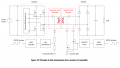
1732453145631.png

Is there any idea that it would be two-way?

Thanks
 

nsaspook

Joined Aug 27, 2009
16,250
The latest public spec says bidirectional comms is possible but I don't see many implementations on devices as an external communications channel.
https://www.st.com/content/dam/AME/...ntations/STDevCon19_6.1_Wireless_Charging.pdf

Qi 1.2.3 defines two communications methods:
• Unidirectional: RX to TX only, ASK, for BPP (Baseline Power Profile). Same as in Qi 1.1
• Bidirectional: RX to TX, ASK and TX to RX, FSK, for EPP (Extended Power Profile). Did not exist in Qi 1.1

https://www.renesas.com/en/document...ess-power-designs-and-system-level-challenges
In Qi-based wireless power designs, Receiver (Rx) and Transmitter (Tx) exchanges the messages using the bidirectional in-band communication. These messages are critical to establish the power contract, regulate the operating point, and detect foreign objects. Receiver-to-transmitter communication is completed by Amplitude Shift Keying (ASK) using with a bit-rate of 2Kbps. The receiver modulates the amplitude of the load applied to the receiver's coil by switching the external capacitors (Cmod) from AC1 and AC2 both to ground. To the transmitter, this appears as an impedance change, which results in measurable variations of the transmitter’s coil’s voltage and current. The transmitter’s controller decodes the message using integrated voltage and current demodulator and then regulates the power transfer accordingly. Transmitter-to-receiver communication is accomplished by frequency-shift keying (FSK) modulation over the power signal frequency using with a bit-rate of 200bps. The receiver detects the minor change in operating frequency and decodes the message sent by the transmitter.
In-band Transmitter-to-receiver communication is slow @200bps. Maybe BLE out-of-band would be better.
 
Top