Q of 3rd order filters

LvW

Joined Jun 13, 2013
2,035
Hi again.
MrAl, I will try to respond to some of your statements/conclusions.

Quote: "Then ask yourself why i would think it did. "

Yes, thats what I did several times. But I did not find an answer. I think, it is YOUR turn to convince me that you are right - or to proove that I am wrong.

Quote: "But i have to comment slightly here. You have given me an equation with no variable or symbol Q in it and asking me if there is a Q in it. That implies a few things.
First, that you are defining the Q of a filter based on what a first order filter equation has in it."


No - that is wrong. At least 4 times I have mentioned that there is a definition that was agreed upon since several decades.
I did not define anything. Shall I repeat again?
It is the POLE POSITION which is used for defining the Q-value of a second-order lowpass.
The fact that it does not appear in the 1st-order equation is the RESULT of this definition (because it applies for a pole pair only) and not the definition itself.

Quote: "Second, that means that you cant understand how something can have a Q when it is not in the equation."

Wrong conclusion. The absence of Q in the 1st-order equation results from its definition. Thats all!!

Quote: Ok so we have established that you are defining the existence of a Q by what an equation has in it, if it has it then it has a Q, if it does not have it then it does not have a Q.

Wrong conclusion (see above)

Quote: That is because we are seeking a method to figure out the Q of different filters, without resorting to old fixed definitions, if it even is one.
....................................
What this leads to is a more general definition of Q apparently, but to be honest i dont think it is actually new because it appears elsewhere also.


Also wrong - as far as my person is concerned. I am not seeking a new definition. Such a new and "more general" definition appears "elsewhere"?
Up to now, this is an assertion only - unless you give me a reference. I never have heard about it....

Quote: "Take two first order LP filters (that dont have a Q because it doesnt exist for first order filters) and connect them in cascade and you get a 2nd order filter with a Q of 0.5."
Does that sound right to you, because it does not sound right to me. It seems more logical that the two first order filters must have a Q of something.


Yes - it sounds right to me. And the explanation is simple (and will be no surprise to you):
Two first-order filters in cascade form a second-order filter - and now the Q-definition is applicable because we now have a pole pair!!

Quote:
"Corollary:
If we wanted to compare two filters with unknown topology let's say these three:
1. Q=0.5
2. Q=1.3
3. Q=5
We can see right off that #3 has higher Q then #2 and that has Q higher than #1.
Also, because the Q of #2 and #3 is above *0.5* (the star of the show) we know they must be of 2nd order or greater.


No - again, you have not the right understanding! A Q=5 is a second-order filter (Chebyshev response) with a large peaking of the amplitude before the passband ends. Again and again: Q-values for lowpass filters are defined for 2nd-order only.
As an example:
A lowpass with Q=1.306 is a Chebyshev filter (2nd order) with a peaking (ripple) of 3 dB.

More than that , this touches my question you still have not answered: When you are speaking of Q for higher orders - WHAT IS YOUR DEFINITION?

Quote:
"The next simple question is, what order is #1?
Now if you want to say that ti *must* be 2nd order because a first order can not have a Q because it does not exist that's fine, but i cant agree with that for the following reason (with this example only):
We could be referring to a first or second order filter with item #1 to keep the list shorter. If we did not do that, we''d have to list like this:
1. Q=0.5
2. Q=1.3
3. Q=5
4. Q does not exist
Granted that takes the ambiguity out of it."


I must admit - I do not understand the logic behind it....can you explain where you see any "ambiguity"?

Quote:
Let me state this point another way...
If we are discussing what kind of filter to use for a given application, the dialog may go like this:
"Hey Dexter, what kind of filter should we use for this new product?"
"Well Henry, do you think we should use a filter with a Q of 4 or a Q of 7, or how about a filter that does not have a Q because it does not exist?"
"What? We just need a reasonable sharpness and we know that correlates to the Q of the filter, so how sharp is the filter you say has no Q because it does not exist?"
"Gee Dexter, i cant tell because it has no Q because it does not exist."
"Well then how do we know if it has a sharp enough response for our needs?"
"I guess we dont, unless of course you would like to assign a Q that correlates to the sharpness of the response, even though the Q does not appear in any formulas yet."
"Oh ok that sounds reasonable, then we could tell the difference when comparing filters."
"Ok as long as everyone agrees then we'll do that."
"Ok. By the way, my name is not Dexter it is Qdexter."
"Oh gee, sorry i was under the impression that the Q did not exist."
"Ha ha, very funny, so being Henry, i guess you are an inductor then?."
<Henry quietly walks out of the room>
:)
Although the above is a little funny, it makes a point about comparing filters with regard to Q."


I must admit that this dialog is really crazy (not really funny).
The first answer from Dexter (3rd line) shows that he has no idea about filter design; he even does not know how to specify a filter. Thats all I can say to this part of your answer.

Again - please answer my question. Several times you have mentioned that there is a Q-value even for higher-order lowpass functions. And this means: You must have a definion in your mind. Why don't you enlighten me and give this definition?

Finally, if my choice of words seems a little rude at times, then I'm sorry.
I do get a little impatient when I have to repeat my arguments again and again ....... and you neither accept nor disproove it.

Regards
 
Last edited:

MrAl

Joined Jun 17, 2014
13,761
Without quoting your entire post i'll reply, and thanks for the reply too.

"No - that is wrong. At least 4 times I have mentioned that there is a definition that was agreed upon since several decades. "
Ok i think we have found the heart of the disagreement here. You are relying on a definition that was formed long ago apparently. I think you have to review this and i'll say why again in a bit but first i'll answer your question that i could have sworn we agreed on already.

Your question was how do i define a higher order filter Q.
Basically i thought we agreed that we would use the pole positions for that. I have no problem wit that.
It is only the first order that we seem to disagree on.

There are other references to "Q being defined for 2nd order and above only" but you will notice with that definition they never say "Q does not exist for a first order filter". Why is that? Because they simply have NO definition as of yet. If you have no definition it surely cant exist, but once you get one then it does exist.

So one quick question and this might help clear up my point.
You are given a task to design a 5th order filter with two 2nd order LP filters and one 1st order filter. Knowing filter design, you know some things will be understood to have to be observed:
1. This will require a cascade of two 2nd order filters and one 1st order filter.
2. To avoid saturation it is best to put the filter with the lowest Q first and the rest after that.

Now in the cascade arrangement, we have three component sections each will have a position 1, 2, or 3 in the cascade chain.
The 100 dollar question then is:
In order to satisfy #2 above, what position do you place the 1st order filter? Does it go in position 1, 2, or 3?
 

Thread Starter

PeteHL

Joined Dec 17, 2014
585
This is what LvW's logic is, I think. Analog filter analysis tells you that a first order high/ low pass filter does not have a pole. Pole Q is the only legitimate "Q" that exists. There is no other meaning of Q other than pole-Q. Hence the first order filter does not have a Q.

LvW does not accept a definition of Q as the quality factor, that is, the extent to which any filter reduces the range of frequencies where amplitude response of the filter is between 0 dB and -3 dB.
 

Papabravo

Joined Feb 24, 2006
22,105
A first order filter has a single pole. The only way it can have a single pole is for that pole to be on the negative real axis. A pole on the negative real axis gives you a Q which is identically equal to 1/2 or 0.5. The inverse cosine of 1/(2*Q) gives you 0° which is the angle from the negative real axis of the vector from the origin to the pole. There it is. Definition, motivation, resolution.
 

MrAl

Joined Jun 17, 2014
13,761
A first order filter has a single pole. The only way it can have a single pole is for that pole to be on the negative real axis. A pole on the negative real axis gives you a Q which is identically equal to 1/2 or 0.5. The inverse cosine of 1/(2*Q) gives you 0° which is the angle from the negative real axis of the vector from the origin to the pole. There it is. Definition, motivation, resolution.
Ha ha, ok thank you. I did try to point that out several hundred posts ago but it seems some thing go unread or something. I dont blame you but i think i have to blame those that were following the thread more closely.
Anyway, thanks.

I have shown that there are practical reasons for stating that the first order has a Q (1/2 as you noted) but they simply seem to be ignored. The reason i think is because some literature (probably a lot of it) states that the definition of Q applies to 2nd order and above ONLY. Thus, authors will be hesitant to state otherwise for fear of contradicting some written text somewhere.
I have to say that it is rare to see anything written explicitly for the first order filter with or without a Q. I have seen written material that also states a Q=0.5 but i'd have to do a search.
You know what they say, if it walks like a duck and quacks like a duck, it's probably a duck. The practical and what's more, a measurement often reveals things about something that were not realized before.
 

Papabravo

Joined Feb 24, 2006
22,105
Ha ha, ok thank you. I did try to point that out several hundred posts ago but it seems some thing go unread or something. I dont blame you but i think i have to blame those that were following the thread more closely.
Anyway, thanks.

I have shown that there are practical reasons for stating that the first order has a Q (1/2 as you noted) but they simply seem to be ignored. The reason i think is because some literature (probably a lot of it) states that the definition of Q applies to 2nd order and above ONLY. Thus, authors will be hesitant to state otherwise for fear of contradicting some written text somewhere.
I have to say that it is rare to see anything written explicitly for the first order filter with or without a Q. I have seen written material that also states a Q=0.5 but i'd have to do a search.
You know what they say, if it walks like a duck and quacks like a duck, it's probably a duck. The practical and what's more, a measurement often reveals things about something that were not realized before.
I know that you know what you are doing and talking about. I think Van Valkenburg has been a recognized authority for 40 years. This is not "new physics" here. This is just like people who make foolish assertions about legal maters on which they have done no reading and have no evidence.
 

MrAl

Joined Jun 17, 2014
13,761
This is what LvW's logic is, I think. Analog filter analysis tells you that a first order high/ low pass filter does not have a pole. Pole Q is the only legitimate "Q" that exists. There is no other meaning of Q other than pole-Q. Hence the first order filter does not have a Q.

LvW does not accept a definition of Q as the quality factor, that is, the extent to which any filter reduces the range of frequencies where amplitude response of the filter is between 0 dB and -3 dB.
Hi again,

Yes that is good, but what analog filter analysis really tells us is that nobody really wants to call it Q, that's all, they would jump to the conclusion that it has to be written somewhere in order to call it Q.
Also, the first order does have a pole as Papa pointed out, it just doesnt have a "complex pole pair", and that is what he wants to state in order to be able to state that the first order "has no Q".

What i find interesting though is that even without any documentation or regular filter formulas, we find applications that refer to Q that would work with first order filters as well. The best i think is when we talk about sharpness of a filter, we know the first order has a characteristically 'unsharp' response, and we know that the sharpness increases with Q, so it makes sense to assign some value of Q to 1st order so that when we talk about sharpness we can refer to the Q of *ALL* filters, not just some, and that makes a LOT of sense to me.
That is more important than any book writing or lack thereof.

This reminds me of a discussion about a "zero Ohm resistor".
The question is, since a zero Ohm resistor by definition has no resistance, can it really be called a "resistor"?
Well, the real life part has a part number, it has a shape like a regular resistor with non zero value, and it solders into a PC board like a resistor, and it provides a necessary function in the production of real PC boards.
So do we call it a resistor or do we resort to calling it a "virtual resistor".
Well, when we look it up we wont see "virtual" but we will see "resistor" and that's how we will find the part and it will be listed in the BOM as a resistor.
Some may still wish to call it a virtual resistor, but that's up to them.
 
Last edited:

MrAl

Joined Jun 17, 2014
13,761
I know that you know what you are doing and talking about. I think Van Valkenburg has been a recognized authority for 40 years. This is not "new physics" here. This is just like people who make foolish assertions about legal maters on which they have done no reading and have no evidence.

Hello again,

Thank you and same with you.

Are you talking about M. E. Van Valkenburg?
I wish i had the pleasure of reading any of his analysis theory but unfortunately i dont own any of his material at the present time. If you have a pertinent link or reference that would be great.
 

Papabravo

Joined Feb 24, 2006
22,105
Hello again,

Thank you and same with you.

Are you talking about M. E. Van Valkenburg?
I wish i had the pleasure of reading any of his analysis theory but unfortunately i dont own any of his material at the present time. If you have a pertinent link or reference that would be great.
Yes I was talking about him. His book, Analog Filter Design was where I learned the subject after graduation. He passed away in 1997, before he was able to do a second edition. One of his associates did do that update and published the result in 2001.

https://www.amazon.com/gp/offer-lis...+Filter+Design&qid=1590711716&sr=8-6&dchild=1
https://www.amazon.com/gp/offer-lis...+Filter+Design&qid=1590711770&sr=8-2&dchild=1

Watch prices on used copies, especially at semester ends
 

LvW

Joined Jun 13, 2013
2,035
A first order filter has a single pole. The only way it can have a single pole is for that pole to be on the negative real axis. A pole on the negative real axis gives you a Q which is identically equal to 1/2 or 0.5. The inverse cosine of 1/(2*Q) gives you 0° which is the angle from the negative real axis of the vector from the origin to the pole. There it is. Definition, motivation, resolution.
Everything OK, no doubt about it - however, the last sentence contains your own definition, right?
Of course, you can do that - but for which purpose? Does this "definition" contain any new information?
No - You have applied a definition to a function to which this definition does not apply.
Does an arbitrarily defined Q value describe any additional property of the function?
No - in contrary, it does not fit into (does it destroy?) the logic sequence of filter orders and their describing parameters:

6th order (6 parametrs): 3 pole pairs (w1/Qp1, w2/Qp2, w3/Qp3)
5th order (5 parameters): 1 real pole, 2 pole pairs (real w1, w2/Qp2, w3/Qp3)
4th order (4 parametrs): 2 pole pairs (w1/Qp1, w2/Qp2)
3rd order (3 parameters): 1 real pole, 1 pole pair (real w1, w2/Qp2)
2nd order (2 parametrs): 1 pole pair (w1/Qp1)
1st order (1 parameter): 1 real pole (real w1)

Remark: It is interesting that the existing definition for 2-nd order functions does even apply for TWO REAL poles on the neg. real axis of the s-plane.
Hence, it covers even lowpass responses (2nd-order) with a rather bad "sharpness" (MrAls wording) and a Q<0.5.

Can anybody convince me for what purpose we should assign a Qp-value to the first order?
To me, a definition of a certain describing parameter should (a) be necessary for describing the behaviour of a circuit or a function and (b) make sense - because it helps to explain in a clear and descriptive way the role/influence of this parameter .
I think, everybody will agree that both arguments do not apply here (Q value for the 1st order?).
Am I wrong? Where are your arguments in favour for such a new definition?
Up to now - I only could read that "we could" do that?

In the past 25 years, I have consulted at least 15 books on filter design (including van Valkenburg).
You have mentioned "van Valkenburg" - can somebody give me a reference where a Q value for the 1st order was assigned?

To me, this discussion is really crazy and superfluous...
(Perhaps it is a good thing that I have to leave this "interesting" discussion because of a one-week holiday trip)

Regards to all

Final remark:
Quote Papabravo: "This is just like people who make foolish assertions about legal maters on which they have done no reading and have no evidence."
Such personal remarks deserve no answer... they speak for themselves
 
Last edited:

LvW

Joined Jun 13, 2013
2,035
This is what LvW's logic is, I think. Analog filter analysis tells you that a first order high/ low pass filter does not have a pole. Pole Q is the only legitimate "Q" that exists. There is no other meaning of Q other than pole-Q. Hence the first order filter does not have a Q.

LvW does not accept a definition of Q as the quality factor, that is, the extent to which any filter reduces the range of frequencies where amplitude response of the filter is between 0 dB and -3 dB.
Pete - just one comment. It is not my logic.
It is the logic of experienced filter books authors.
Have you ever had a look into such book?
(Your last sentence deserves no reply, it is nonsense...)
 
Last edited:

LvW

Joined Jun 13, 2013
2,035
What i find interesting though is that even without any documentation or regular filter formulas, we find applications that refer to Q that would work with first order filters as well. The best i think is when we talk about sharpness of a filter, we know the first order has a characteristically 'unsharp' response, and we know that the sharpness increases with Q, so it makes sense to assign some value of Q to 1st order so that when we talk about sharpness we can refer to the Q of *ALL* filters, not just some, and that makes a LOT of sense to me.
MrAl - I remember that you several times spoke about the Q of higher-order filters (as a counterargument for my statement that a pole-Q is defined and used for second-order functions only).
Several times I have asked you to DEFINE and explain this Q-value for orders n>2.
Unfortunately, without any success. Do you still stick to such a new definition?
 

Tesla23

Joined May 10, 2009
560
Not only can't I see any use to it, but I have never seen anyone assign a Q to anything other than a second order filter. Yes, if you apply the definition of pole Q to a real pole you get Q=0.5, but I have never seen it used in association with filter consisting of a single real pole (it doesn't convey any useful information), and I can't see any use to it. (and yes - I have a copy of Van Valkenburg's book, amongst others). It appears the whole notion of talking about a Q value for anything other than a second order filter is because of some rule of thumb in an app note. Well, in my experience, app notes vary from inspired gems to gibberish, and this particular comment is less well thought out than the rest of the app note.

What is the TS doing that can't be addressed using the usual tools of filter design developed over the last 60 years or so? Filtering is often a trade-off between the time response and the frequency response. What sort of frequency response is required? I haven't seen it mentioned. Why can't he use a piece of wire?

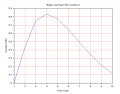
Why the emphasis on overshoot, and what sort of overshoot can be tolerated? Let's start with the textbook solutions, what is wrong with a Bessel filter, here is a plot of overshoot vs order:

1590746540187.png

All these filters have less than 1% overshoot - is this a problem? They have a much better rolloff than cascaded real poles.

Question: If a filter has a maximum pole Q of 1.4, what is it's overshoot?

You can't tell in general, but for what it's worth, a 10th order Bessel filter has a maximum pole Q of 1.4, with an overshoot of about 0.12%.
 

LvW

Joined Jun 13, 2013
2,035
To all!
Gentlemen, let me again repeat all my arguments against an application of the well-established "pole-Q" definition to first order lowpass function. (For clarification: THIS IS NOT MY DEFINITION. It is used and applied in all relevant filter books. )

** Here are some of the arguments against a Q-assignment for 1st-order functions:

* For all possible second-order functions, the value of Qp determines the magnitude at w=wp. This is an important information regarding peaking of the function (yes/no). This works, of course, also for Qp=0.5 and Qp<0.5. But it does not work for 1st-order functions.
* If we would assignt Qp=0.5 to first-order functions, we would face a specific case: Two functions with Qp=0.5 (1st resp. 2nd order) - but with different frequency response. This would be an exception to the rule: Pole-Q determines frequency response. Does this make sense? Why should we do this?
* The defintion of Qp has a direct relation to the damping factor d of a second-order system (Qp=1/2d). The damping factor tells us about the property of a system which - in principle - is able to oscillate (overdamped, underdamped, critically damped). However, a 1st-oder system is not able to oscillate and there is no damping factor for a 1st-order system.
* See the my post 150 (list of filter orders). Logic as well as the systematic would be disturbed
* All filter tables in relevant textbooks on filter design list pole parameters for second-order stages (wp and Qp or corresponding factors like a and b). But in case of uneven filter orders - for all single-pole stages only the pole frequency is tabulated.
* This is because an information Qp=0.5 is without any information...all 1st-order functions have the same response.
* Such a value is not needed and not used during any calculation. In contrast - it could lead to confusion because we have two functions with Q=0.5 (1st and 2nd order).

** Here are the arguments in favour of a Q-assignment for an application to 1st-order functions:

:::::::::::::::

Up to now, I could only read: "We could do it." No technical arguments.
However, as technicians/engineers shouldn`t we ask "why"? Does it makes sense - even if there are counter arguments?
Where are your arguments? Now, it´s your turn....
 
Last edited:

MrAl

Joined Jun 17, 2014
13,761
MrAl - I remember that you several times spoke about the Q of higher-order filters (as a counterargument for my statement that a pole-Q is defined and used for second-order functions only).
Several times I have asked you to DEFINE and explain this Q-value for orders n>2.
Unfortunately, without any success. Do you still stick to such a new definition?
I am not sure what you are talking about. I agree that we can use the pole positions.
But you totally and completely ignored my filter design problem electing not to even try to design the filter with said specs. I'll repeat it here:

You are given a task to design a 5th order filter with two 2nd order LP filters and one 1st order filter. Knowing filter design, you know some things will be understood to have to be observed:
1. This will require a cascade of two 2nd order filters and one 1st order filter.
2. To avoid saturation it is best to put the filter with the lowest Q first and the rest after that.

Now in the cascade arrangement, we have three component sections each will have a position 1, 2, or 3 in the cascade chain.
The 100 dollar question then is:
In order to satisfy #2 above, what position do you place the 1st order filter? Does it go in position 1, 2, or 3?
 

MrAl

Joined Jun 17, 2014
13,761
To all!
Gentlemen, let me again repeat all my arguments against an application of the well-established "pole-Q" definition to first order lowpass function. (For clarification: THIS IS NOT MY DEFINITION. It is used and applied in all relevant filter books. )

** Here are some of the arguments against a Q-assignment for 1st-order functions:

* For all possible second-order functions, the value of Qp determines the magnitude at w=wp. This is an important information regarding peaking of the function (yes/no). This works, of course, also for Qp=0.5 and Qp<0.5. But it does not work for 1st-order functions.
* If we would assignt Qp=0.5 to first-order functions, we would face a specific case: Two functions with Qp=0.5 (1st resp. 2nd order) - but with different frequency response. This would be an exception to the rule: Pole-Q determines frequency response. Does this make sense? Why should we do this?
* See the my post 150 (list of filter orders). Logic as well as the systematic would be disturbed
* All filter tables in relevant textbooks on filter design list pole parameters for second-order stages (wp and Qp or corresponding factors like a and b). But in case of uneven filter orders - for all single-pole stages only the pole frequency is tabulated.
* This is because an information Qp=0.5 is without any information...all 1st-order functions have the same response.
* Such a value is not needed and not used during any calculation. In contrast - it could lead to confusion because we have two functions with Q=0.5 (1st and 2nd order).

** Here are the arguments in favour of a Q-assignment for and aplication to 1st-order functions:
:::::::::::::::

Up to now, I could only read: "We could do it."
However, as technicians/engineers shouldn`t we ask "why"? Does it makes sense - even if there are counter arguments?
Where are your arguments? Now, it´s your turn....
You have ::::::::::::: because you ignore every argument FOR it. DESIGN THE FILTER:

You are given a task to design a 5th order filter with two 2nd order LP filters and one 1st order filter. Knowing filter design, you know some things will be understood to have to be observed:
1. This will require a cascade of two 2nd order filters and one 1st order filter.
2. To avoid saturation it is best to put the filter with the lowest Q first and the rest after that.

Now in the cascade arrangement, we have three component sections each will have a position 1, 2, or 3 in the cascade chain.
The 100 dollar question then is:
In order to satisfy #2 above, what position do you place the 1st order filter? Does it go in position 1, 2, or 3?
 

MrAl

Joined Jun 17, 2014
13,761
Not only can't I see any use to it, but I have never seen anyone assign a Q to anything other than a second order filter. Yes, if you apply the definition of pole Q to a real pole you get Q=0.5, but I have never seen it used in association with filter consisting of a single real pole (it doesn't convey any useful information), and I can't see any use to it. (and yes - I have a copy of Van Valkenburg's book, amongst others). It appears the whole notion of talking about a Q value for anything other than a second order filter is because of some rule of thumb in an app note. Well, in my experience, app notes vary from inspired gems to gibberish, and this particular comment is less well thought out than the rest of the app note.

What is the TS doing that can't be addressed using the usual tools of filter design developed over the last 60 years or so? Filtering is often a trade-off between the time response and the frequency response. What sort of frequency response is required? I haven't seen it mentioned. Why can't he use a piece of wire?

Why the emphasis on overshoot, and what sort of overshoot can be tolerated? Let's start with the textbook solutions, what is wrong with a Bessel filter, here is a plot of overshoot vs order:

View attachment 208420

All these filters have less than 1% overshoot - is this a problem? They have a much better rolloff than cascaded real poles.

Question: If a filter has a maximum pole Q of 1.4, what is it's overshoot?

You can't tell in general, but for what it's worth, a 10th order Bessel filter has a maximum pole Q of 1.4, with an overshoot of about 0.12%.

Did you try to design the filter of the filter design problem i posted?
Here it is again. ALL YOU HAVE TO DO is figure out what position in the chain of cascade stages that the first order LP filter goes. There are three positions, first, second, and third, you have to figure out if the first order filter goes in position 1, 2, or 3 based on the filter specs and recommended practices in REAL filter design.

You are given a task to design a 5th order filter with two 2nd order LP filters and one 1st order filter. Knowing filter design, you know some things will be understood to have to be observed:
1. This will require a cascade of two 2nd order filters and one 1st order filter.
2. To avoid saturation it is best to put the filter with the lowest Q first and the rest after that.

Now in the cascade arrangement, we have three component sections each will have a position 1, 2, or 3 in the cascade chain.
The 100 dollar question then is:
In order to satisfy #2 above, what position do you place the 1st order filter? Does it go in position 1, 2, or 3?
 

LvW

Joined Jun 13, 2013
2,035
You have ::::::::::::: because you ignore every argument FOR it. DESIGN THE FILTER:

You are given a task to design a 5th order filter with two 2nd order LP filters and one 1st order filter. Knowing filter design, you know some things will be understood to have to be observed:
1. This will require a cascade of two 2nd order filters and one 1st order filter.
2. To avoid saturation it is best to put the filter with the lowest Q first and the rest after that.

Now in the cascade arrangement, we have three component sections each will have a position 1, 2, or 3 in the cascade chain.
The 100 dollar question then is:
In order to satisfy #2 above, what position do you place the 1st order filter? Does it go in position 1, 2, or 3?
MrAl - with all respect, the question "how to design" a filter deserves a new thread because it has nothing to do with the subject of our discussion.
More than that, you feel it necessary to tell me that I would "ignore every argument for it"...
May I kindly ask you to tell me in which of your contributions I could find such an argument ?
Perhaps I have overlooked it?
Regards
LvW
 

Tesla23

Joined May 10, 2009
560
Did you try to design the filter of the filter design problem i posted?
Here it is again. ALL YOU HAVE TO DO is figure out what position in the chain of cascade stages that the first order LP filter goes. There are three positions, first, second, and third, you have to figure out if the first order filter goes in position 1, 2, or 3 based on the filter specs and recommended practices in REAL filter design.

You are given a task to design a 5th order filter with two 2nd order LP filters and one 1st order filter. Knowing filter design, you know some things will be understood to have to be observed:
1. This will require a cascade of two 2nd order filters and one 1st order filter.
2. To avoid saturation it is best to put the filter with the lowest Q first and the rest after that.

Now in the cascade arrangement, we have three component sections each will have a position 1, 2, or 3 in the cascade chain.
The 100 dollar question then is:
In order to satisfy #2 above, what position do you place the 1st order filter? Does it go in position 1, 2, or 3?
It's straightforward, you put them in order of increasing peaking, so the 1st order section with no peaking goes first, followed by the second order sections in order of increasing Q. What's your point? What's this got to do with the OP's problem?
 
Top