Facebook
 Google
 GitHub
 Linkedin

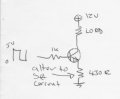
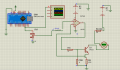
View attachment 318818
In these case I want to have 10- 1k Load and want to maintain the same mA output, Any suggestions?
Hi,
That circuit makes it look like you are on the right track. There are a few points to think about.
First, do you want (say) 10ma peak current or 10ma average current?
Your circuit so far is set up to be able to set the peak current, which is good I think, as long as the frequency is not too high.
Then, as others have been saying, if you want 10ma through 500 Ohms then the voltage across that 500 Ohms would have to be 5.000 volts or very close to that.
Unfortunately, the transistor and sense resistor will drop some voltage, so you may be stuck at 4.5 volts, which limits your resistor value to 450 Ohms if you really need 10ma peak. If you absolutely have to use 500 Ohms, then you would have to supply a little more voltage, like 5.5 volts, for that 10ma current that is. If you can go a little lower on the current, like 9ma peak, then you can probably do that 500 Ohm resistor value. You will have to test this of course.
The resolution will depend on the resolution of the D to A converter in your uC chip. If you have a 10 bit D to A you will get roughly 0.010/1024=9.77ua approximately, at least in theory. Unfortunately, the sense resistor probably would have to increase quite a bit in order for your A to D converter to be able to sense that small current. The voltage across a 0.25 Ohm resistor is just about 2.44uv, which is hard to measure with an A to D converter unless it is set up to amplify that low level.
In the case of 10ma, the voltage will only be 2.5mv, which is also a small level to be measured with a standard A to D converter.
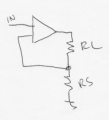
When these issues come up it is sort of standard practice to use a measuring system that allows scaling of the measurement through amplification. You amplify the signal by a factor A, then in software you divide by A if needed. That gives you the actual measurement. You also need to be able to change that amplification factor A for different gains as the measurement goes lower and lower. For example, you might start at A=1, then jump to A=2, then A=5, then A=10, then A=20, then A=50, then A=100, like that, until you get a reading that can be handled accurately with the A to D converter you are using. This requires a programmable gain amplifier.
I do not know how far you want to take this though and how much error you can tolerate. You might have to mention that too because the allowable error will play a big part in the selection of parts.