PWM Signal Generator

Thread Starter

kalemaxon89

Joined Oct 12, 2022
389
I do not know which is the right section of the forum in which to put this question. Feel free to move it if you think this is not correct.

I want a PWM square wave, for example, with duty cycle 35%.
I don't understand how V(rms) is calculated by the voltage probe.
I've a square wave with Vpeak = 9V and Duty Cycle of 35% .. so if I'm not mistaken Vrms = 0.35*9 = 3.15V.

Am I wrong?
Did I make a mistake when creating the PWM circuit?

If my calculation are right .. I noticed that the correct V(rms) value appears in the "yellow box" of the voltage probe during the simulation with the entry V(dc).

(I'm using NI multisim)
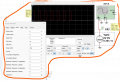
1680282442370.png

Thanks!
 

Papabravo

Joined Feb 24, 2006
22,083
The RMS voltage of a waveform is different than the Average. 3.15 Volts is the average. To get the RMS value you have to square the waveform, compute the average or mean of the squared waveform over one period, and then take the square root of the average of the squared waveform. In this case the RMS value is 5.3245 Volts.

\( 9^2\;=\;81.0 \)
\( (81.0)(0.35)\;=\;28.35 \)
\( \sqrt{28.35}\;=\;5.3245 \)

RMS stands for Root Mean Square
 

Thread Starter

kalemaxon89

Joined Oct 12, 2022
389
The RMS voltage of a waveform is different than the Average. 3.15 Volts is the average. To get the RMS value you have to square the waveform, compute the average or mean of the squared waveform over one period, and then take the square root of the average of the squared waveform. In this case the RMS value is 5.3245 Volts.

\( 9^2\;=\;81.0 \)
\( (81.0)(0.35)\;=\;28.35 \)
\( \sqrt{28.35}\;=\;5.3245 \)

RMS stands for Root Mean Square
Thanks for the clarification!

I'll just take advantage of this for another curiosity (if it's not a problem).
If I want to drive the Vgs of a MOSFET with a PWM square wave .. what I'm interested in is the Vrms value .. or the average?
 

crutschow

Joined Mar 14, 2008
38,520
Here's another way to look at it:
The PWM average voltage as well as the power is obviously proportional to the PWM duty-cycle.
But since the power is proportional to the square of the voltage, not the average, you calculate the RMS voltage as the square-root of the voltage-squared duty-cycle product, or √(9²*0.35) = √28.35 = 5.3245Vrms.
 

crutschow

Joined Mar 14, 2008
38,520
If I want to drive the Vgs of a MOSFET with a PWM square wave .. what I'm interested in is the Vrms value .. or the average?
If you are filtering the PWM to get a DC voltage, then its the Vave value.
You use Vrms when you are interested in the heating effect or power generated by the waveform.
 

Thread Starter

kalemaxon89

Joined Oct 12, 2022
389
If you are filtering the PWM to get a DC voltage, then its the Vave value.
You use Vrms when you are interested in the heating effect or power generated by the waveform.
What if I'm interested to pilot the gate of a Mosfet?
(in this case I think I'm interested in filtering the PWM to get a DC voltage .. so Vaverage)
 
Top