Push-Pull Amplifier Feedback mechanism

crutschow

Joined Mar 14, 2008
38,516
so do I need to use a different topology ?
Not necessarily.
I was just showing an example simple design that works well with both AC and DC feedback to stabilize its operation and give low distortion.
Many simple audio power circuits don't have that much feedback stabilization.

But if you have something that works satisfactorily for your purposes, then stick with that. :)
 
Last edited:

Thread Starter

demir-ali

Joined Jul 13, 2024
321
Not necessarily.
I was just showing an example simple design that works well with both AC and DC feedback to stabilize its operation and give low distortion.
Many simple audio power circuits don't have that much feedback stabilization.

But if you have something that works satisfactorily for your purposes, then stick with that. :)
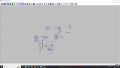
I have simulated what you shared yet , since u have given the asc file before I kept it. It works fine , but I was looking for If I could go for some basic changes on my circuit to get larger swing at output of diff pair.
These subject are actually my next semesters class but I am interested and wanted to learn. I am not that much interested to audio builds. Also thank you for publishing a working built with me.
I am still confusing with how I could go larger swings with single ended built.
1726175116525.png
 

Ian0

Joined Aug 7, 2020
13,132
I have simulated what you shared yet , since u have given the asc file before I kept it. It works fine , but I was looking for If I could go for some basic changes on my circuit to get larger swing at output of diff pair.
These subject are actually my next semesters class but I am interested and wanted to learn. I am not that much interested to audio builds. Also thank you for publishing a working built with me.
I am still confusing with how I could go larger swings with single ended built.
View attachment 331507
by driving a common emitter amplifier with the current mirror, as per posts 11, 16, 23 and 29
 

crutschow

Joined Mar 14, 2008
38,516
If I could go for some basic changes on my circuit to get larger swing at output of diff pair.
The circuit I posted is not limited by the differential pair output swing, but you can use a current mirror as a load, as shown in you posted circuit, to get a higher gain.

I tried such a circuit in my posted amp, but it didn't seem to make any significant difference it its simulated performance or distortion.
 

Thread Starter

demir-ali

Joined Jul 13, 2024
321
by driving a common emitter amplifier with the current mirror, as per posts 11, 16, 23 and 29
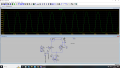
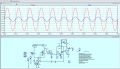
I guess I just can't get It. How will it work if transistor will go off in the pair. Output wont be distorted ?
When circuit works fine with 100mV input but when its 300mV the out swing is 1.2V and it turns it off.
Can you please modify It so I can get you better ?

1726175587066.png
 

Attachments

Thread Starter

demir-ali

Joined Jul 13, 2024
321
I can go large swings after some other stages , I mean is it possible to get larger swing at output of diff pair ?
For example 5 gain from feedback applied to 500mV input ?
 

Ian0

Joined Aug 7, 2020
13,132
No. The diff pair is required because of the matching between the two transistors is required for distortion cancellation.
 

BobTPH

Joined Jun 5, 2013
11,519
But when input itself is large enough than diff pair goes off anyway?
The negative feedback keeps the difference between the differential inputs very small.

Of course any amplifier can be overdriven and the output will be distorted. The answer is: don’t overdrive it. Design for a gain and max output swing then supply no more signal than the output swing divided by the gain.
 

Thread Starter

demir-ali

Joined Jul 13, 2024
321
Yea but is that possible with small changes , to get 5 feedback gain and 500mv input. For an opa its very reasonable value
 

BobTPH

Joined Jun 5, 2013
11,519
You are confusing the input to amplifier circuit with the differential input of the opamp. If you put 500mV between the differential inputs of any op amp, the output will be pegged at one rail or the other.

The input to the gain 5 circuit using the opamp, if single ended, is typically referenced to ground. But your amplifier circuit with 5 gain will not have the differential inputs at ground and the circuit input. Draw out an inverting and no non-inverting opamp circuit with gain 5 (or -5). Then calculate the voltages at the opamp + and - inputs. Use an open loop gain of 100,000.
 

Thread Starter

demir-ali

Joined Jul 13, 2024
321
You are confusing the input to amplifier circuit with the differential input of the opamp. If you put 500mV between the differential inputs of any op amp, the output will be pegged at one rail or the other.

The input to the gain 5 circuit using the opamp, if single ended, is typically referenced to ground. But your amplifier circuit with 5 gain will not have the differential inputs at ground and the circuit input. Draw out an inverting and no non-inverting opamp circuit with gain 5 (or -5). Then calculate the voltages at the opamp + and - inputs. Use an open loop gain of 100,000.
Sir I already meant that basic usage of opamp.
We put 500mV input at noninv , set gain to 5 at noninv and output using feedback and its fine.
I mean why I cant do same thing in mine
 

Thread Starter

demir-ali

Joined Jul 13, 2024
321
You are confusing the input to amplifier circuit with the differential input of the opamp. If you put 500mV between the differential inputs of any op amp, the output will be pegged at one rail or the other.

The input to the gain 5 circuit using the opamp, if single ended, is typically referenced to ground. But your amplifier circuit with 5 gain will not have the differential inputs at ground and the circuit input. Draw out an inverting and no non-inverting opamp circuit with gain 5 (or -5). Then calculate the voltages at the opamp + and - inputs. Use an open loop gain of 100,000.
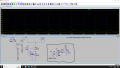
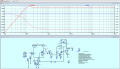
I want do something similar in my circuit but if fails if signal is relatively large
1726224341115.png
 

BobTPH

Joined Jun 5, 2013
11,519
You will have to post the exact circuit of your amp configured for gain 5 along with the .asc file if you want that answered.

Have you tested the common mode rejection of your amp? Raising or lowering both inputs by, say 500mV must cause no change in the output if you want it to act like an opamp. I suspect that is what is failing.
 

Thread Starter

demir-ali

Joined Jul 13, 2024
321
I have posted the asc file many times sir
here it is. I have no other file. You are free to change the file
But , my transistor goes off because Vce gets 0. Thats why we use 2 parts for half cycyles in ppa.
 

Attachments

BobTPH

Joined Jun 5, 2013
11,519
That circuit is incomplete and has no feedback. Try again. I need the exact circuit you are talking about. All you have posted is the differential pair circuit with no feedback applied. Your circuit has a gain of 500.

If used as a part of a complete amplifier with a gain of 5 controlled entirely by negative feedback, you would not any more swing than that in the input stage. You need a voltage amplifier and an output stage before you can use it like an opamp.
 

Thread Starter

demir-ali

Joined Jul 13, 2024
321
That circuit is incomplete and has no feedback. Try again. I need the exact circuit you are talking about. All you have posted is the differential pair circuit with no feedback applied. Your circuit has a gain of 500.

If used as a part of a complete amplifier with a gain of 5 controlled entirely by negative feedback, you would not any more swing than that in the input stage. You need a voltage amplifier and an output stage before you can use it like an opamp.
This file includes gain and output too. What can I chane in it ?
Can you modify this then ?
 

Attachments

Top