Push-Pull Amplifier Feedback mechanism

Thread Starter

demir-ali

Joined Jul 13, 2024
321
A common emitter amplifier on the output of the diff pair will swing rail-to-rail.
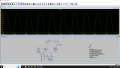
But for example , when my input swing is around 1V and I set feedback gain at inverting input to 4 , the signal goes distorted at down side.
1726154367209.png
 

Ian0

Joined Aug 7, 2020
13,132
But I have large inputs so what to do ?
In commercial opamps we can do what I mean. What is missing in my circuit ?
@Ian0
Global feedback will fix it, it works just the same as in an op-amp.
Connect a potential divider between the output and the inverting input of the diff pair. (The inverting input is the one that doesn't drive the next stage, it drives the diode side of the current mirror)
If the inputs are larger than a couple of volts, then make an inverting amplifier, or divide them down.
 

Thread Starter

demir-ali

Joined Jul 13, 2024
321
Global feedback will fix it, it works just the same as in an op-amp.
Connect a potential divider between the output and the inverting input of the diff pair. (The inverting input is the one that doesn't drive the next stage, it drives the diode side of the current mirror)
If the inputs are larger than a couple of volts, then make an inverting amplifier, or divide them down.
Can you draw it please sir, so I can check when I get back to computer.
 

Ian0

Joined Aug 7, 2020
13,132
Can you draw it please sir, so I can check when I get back to computer.
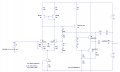
This is something similar I've been working on.
R7/R9 and R12/R13 help with linearity if there is some imbalance between the two transistors in the pair.
You can use darlingtons in the output, in which case you will need less current in the voltage amplifier stage.
I used a JFET current source for the long tailed pair, you can keep the current mirror.
C1 is the dominant pole capacitor (you'll need that to keep it stable, especially with slow output transistors)
R21/C8 is the Zobel network (you'll need that to keep it stable into an inductive load)Screenshot from 2024-09-12 17-35-22.png
 

Thread Starter

demir-ali

Joined Jul 13, 2024
321
This is something similar I've been working on.
R7/R9 and R12/R13 help with linearity if there is some imbalance between the two transistors in the pair.
You can use darlingtons in the output, in which case you will need less current in the voltage amplifier stage.
I used a JFET current source for the long tailed pair, you can keep the current mirror.
C1 is the dominant pole capacitor (you'll need that to keep it stable, especially with slow output transistors)
R21/C8 is the Zobel network (you'll need that to keep it stable into an inductive load)View attachment 331491
Here you get output from the side of noninv input and can you give large input swings without distortion ?
At this point my problem is how do I change my input stage and to understand why is that.
 

Ian0

Joined Aug 7, 2020
13,132
It will work until either:
the base of Q1 is higher voltage than the base of Q6
or
The emitter of Q1 is too low for J1 to keep a constant current.
If you had a current mirror as a constant current source for the long tailed pair, it would continue to work until the input was 1.3V above the negative rail.
 

Thread Starter

demir-ali

Joined Jul 13, 2024
321
It will work until either:
the base of Q1 is higher voltage than the base of Q6
or
The emitter of Q1 is too low for J1 to keep a constant current.
If you had a current mirror as a constant current source for the long tailed pair, it would continue to work until the input was 1.3V above the negative rail.
thats what my problem exactly is. how can I improve this
 

crutschow

Joined Mar 14, 2008
38,512
Below is an example of relatively simple audio amp circuit that uses a differential input stage (Q1 and Q2) for both AC and DC feedback from the output.
The AC feedback reduces distortion and the gain is determined by the relative value of R4 and R5.
The DC feedback through R5 biases the output at 1/2 the supply voltage as generated by R1 and R8.

1726164774541.png
 
Last edited:

Thread Starter

demir-ali

Joined Jul 13, 2024
321
Below is an example of relatively simple audio amp circuit that uses a differential input stage (Q1 and Q2) for both AC and DC feedback from the output.
The AC feedback reduces distortion and the gain is determined by the relative value of R4 and R5.
The DC feedback through R5 biases the output at 1/2 the supply voltage as generated by R1 and R8.

View attachment 331498
so do I need to use a different topology ?
lm741's inner circuit seems similar with mine but I could not solved my issue.
Its reasonable transistor goes off when it exceeds 0.8V downwards but what may should I look for.
My purpose is to experience something and learn , I analysed the topology in mine , and I found it following Razavi's book.
I know I do not have to use it always I first need to know why am I doing that when changing something.
 

Thread Starter

demir-ali

Joined Jul 13, 2024
321
The 741 internal circuit isn't a long tailed pair. That makes it rather different from most available op-amps.
It is a version of the "no-tail pair" or "complementary long-tailed pair" like this one.
https://www.4qdtec.com/pwramp.html
It's not a good amplifier.
Yes you are right. I just want to learn about the subject and move on since probably I will use opa's instead building one in future.
Do you have any suggestions for me today sir ? May be circuit or tech to look for ?
 

Ian0

Joined Aug 7, 2020
13,132
Yes you are right. I just want to learn about the subject and move on since probably I will use opa's instead building one in future.
Do you have any suggestions for me today sir ? May be circuit or tech to look for ?
Read Doug Self's book on power amplifiers, or any of John Linsley Hood's.
 
Top