Facebook
 Google
 GitHub
 Linkedin
Hello,
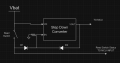
I am in the process of designing a circuit with ultra low consumption, which consist of a battery with 3.6V nominal voltage, a step down converter to regulate to 3.3V, a MCU, a reed switch and a few other components.
For the step-down converter I found a suitable one for my purpose, a ISL9123 from Renesas that has a bypass feature, it has an enable pin.
The enable pin allows me to activate it for the first time with a classic momentary reed switch, once the reed switch closes for a brief period it should keep the step down converter on until end of battery life.
For this I have used a diode (D2) that connects the outputs back to the enable pin, theoretically once Vout is present the enable pin will stay on.
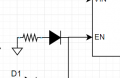
Diode D1 is present so I can read the state of the reed switch for another purpose with my MCU when the Step down is on.
The issue I'm facing is that the Load Switch needs a logic HIGH or LOW at the enable pin, no floating.
A simple pull-down resistor would resolve this issue but this means current loss through it when the enable pin logic high, even with big resistor values such as 1Mohm would consume 3.3uA which is way too much, also I assume with big resistor value it would cause issues?
I come here for your help, maybe someone have an idea I could avoid using a pull-down resistor?
Thank you
Regards
I am in the process of designing a circuit with ultra low consumption, which consist of a battery with 3.6V nominal voltage, a step down converter to regulate to 3.3V, a MCU, a reed switch and a few other components.
For the step-down converter I found a suitable one for my purpose, a ISL9123 from Renesas that has a bypass feature, it has an enable pin.
The enable pin allows me to activate it for the first time with a classic momentary reed switch, once the reed switch closes for a brief period it should keep the step down converter on until end of battery life.
For this I have used a diode (D2) that connects the outputs back to the enable pin, theoretically once Vout is present the enable pin will stay on.
Diode D1 is present so I can read the state of the reed switch for another purpose with my MCU when the Step down is on.
The issue I'm facing is that the Load Switch needs a logic HIGH or LOW at the enable pin, no floating.
A simple pull-down resistor would resolve this issue but this means current loss through it when the enable pin logic high, even with big resistor values such as 1Mohm would consume 3.3uA which is way too much, also I assume with big resistor value it would cause issues?
I come here for your help, maybe someone have an idea I could avoid using a pull-down resistor?
Thank you
Regards