You say that you can't get the pulse source to do what you want. Okay. Fine. But how can we possibly tell what you are doing wrong with the pulse source when you won't tell us how you set it up or how it is behaving. Just saying that it doesn't do what you wanted it to gives us nothing to work with! This is like calling up an auto mechanic and telling him that you can't get cold air to come out of the vents and then asking them what you need to do to fix it. How can they possibly do that unless you give them detailed information about what you did and what happened in response?
You say that you can't get the pulse source to do what you want. Okay. Fine. But how can we possibly tell what you are doing wrong with the pulse source when you won't tell us how you set it up or how it is behaving. Just saying that it doesn't do what you wanted it to gives us nothing to work with! This is like calling up an auto mechanic and telling him that you can't get cold air to come out of the vents and then asking them what you need to do to fix it. How can they possibly do that unless you give them detailed information about what you did and what happened in response?
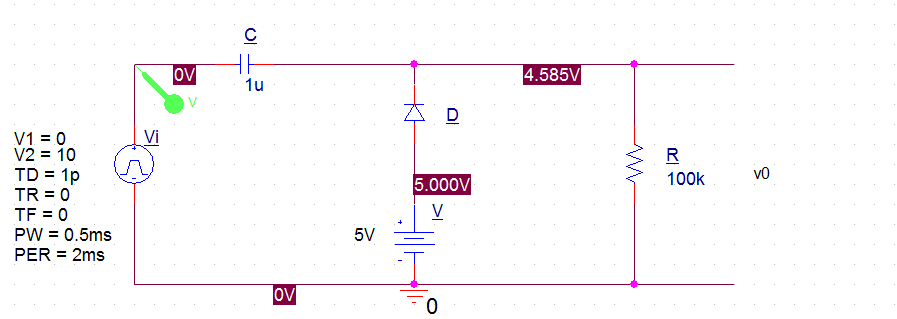
These appear to be the operating point values (the values at the very beginning of the simulation). So at that time the pulse output if 0V. That agrees with the green probe. The voltage at the top of the supply is 5 V. That agrees with the fact that it is at the positive terminal of a 5 V battery that is tied to the common. And the diode has a voltage of 415 mV across it. That might seem low, since we like to think of the forward drops being in the 600 mV to 700 mV range, but with a 100 kΩ resistor you only have about 46 uA flowing in it. The rule of thumb for a silicon PN junction is that the voltage changes by 60 mV for every decade change in current. So it the diode normally had 600 mV across it with, say, 50 mA of current in it, then at 50 uA of current the voltage would be down by about 180 mV putting it in the 420 mV range. So that's not unreasonable at all.
Keep in mind that this is ONLY the initial operating point solution.
You are probably more interested in the transient analysis simulation results. What do those look like?
As to getting the pulse source to match the waveform you want, the waveform you are trying to simulate goes between +20 V and -10 V. You've set up your pulse source to go between 0 V and 10 V. What do you think you might want to change that to?
These appear to be the operating point values (the values at the very beginning of the simulation). So at that time the pulse output if 0V. That agrees with the green probe. The voltage at the top of the supply is 5 V. That agrees with the fact that it is at the positive terminal of a 5 V battery that is tied to the common. And the diode has a voltage of 415 mV across it. That might seem low, since we like to think of the forward drops being in the 600 mV to 700 mV range, but with a 100 kΩ resistor you only have about 46 uA flowing in it. The rule of thumb for a silicon PN junction is that the voltage changes by 60 mV for every decade change in current. So it the diode normally had 600 mV across it with, say, 50 mA of current in it, then at 50 uA of current the voltage would be down by about 180 mV putting it in the 420 mV range. So that's not unreasonable at all.
Keep in mind that this is ONLY the initial operating point solution.
You are probably more interested in the transient analysis simulation results. What do those look like?
As to getting the pulse source to match the waveform you want, the waveform you are trying to simulate goes between +20 V and -10 V. You've set up your pulse source to go between 0 V and 10 V. What do you think you might want to change that to?
Again. What did you expect? The only results you've shown so far are perfectly reasonable. So if you were expecting something else, the problem is with your expectations. But I can't tell you where you went wrong in coming up with your expectations when you won't tell me what they were!
Look at the parameters that you current have for the pulse source. Do you see where it says V1 = 0 V and V2 = 10 V. Change them to be V1 = 10 V and V2 = -20 V.
Try changing the rise time and fall times to 1 ms each and then change the PW to 5 ms and the period to 10 ms. Run the simulation again and see what results you get.
Can You to congratulate. The Source scheme contains the mistake. In this instance it is impossible use POLCAP. In process of the work polarity is changed.

 Facebook
 Google
 GitHub
 Linkedin