programmable timer for a solar LED

Thread Starter

end-user

Joined Feb 23, 2017
6
*Disclaimer* I'm a complete novice when it comes to circuit design

I would love to know how I would go about creating a programmable timer switch for a solar-powered LED light. I'm looking at a lot of these super-cheap solar rechargeable LED options and I'd love to mod them so I could provide an on/off sequence based on a 24hr timer. This would allow for more targeted usage (less waste) and better charging. I assume I'd need some type of component that could be programmed, but given the complexity and power source, wouldn't an Arduino be over-kill? Is CMOS suitable for this use? I think most of these are 3v solutions, right?
 

Bernard

Joined Aug 7, 2008
5,784
Might start with a battery operated clock. Attach a magnet to hour hand, remove minute hand if
it obstructs. Attach 2 reed switches via moveable arms to fit under magnet. SW 1 applies V to gate of 2N5060 SCR, 2nd shorts SCR. LED is from + V to anode. But why ?
 

TheButtonThief

Joined Feb 26, 2011
237
Yes, an Arduino would be overkill and also quite thirsty on power itself.

I'm not sure why you'd want to add a timer, surely it's best the way it is, lighting on when sun falls and lighting off when sun rises...?
 

Thread Starter

end-user

Joined Feb 23, 2017
6
Because I don't need it on all night - I just want to cover specific hours. Also, if this were a path-lighting application, it would save energy on those hours that you're 90% likely not need it - say 1am to 5am. However, I'm specifically looking to essentially extend the daylight hours - those right around dusk.
 

Dodgydave

Joined Jun 22, 2012
11,395
The problem is in winter, the days are shorter and the led light only works for an hour or so ( well mine do), you will have no problem in the summer .
 
Last edited:

LesJones

Joined Jan 8, 2017
4,511
Probably the simplest way would be to modify a mains voltage timer. All the ones I have seen use a single NiMh cell for backup when the mains is removed. You would need to trace the signal that drives the switching device that drives the relay. This device could be a transistor, a small SCR or a small triac. The power taken by this type of timmer is very small as the run for weeks on the tiny button cell. ( I have bought cheap solar garden lights from one of the £ shop chains as a source of NiMh button cells to repair these timers.) When you have identified the signal from the timmer module you can use it to drive a transistor to switch the light on and off.

Les.
 

Bernard

Joined Aug 7, 2008
5,784
Seems like a worthwhile project. I should have incorporated in my lighthouse & saved my battery.
Need some thinking, but would start by rectifying & filtering LED supply, then use a counter like
4060, some parts, & LL FET.
 

Bernard

Joined Aug 7, 2008
5,784
Rectified & filtered , no load, V slowly climbs to about 30 V with 1 AA Ni-Cd solar light.
Instead of shutting LED off, just drop current down to maybe 1 mA, allowing the LED to act as a V reg. for logic ? A simple arrangement might use a higher order stage of 4060 to enable LED. Then for an = time the LED would be dim. If daylight has not arrived when 4060 switches again, the LED would come back on until daylight. If set for, say, 6 h, that is 12 h of control.
 

Thread Starter

end-user

Joined Feb 23, 2017
6
Ok, I guess that sounds good. But I thought batteries were 1.5v, not 30?


Also, I have zero idea of what that diagram would look like.
 

Bernard

Joined Aug 7, 2008
5,784
Battery, AA, Ni-Cd, 1.2 V, boost circuit raises V to about 30 V unloaded , loaded by LED to 3 V.
I have the beginnings of a diagram that I may try to breadboard.
 

Bernard

Joined Aug 7, 2008
5,784
I miss-speculated on garden LED lamp; input current under no output load or light load did not fall off
as much as predicted. No load, input 12 to 20 mA, unstable. LED @ 25 mA as load, input is 28 mA.,
light load of 27k & LED @ 700 uA input is 36 mA ?
So to have light duration control, you will need a separate 3V to 5V power source supplying maybe 500 uA.
 

Bernard

Joined Aug 7, 2008
5,784
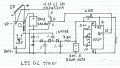
I don't think its practical to modify single LED Garden Lights, but might be for a string of LED's with a common control. With this sample LED light, day-night control is applied at solar panel, SP, neg.
input on circuit board & found that grounding this point it disabled LED with out affecting normal operation, so a N ch LL FET is used to turn off LED after 6 hr. On this board the high freq. pulses are rectified & filtered before going to the LED, but by going to the inductor was able to use V doubler on the pulse stream to get 500 uA. charging current for auxillary battery B , 3 AAA NiCd's. Possible other choices might be: 3V Polyacene battery- a big
cap. in small package. or ML621, LI rechargeable, 3 V, 5 mA hr.
A light dependent resistor is used to disable the 4060 counter during daylight.
Time is adjusted with 1 M pot at pin 10, 4060. Full range is about 3 hr. to 12 hr. 10 uF cap is + to pin 9. R between pin 12 & 8 is 2.7K & depends on LDR used.LED GL timer 00000.jpg
Neglected to mention, drain on battery B is 10 uA. @ reset & 20 uA. when counting.
 
Last edited:

dl324

Joined Mar 30, 2015
18,314
I'm looking at a lot of these super-cheap solar rechargeable LED options and I'd love to mod them so I could provide an on/off sequence based on a 24hr timer. This would allow for more targeted usage (less waste) and better charging.
Why don't you describe the problem you're trying to address before trying to engineer a solution?

My guess is that you only want the LED to be on when the light would be useful. Most solar LED lights I've seen included an LDR that turned the LED off when it was sufficiently light. What more are you looking for?
 

Thread Starter

end-user

Joined Feb 23, 2017
6
Why don't you describe the problem you're trying to address before trying to engineer a solution?

My guess is that you only want the LED to be on when the light would be useful. Most solar LED lights I've seen included an LDR that turned the LED off when it was sufficiently light. What more are you looking for?

I want a solar-powered LED that I can program to turn on and off at specific points in the day.
 

Thread Starter

end-user

Joined Feb 23, 2017
6
Why? How many on/off times? Does it need to track actual times? Does it need to also take into account ambient light level?

As stated, there's a lot of time it does not need to be on. Turning it off should save power as well as be more gentle on the batteries (not full depletion)
Let's say once cycle (on then off) every 12hr.
No.
No.
 

dl324

Joined Mar 30, 2015
18,314
Turning it off should save power as well as be more gentle on the batteries (not full depletion)
Well... The issue is that you don't have much to work with.

All of the solar powered LED lights I've seen have a single AA battery. 1.2V isn't much to work with. I haven't needed to work with ultra low supply voltages, but I suspect finding timers, opamps, or comparators that operate at 1.2V will be problematic. Adding a voltage boost circuit adds complexity.

The circuit posted by @Bernard adds a voltage multiplier and 3 AAA batteries. You'd need to do that for every light...

I use a solar LED in my garage to provide light for cats. Since there's no sunlight to charge the batteries, I have to replace them periodically; which I do every few days. Even after 3 days, the LED is still dimly lit.
 

Bernard

Joined Aug 7, 2008
5,784
I was wondering if a cap. could power a 4060 for the required 6 or more hours, so I dug out a 1 F @ 5V cap.
& charged it up to 4.2 V from Bat. A & multiplier. Shined a light on LDR to reset counter at 1 PM & rechecked
after dancing the night away at 9 PM, 3.4 V, disconnected counter & re checked cap. 8 AM, still 3V.
If a longer off period than on is required, a AND gate, 4081, can be added to give 3 X on period.
 
Top