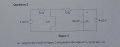
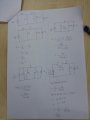
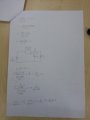
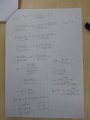
problem from laplace

WBahn

Joined Mar 31, 2012
32,823
What, if anything, have you done to check whether your solution is true?

Before you even start the analysis, determine what you expect the initial and final voltage to be.

Does your solution agree with these?

You solution has cos(3/4) and sin(3/4). These are just numbers. Is that what you expect?

If you had bothered to track your units, I think you would have found that there is a problem here.
 

Thread Starter

full

Joined May 3, 2014
225
What, if anything, have you done to check whether your solution is true?

Before you even start the analysis, determine what you expect the initial and final voltage to be.

Does your solution agree with these?

You solution has cos(3/4) and sin(3/4). These are just numbers. Is that what you expect?

If you had bothered to track your units, I think you would have found that there is a problem here.
no, in end my answer is wrong ,if I use calculator for 2s^2 + 3s +2 I get (s +3/4)^2 +1
 

WBahn

Joined Mar 31, 2012
32,823
I'll ask again -- and I'm getting tired of asking this over and over and over and you not doing it -- for this problem what do you expect the answer to be at t=0 and at t=∞. Figure that out before you start doing any Laplace stuff at all.

And TRACK YOUR UNITS!
 

MrAl

Joined Jun 17, 2014
13,702
Hi,

I agree with WBahn that your time solution does not look right at all, simply because the trig terms dont have any 't' in them. The form we should see is:
A*sin(w*t)
or
A*cos(w*t)
or both:
A*sin(w*t)+B*cos(w*t)

but there will never be something like:
88*sin(5)

there will always be a 't' inside too like:
88*sin(5*t)

These are just examples that do not originate from the problem you are working on right now but are typical of solutions we usually see for problems like this.
 

Thread Starter

full

Joined May 3, 2014
225
Hi,

I agree with WBahn that your time solution does not look right at all, simply because the trig terms dont have any 't' in them. The form we should see is:
A*sin(w*t)
or
A*cos(w*t)
or both:
A*sin(w*t)+B*cos(w*t)

but there will never be something like:
88*sin(5)

there will always be a 't' inside too like:
88*sin(5*t)

These are just examples that do not originate from the problem you are working on right now but are typical of solutions we usually see for problems like this.
I'll ask again -- and I'm getting tired of asking this over and over and over and you not doing it -- for this problem what do you expect the answer to be at t=0 and at t=∞. Figure that out before you start doing any Laplace stuff at all.

And TRACK YOUR UNITS!
my answer is :

v0=e^(-3t/4) (40) cos(√7/4)t - e^(-3t/4) (44/√7) sin(√7/4)t +40
 

MrAl

Joined Jun 17, 2014
13,702
Hi,

Did you check your signs while you did this problem?
It looks like you didnt keep the signs correct throughout the problem again.
Check it over again paying close attention to your signs and see what you can find.
 
Last edited:

WBahn

Joined Mar 31, 2012
32,823
my answer is :

v0=e^(-3t/4) (40) cos(√7/4)t - e^(-3t/4) (44/√7) sin(√7/4)t +40
You still aren't getting the point. BEFORE you do ANY Laplace stuff, look at the circuit and determine what you expect the voltage to be at t=0 and at t=∞. You should be able to look at the circuit and by inspection (or with very little pencil and paper work) be able to say:

v0(t=0) = 28V
v0(t=∞) = 21V

or whatever they should be (I just made those numbers up).

Then you work the problem and say:

v0(t) = some expression with time and exponentials and sines and cosines and whatever.

Then you evaluate that expression at t=0 and t=∞ and compare them to what you expected. If they match, then you have a pretty good likelihood that the expression is correct. If they don't, then you already have some clues as to where to look for the problem (but don't forget that your expected values at the limits might be the problem).

And TRACK YOUR UNITS!

Maybe you simply don't care about catching your mistakes or determining whether or not your answers are correct. If that's the case, either get over it or get the hell out of engineering.
 

MrAl

Joined Jun 17, 2014
13,702
Hello again,

In this case you may want to try to approach the problem using another technique.
For example, try using superposition instead of Thevenin/Norton equivalents this time. See what you get.

Doing this isnt a bad idea anyway because it gives you a second result you can check with your first result and they should match if you got the right answer.
 

WBahn

Joined Mar 31, 2012
32,823
I check a lot my solution but not find any wrong!
Simple question: What do you expect the voltage to be at t=0? Give me a specific value.

Another simple question: What do you expect the voltage to be at t=∞? Give me a specific value.
 

Thread Starter

full

Joined May 3, 2014
225
Simple question: What do you expect the voltage to be at t=0? Give me a specific value.

Another simple question: What do you expect the voltage to be at t=∞? Give me a specific value.
t=0
equal 16

t=∞
equal 19
 

WBahn

Joined Mar 31, 2012
32,823
t=0
equal 16

t=∞
equal 19
THANK YOU!

So now, before we go any further, let's get it so that you understand what is going on in the circuit well enough to get the correct answer for both of these (both of these are wrong -- and they would be wrong even if they were numerically correct since neither 16 nor 19 is a voltage).

So, describe the reasoning behind how you got these values and let's correct whatever misconceptions you have there.
 
Top