Principle of super-heterodyne receiver

Thread Starter

Vilius_Zalenas

Joined Jul 24, 2022
192
Hi,

I have modest electrical engineering and RF basics. I am studying different types of RF receivers for my next project. From the information I have already gathered, one conclusion can be made: super-het type receiver comes with a greatest complexity, but at the same time offers the best technical parameters. However, I can not understand a key feature of it.

It is stated that there are at least two LOs in every super-het receiver : first one implementing the wide IF for good image rejection and the second LO (of low IF) improving the selectivity and adjacent signal rejection.

Given that good image rejection is one of our goals, I dont see how the second LO can be designed to a low IF... Images are inevitable products of mixing process. The second LO introduces (and strongly couples, given the IF is low) images to already filtered signal again. I am aware that the design of such receiver is really difficult, including many filters, LNAs etc., but what is the fundamental purpose of second LO?

Those were just my observations based on an understanding I have right now, I know the the super-het works really well and the second LO is important, I just cant understand why... I am hoping I will after this thread...

Does this super-het topology apply to transmitters just the same? Or there is no point in doing a double up-conversion when transmitting over free-space?

Also, are there any online or free, open-source software that lets you play with super-het simulation parameters without the great complexity of simulating a full discrete element receiver circuit (I mean something like just changing fin, flo1, flo2 in ideal conditions...) Thank you in advance
 
Last edited:

MrChips

Joined Oct 2, 2009
34,630
Super-het receiver works with one LO.
Two LOs is double conversion.
You don't need LO in the transmitter.

What is the advantage of the super-heterodyne receiver?
The purpose of the local oscillator is for frequency conversion to an intermediate frequency, IF.
Instead of having adjustable tuned filters, the filters are tuned to one frequency.

For example, instead of a wide-band receiver from 520kHz to 1600kHz, all signals are frequency shifted to a single IF, for example 455kHz. It is easier to build a narrow band amplifier around one IF than one that covers a wide frequency range.

Another example of frequency shifting is in baseband conversion. By having the LO at the same frequency as the incoming signal, the AM signal is recoverable directly.

The purpose of having two LO is to do the frequency shift in two stages.

https://en.wikipedia.org/wiki/Superheterodyne_receiver
 

crutschow

Joined Mar 14, 2008
38,326
It is stated that there are at least two LOs in every super-het receiver : first one implementing the wide IF for good image rejection and the second LO (of low IF) improving the selectivity and adjacent signal rejection.
That's not true for most superhet commercial broadcast receivers, which have one conversion stage.
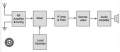
Below is the block diagram for a typical AM or FM broadcast band receiver in the U.S built initially with tubes and then transistors.
The main differences are the RF and IF frequencies used, and the type of demodulator.

1693067047080.png
 
Last edited:

KL7AJ72

Joined Apr 15, 2021
22
Hi,

I have modest electrical engineering and RF basics. I am studying different types of RF receivers for my next project. From the information I have already gathered, one conclusion can be made: super-het type receiver comes with a greatest complexity, but at the same time offers the best technical parameters. However, I can not understand a key feature of it.

It is stated that there are at least two LOs in every super-het receiver : first one implementing the wide IF for good image rejection and the second LO (of low IF) improving the selectivity and adjacent signal rejection.

Given that good image rejection is one of our goals, I dont see how the second LO can be designed to a low IF... Images are inevitable products of mixing process. The second LO introduces (and strongly couples, given the IF is low) images to already filtered signal again. I am aware that the design of such receiver is really difficult, including many filters, LNAs etc., but what is the fundamental purpose of second LO?

Those were just my observations based on an understanding I have right now, I know the the super-het works really well and the second LO is important, I just cant understand why... I am hoping I will after this thread...

Does this super-het topology apply to transmitters just the same? Or there is no point in doing a double up-conversion when transmitting over free-space?

Also, are there any online or free, open-source software that lets you play with super-het simulation parameters without the great complexity of simulating a full discrete element receiver circuit (I mean something like just changing fin, flo1, flo2 in ideal conditions...) Thank you in advance
Hi Vilius:
I would say that there are two local oscillators for any GOOD communications receivers. There are still a lot of single conversion receivers around, including your garden variety AM radio.
In the U.S., the standard IF frequency for an A.M. radio is 455 khz, which is a reasonable compromise between selectivity and image rejection. In the early 1960s, Hallicrafters and others started making dual conversion receivers with a high IF of around 1600 KHz and a low IF of 50 KHz. (The Collins R-390 actually had FOUR conversions if you include the tuneable IF stage near the front end...but that was (and is) a pretty exotic design.
 

Janis59

Joined Aug 21, 2017
1,894
Hi! My young age was gone in the giant prizon named ussr, thus, as the every soviet boy I dreamed about how to safely escape the iron courtain :) :) and while its not done ready yet listened the "rotten capitalist voices" by radio like VOAA, Svoboda/Free Europe and many many more. So, the best tool was VEF-Spīdola 10 (sensitivity 10 microvolts per meter), next was VEF12 (25 microvolts), VEF 201 and 206 (50 microvolts), VEF 202 (100 uV), VEF 231 (250 uV). Guess why the every next more modern model became more and more bad in terms of sensitivity.... :)All them was a superheterodynes with a rather good six-pole KSS (CSF) filter. I made an experiments then, in era of transistors like MP40 and P401, to add the surplus input amplifier, to add the surplus KSS filter cascade etc etc. Anyway, I know for a sure, superheterodine is bad with the spooky frequencies, which highly alters soviet anti-radio (sawing) stations probability to hit Your channel. Ah, ya, today in my sailship radio sensitivity is 0.1 microvolt per meter :) If to vote for best suited radio for stable far-beating distances, I would vote for prime conversion radios with fundamental pre-amplifier (up even to Peltier cooled LNA) and synchronous detection (At English more frequently labeled as PLL). If the lucky hand, the 0.01 microvolt is not the empty fool`s dream. There not exist any spooky mirrors of other channels thus the aether is relatively "clean".

If You Vilius, being like me the inhabitant of beautiful land next to dreadful boarder next before a brown stinky bear, know bit and may read at bear boar language, here is bit theory over FSS (Filtr Sosretdotočennoj Selekciji) https://lektsii.org/17-76440.html
Anyway, I may bet from hands-on experience, this filter best possible adjusting procedure quality means everything on that kind of radio. And nowadays we have a NanoVNA what is brilliantly suited to do this job faultlessly.
 
Last edited:
Top