powered speakers amp problem

JoeJester

Joined Apr 26, 2005
4,390
All we use the capacitor for is to block any DCVoltages. Have you looked into an oscilloscope? Have you considered using one of those sound card based scopes? They certainly cove the audio range and some are free. I would build a buffer between my sound card input and whatever I'm testing.

Another handy piece of Test equipment one can build is an ESR meter to test electrolytic capacitors in a de-energized circuit.

A signal generator could be a simple oscillator.

This problem you got now can be solved. It depends on you, your time, and your friends budget to get it fixed. There is the economics consideration. I don't think anyone wants to pay more than half of the price of new (parts, labor, and tax).
 

Thread Starter

dougalere

Joined Mar 4, 2015
128
thats a relief, re,21 volts- i thought i might have blown something that caused an over voltage, causing the demise of the chip and probably the rest of the board as well, thinking it should be 15 volts ,
but a quick check states VDD on the audio chip should be 19.5 volts,which is pretty close ,.but i'll check
on the chip spec for max voltage,
i cant think why the chip failed though, it was only on a few minutes,
if the power voltage was right.
ill have to put the heatsink back on when i fit the new chip.
 

Thread Starter

dougalere

Joined Mar 4, 2015
128
yes i did look into those computer oscilloscopes, but i was using high frequencies on a project, at the time.
and those oscilloscopes mainly covered low to med frequencies.
.what about injecting low level audio at various stages , i can soon knock up somethig.
i will certainly look again at yhose oscilloscopes,

will check the LF chip in the morning and let you know what happens.
 

JoeJester

Joined Apr 26, 2005
4,390
Sure, you can create a 1k /5k switchable oscillator. I was going to recommend you visit Elliot Sound Products and look over their DIY test equipment list in on the projects page.

The computer based oscilloscopes are probably good for general purpose audio troubleshooting. Davy Jones (EEVBLOG) does a review on all kinds of test equipment. I saw a four channel, Rigol DS1054Z Digital Oscilloscope, 50 MHz scope for $399 USD.

If you need free circuit simulation software, TI has one called TINA-TI. I bought TINA about 20 years ago when I dropped Electronics Workbench (now it's multisim). Most here use LTSPICE, a free one from Linear Technology.
 

Thread Starter

dougalere

Joined Mar 4, 2015
128
just tried LFchip, nothing on that either......i would have expected something with the finger test, but nothing. so both audio chips could be ok.
however checked the voltages on the multi plug- neg correct at minus 15 volts.. but pos reads minus 3.22.volts.!

culprit Q 101 ?
 
Last edited:

Thread Starter

dougalere

Joined Mar 4, 2015
128
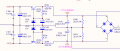
upload_2016-9-3_9-59-26.png
NO +15 VOLTAGE
might need some help on this
Q101 reads 800 base to emitter and base to collector and zero on reverse polarity, in circuit.
with 1800 on collector to emitter, varying ,i will wait for the caps to discharge
r103 is ok
z101 is reading as a normal diode would,
i would like to find the fault without powering up if poss.
 
Last edited:

Thread Starter

dougalere

Joined Mar 4, 2015
128
You aren't the first, nor the last, to accidentally short a power supply.

i dont know if youve got this one in the states -

he who never breaks anything, never makes anything.
 

JoeJester

Joined Apr 26, 2005
4,390
Look at the jumper JP10. You can probably trace that right back to Q101. I don't have a clean enough picture to determine the exact source.

The base voltage at Q101 should be +15V. The collector voltage should be equal to the +27v supply.

BC639 is a replacement for Q101,

Edited to correct previous errors when I was looking at the wrong supply.
 
Last edited:

Thread Starter

dougalere

Joined Mar 4, 2015
128
just made a start
not good, across the big caps c100 and c102, im getting 39 volts on both pos and neg
of course it should be 27 volts, what could cause this
as this is the rpg 8 cab and not the rpg 6 as schematic, i wondered if they had stepped
the transformer voltage up for the rpg8.
but no- the transformer is clearly marked as per the schematic.

zener z101 reading zero anode and cathode
.r105 and r106 both reading 57 ohms. close to ok

vdd is 21.5 volts pos and neg- should be 19.5 a bit high.
..
got to be transistor although its reading ok on base to E and C, what do you think?
2sd 667 plenty on ebay

15 volt line is 14.8 neg ok
zero pos
 
Last edited:

SLK001

Joined Nov 29, 2011
1,549
The +/- 39V is the peak voltage. The RMS is 27V, so these are okay. It will always be high when unloaded.

zener z101 reading zero anode and cathode
Powered? Then Z101 is shorted. To test the transistor, remove Z101 and replace it with Z102. If the xsistor is okay, you should now get +15V out.
 

JoeJester

Joined Apr 26, 2005
4,390
im getting 39 volts on both pos and neg
If the model of the transformer is the same as the one on the PR6 speakers, the higher voltage is 21.3V rms or 30.1V maximum on the capacitors. Are you sure you didn't slip the finger from the 2 to the 3? Of course, all of that depends on the proper Mains voltage.
 

Thread Starter

dougalere

Joined Mar 4, 2015
128
Are you sure you didn't slip the finger from the 2 to the 3 ?

thanks joe
yes powered, i didnt suspect the zener as it reads 900 a to c and open c to a .
just as a good 4148 would.
ive already replaced z101 some weeks ago, as it was damaged by the damp,
so its on the copper side and easy to get to, hopefully i bought a pair,

looking ahead-tracing.
i did a chip count on the preamp board and all the op amps are there,
and all the componants at the quad chip appear to be on the preamp board.
so the quad chip would appear to be redundant.
wonder if it got left in during the transition to the new board layout-. just a thought

this is clever,
Can be used to inject a square wave signal, rich in harmonics, or used with headphones as an audio tracer
 
Last edited:

Thread Starter

dougalere

Joined Mar 4, 2015
128
no thought id got a zener, so ill order a zener, and a coupleof 667s
in the meantime, could i cut the zener lead wire at the hot end and measure the voltage,?
 

JoeJester

Joined Apr 26, 2005
4,390
Injecting squarewaves into audio circuits can give a lot of clues, like loss of HF response and loss of LF response ... when using an oscilloscope. Without, all you would do is hear the frequency being injected.

Any oscillator circuit producing a 1 V peak output should suffice as a signal injector. A variable frequency function generator would be useful.

Your circuit just extremely over amplifies any signal.
 
Last edited:
Top