Power supply without the power

Status
Not open for further replies.

Thread Starter

ricebridge

Joined Jun 24, 2017
30
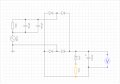
So… I designed this power supply in EveryCircuit, and it gave me 17VDC unladen, which was what I wanted. Then I built it IRL, added an LM741 with the correct setup for 17VDC… and only got 7VDC. Moreover, the resistors are cooking.
There’s probably an obvious flaw here… but I need help to find it.

Note: The reason why I used 2x10μF instead of 1x22μF is because that’s what I had at home. Same thing with using 4xBC548 with individual resistors — it’s what I had laying around and I tried to spread out the load, otherwise it would have exceeded their capacity. IMG_4021.jpeg
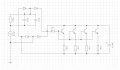
Vout is of course on the right, across the 2.2mF cap.
 

sghioto

Joined Dec 31, 2017
8,634
So… I designed this power supply in EveryCircuit, and it gave me 17VDC unladen, which was what I wanted. Then I built it IRL, added an LM741 with the correct setup
Besides the LM741 what else is connected using the 17 volts?
Is this using 220Vac as the source?
Show this LM741 circuit also.
 
Last edited:

Thread Starter

ricebridge

Joined Jun 24, 2017
30
The source is 230VAC (and I’m well aware of the risks).

When testing, I haven’t used a load. It will be used to supply 17VDC @ max 1.2A.

The resistors were calculated to handle the power.
 

nsaspook

Joined Aug 27, 2009
16,273
The source is 230VAC (and I’m well aware of the risks).

When testing, I haven’t used a load. It will be used to supply 17VDC @ max 1.2A.

The resistors were calculated to handle the power.
The means you will be dropping about 200VAC @1.2A over various components in that circuit and generating over 200W of heat as wasted energy.

Very bad engineering and design completely separated from the obvious safety issues. Use a properly designed power supply.
 

Thread Starter

ricebridge

Joined Jun 24, 2017
30
The means you will be dropping about 200VAC @1.2A over various components in that circuit and generating over 200W of heat as wasted energy.

Very bad engineering and design completely separated from the obvious safety issues. Use a properly designed power supply.
The idea was to explore a transformerless power supply, and this was what I was led to believe would be the basic design. Well, could you direct me to something better?
 

nsaspook

Joined Aug 27, 2009
16,273
The idea was to explore a transformerless power supply, and this was what I was led to believe would be the basic design. Well, could you direct me to something better?
Transformerless power supply normally are normally designed for application power levels in the range of a old carbon-zinc 9V battery.

I would just buy something safe, reliable and inexpensive unless you want to build power supplies. Search for 17V 1.5 or 2.0A power supplies
 

tonyStewart

Joined May 8, 2012
231
PSU design, Buy is always cheaper than make.
If you know how to make it cheaper, you don't need to ask any questions.
If you need to ask questions, you ought to reverse engineer a buy option.
 

Thread Starter

ricebridge

Joined Jun 24, 2017
30
I must say I’m a little surprised by the replies. If I wanted to buy my stuff rather than learn about building it, I wouldn’t be on this forum at all, would I?

My question remains. If a transformerless power supply normally looks something like this:
IMG_4022.jpegthen why do I only get about half the power that I should?
 

Ian0

Joined Aug 7, 2020
13,112
The means you will be dropping about 200VAC @1.2A over various components in that circuit and generating over 200W of heat as wasted energy.

Very bad engineering and design completely separated from the obvious safety issues. Use a properly designed power supply.
It's a capacitive dropper circuit. The 2x10uF are in series with the mains supply.
However, I bet it would be possible to get a 25VA power supply, fully isolated and regulated in the space taken up by a couple of 10uF motor-run capacitors.
 

Ian0

Joined Aug 7, 2020
13,112
I must say I’m a little surprised by the replies. If I wanted to buy my stuff rather than learn about building it, I wouldn’t be on this forum at all, would I?

My question remains. If a transformerless power supply normally looks something like this:
View attachment 344919then why do I only get about half the power that I should?
because you have shunt-regulated it, and any excess power is being dissipated by the zener diode.
 

Ian0

Joined Aug 7, 2020
13,112
If I wanted to buy my stuff rather than learn about building it, I wouldn’t be on this forum at all, would I?
So get yourself some strips of silicon-iron, some thin enamelled wire, 3D print yourself a bobbin and get winding. Only a few thousand turns on the primary.
Would you prefer to make your own transformer or simply buy one?

There are applications where a capacitive dropper power supply is a good idea. This isn't one of them.
 

LowQCab

Joined Nov 6, 2012
5,101
It's unlikely that anyone here will help You with such an obviously DEADLY Circuit.
In fact, these types of Circuits are supposedly banned in these Forums.
I'm surprised that this Thread hasn't been deleted yet,
although, admittedly, no one has offered much assistance with this project,
but rather, everyone has been trying to talk You out of it.

You should take our collective advice.
.
.
.
 

nsaspook

Joined Aug 27, 2009
16,273
It's a capacitive dropper circuit. The 2x10uF are in series with the mains supply.
However, I bet it would be possible to get a 25VA power supply, fully isolated and regulated in the space taken up by a couple of 10uF motor-run capacitors.
Right, it's reactive power but the real losses are still high in that circuit due to large peak currents. Far too much current to expect any sort of efficiency from a capacitive dropper.
 
Last edited:

Pyrex

Joined Feb 16, 2022
502
It's not a good design.

At the moment of switching on there will be a very strong current . To limit the current, add 4.7 Ohm 10W resistor in series to the mains.

Voltage drops from 17V to 7V. I suspect the load draws too much current.

And, as you was warned before, this power supply is not a safe device
 

Ian0

Joined Aug 7, 2020
13,112
It's not a good design.

At the moment of switching on there will be a very strong current . To limit the current, add 4.7 Ohm 10W resistor in series to the mains.
You’re right about that. 20uF switched on at mains peak will kill the zener, and possibly the bridge.
 
Status
Not open for further replies.
Top