Facebook
 Google
 GitHub
 Linkedin
hi there. i've been working really hard on this circuit for very long and i think i won't be able to do it without any help. any help is appreciated.

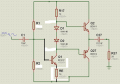
i'm to design a 2-3 stage class ab amplifier with no feedback. signal input is 1Vp-p 30KHz. supply voltages are ±12V. my aim is to amplify this signal upto 24Vp-p (24 gain). as i use a small load (20ohm) i have to use a push-pull stage (or maybe darlington pair) to drive this load. i have to use bc237 (beta=100) and bd911-912 (beta=60).
my first problem is that i have never reached max swing at 1st stage output. there is clipping at higher gains. i've actually wrote a matlab code for calculating the resistor values. one assumption is that i set Vc=0 as i don't want any dc offset at output.
re=1000 ;(i assumed re to be 1k)
rc=24*re
ic=12/rc
rth=10.1*(re)
vth=ic*((rth/100)+re)-11.3
r1=(24*rth)/(vth+12)
r2=(rth*r1)/(r1-rth)
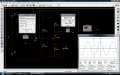
the first problem here is that, the theorethical values never matches up with simulations. Vc never turns out to be 0 V. i have to change bias resistors (mainly R1) to set for 0 (so there may be something wrong with the code?). another point is that, gain is roughly rc/re=24, but at this case clipping occurs. so i drop the gain in order to prevent clipping. when i set rc/re=16, i get (+9.7) - (-10V) max swing without clipping which is also biased a little bit. with increased gain more biasing and clipping occurs.
the second problem is, i don't know how to connect the first stage output to the push-pull stage. when i use the push-pull alone with 24Vpp input, it gives the same output (which is what it should do). but when i connect them directly (after c2 to c4-c5 connection with rc/re=16) i get the peaks of first stage (+85mv) - (-225mv) and the peaks at output (155mv) - (-160mv). biased and much smaller.
using a current amplifier (common collector) as a second stage may be necessary. or there might be an additional transistor used for bias current stabilization (for diodes) for output stage. i don't really know what's the problem.
well this circuit looks like a simple one but indeed a very problematic one for me.

i'm to design a 2-3 stage class ab amplifier with no feedback. signal input is 1Vp-p 30KHz. supply voltages are ±12V. my aim is to amplify this signal upto 24Vp-p (24 gain). as i use a small load (20ohm) i have to use a push-pull stage (or maybe darlington pair) to drive this load. i have to use bc237 (beta=100) and bd911-912 (beta=60).
my first problem is that i have never reached max swing at 1st stage output. there is clipping at higher gains. i've actually wrote a matlab code for calculating the resistor values. one assumption is that i set Vc=0 as i don't want any dc offset at output.
re=1000 ;(i assumed re to be 1k)
rc=24*re
ic=12/rc
rth=10.1*(re)
vth=ic*((rth/100)+re)-11.3
r1=(24*rth)/(vth+12)
r2=(rth*r1)/(r1-rth)
the first problem here is that, the theorethical values never matches up with simulations. Vc never turns out to be 0 V. i have to change bias resistors (mainly R1) to set for 0 (so there may be something wrong with the code?). another point is that, gain is roughly rc/re=24, but at this case clipping occurs. so i drop the gain in order to prevent clipping. when i set rc/re=16, i get (+9.7) - (-10V) max swing without clipping which is also biased a little bit. with increased gain more biasing and clipping occurs.
the second problem is, i don't know how to connect the first stage output to the push-pull stage. when i use the push-pull alone with 24Vpp input, it gives the same output (which is what it should do). but when i connect them directly (after c2 to c4-c5 connection with rc/re=16) i get the peaks of first stage (+85mv) - (-225mv) and the peaks at output (155mv) - (-160mv). biased and much smaller.
using a current amplifier (common collector) as a second stage may be necessary. or there might be an additional transistor used for bias current stabilization (for diodes) for output stage. i don't really know what's the problem.
well this circuit looks like a simple one but indeed a very problematic one for me.