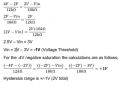
Positive Feedback Schmitt Trigger Calculation. Help :(

Thread Starter

Faheem25

Joined Oct 24, 2019
35
Look:
(5V - 2.5V)/12kΩ = (2.5V - Vin)/18kΩ

(2.5 - Vin)/18 = 2.5/12

(2.5 - Vin) = (2.5*18)/12

(2.5 - Vin) = (2.5*18)/12

2.5 - Vin = 3.75

Vin = 2.5 - 3.75 = -1.25V
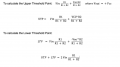
1572204079297.png

I see, someone told me to do this. Is that right. Two different steps. Maybe you could explain what this would be for, circuit type etc.

@Jony130 MOD.E
 
Last edited by a moderator:

Jony130

Joined Feb 17, 2009
5,598
I see, someone told me to do this. Is that right
Well, almost right. But because your circuit is not a standard Schmitt trigger.
In this case, you need to use a "general rule":
To be able to find the Upper/Lower threshold Voltage you need to know that the opamp output voltage for positive saturation (Vcc) and for the negative one (Vee), +5V and -5 for an ideal opamp.
Then you need to find the Vin value for which the voltage at non-inverting is exactly equal to the voltage at the non-inverting input.
And you must remember that the non-inverting input voltage in your circuit will also changes together with the opamp output voltage.
 

Thread Starter

Faheem25

Joined Oct 24, 2019
35
Well, almost right. But because your circuit is not a standard Schmitt trigger.
In this case, you need to use a "general rule":
To be able to find the Upper/Lower threshold Voltage you need to know that the opamp output voltage for positive saturation (Vcc) and for the negative one (Vee), +5V and -5 for an ideal opamp.
Then you need to find the Vin value for which the voltage at non-inverting is exactly equal to the voltage at the non-inverting input.
And you must remember that the non-inverting input voltage in your circuit will also changes together with the opamp output voltage.
You wouldn't mind calculating that for me please. I got 2V
 

Thread Starter

Faheem25

Joined Oct 24, 2019
35
But I already did just that in post #13
Okay just trying to simplify it a bit more and ill tell you my steps.

I= Vin -Va/ R1 = Va = Vout/ R2
Va = 0 need this value for the switch to occur.
Vin/R1 = Vout/R2

R1 = 18k R2 = 12k
Vout = +/-5V
Vin = (-)18k/12k (+/-2.5V) = -3.75V

So far good? What does the 3.75 indicate, the switch to occur? or is that 2.5..

You're saying its now 2.5 - 3.75 = 1.25V. what does that 1.25 indicate. Sorry, been long time since ive done this
 

ericgibbs

Joined Jan 29, 2010
21,463
hi 25,
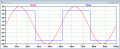
This sim shows the Threshold points at +/-1V ,with a Vout of +/-4V
The Hysteresis range is +/-1V [ 2V total ]

With an actual 741, the Vout range is approx +/-Vsupply -1V, so with a +/-5V supply , Vout range is +/-4V

jony chose the Vout+/-5V as for an ideal amplifier, so the threshold voltages where +/-1.25V

Do you follow OK.?

E
 

Attachments

Thread Starter

Faheem25

Joined Oct 24, 2019
35
hi 25,
This sim shows the Threshold points at +/-1V ,with a Vout of +/-4V
The Hysteresis range is +/-1V [ 2V total ]

With an actual 741, the Vout range is approx +/-Vsupply -1V, so with a +/-5V supply , Vout range is +/-4V

jony chose the Vout+/-5V as for an ideal amplifier, so the threshold voltages where +/-1.25V

Do you follow OK.?

E
Oh god. So Vout is 4v.

Could you calculate it all for me please:(
 

Thread Starter

Faheem25

Joined Oct 24, 2019
35
hi,
All you have to do is fit 4v instead of 5v in jonys posts #13 and #20.
Post your attempt.
E
This is what i did yesterday, so is this correct but maybe i need to change it to 4V rather than 5V. Vout is actually 5V.


1572270931730.png


Is that correct but with 4V rather than 5Vout? I believe its 5V Vout
 

Jony130

Joined Feb 17, 2009
5,598
Or you can use your "method" (superposition principle) and solve this:

LTP:
\[ V_{LTP} \frac{R_2}{R_1+R_2} + V_{OH} \frac{R_1}{R_1+R_2} =\frac{V_{OH}}{2} \]

Where

V_OH is a Positive output voltage (for an ideal Opamp V_OH = VCC)
 

Thread Starter

Faheem25

Joined Oct 24, 2019
35
Do you see the voltage divider connected to the inverting input? What is the voltage than at the inverting input?
yes it would be 2V ?

I don't know why i am struggling with the method, i would honestly appreciate if one could present the full calculation including the formula. would be a massive help
 
Top