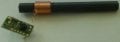
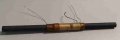
Probably because the same rod can be used for multiple bands. In the winding of the rod, band 1 goes at the top end, band 2 goes in the middle and band 3 goes at the bottom end. If band 2 and 3 aren't used in the radio, only the band 1 winding is on the rod, which will make it look weird and make you think that the position of the winding on the rod is important - which it is not.
The permeability of ferrite compared to that of air suggest that and difference in inductance with respect to placement would be negligible. My best guess is that a short winding takes less copper than one spread across the coil.
This is a very interesting question because the answer is not obvious to most of us.
The inductance of the coil does change depending on its position on the ferrite bar.
In AM radios with ferrite bar antenna, signal peaking at the low frequency end was done by positioning the antenna coil on the rod; and at the high end, by a trimmer across the tuning capacitor.
While I am not disputing your statement, I would like to see proof of this. An inductor is mostly determined (after the turns) by the permeability of the substanceunder the wiring. Your statement would imply that the permeability is changing from end to end - which it does not.
Simply moving the winding along the core can appear to causea change the inductance, since objects entering the magnetic field can cause a small shift in inductance. Moving the entire core-winding assembly can cause the same shift.
The slug is usually shorter than the coil length and it's adjusted in/out of the inductor inner magnetic circuit. The discussion here is about a much longer rod that always occupies the inner magnetic circuit of the inductor as the rod is moved.
The slug is usually shorter than the coil length and it's adjusted in/out of the inductor inner magnetic circuit. The discussion here is about a much longer rod that always occupies the inner magnetic circuit of the inductor as the rod is moved.
In the days of old analog radio.....tunable resonance was used to select a slot(or window) of the band to receive. This tunable slot was tracked by a local oscillator tunable slot to produce a constant F IF.
The tuning of these slots gave an equal output thru-out the band. Hopefully.
The IF section is a constant slot. The transformers or tuned circuits in this chain.....are stagger tuned...to completely fill in the IF slot.
It's kinda hard to explain to the un-familiar......but easy to see during a sweep tune up.
With the digital switching techniques......the limits of resonance can be surpassed with ratios of time itself. A time slot does not need resonance. Just switches.
The trigger for my question was a time code receiver. The coil appears to be wound directly on the rod so could not be moved for tuning and it is very much near the end of the rod.
A magnetic antenna is used for a certain range of frequencies. There is nothing ideal, everything has a spread of parameters. This arrangement of the coil allows you to adjust the inductance (increase and decrease). Inductor adjustment allows to set the lower end of the frequency range correctly, and at the upper end of the frequency range, adjustment is made with trimmer capacitors.
A magnetic antenna is used for a certain range of frequencies. There is nothing ideal, everything has a spread of parameters. This arrangement of the coil allows you to adjust the inductance (increase and decrease). Inductor adjustment allows to set the lower end of the frequency range correctly, and at the upper end of the frequency range, adjustment is made with trimmer capacitors.
That would be my thought too and the offset allows a rod clamp mount away from the coils and/or for a coupled winding to be added later in that space. A standard number of turns for the inductance and the length (longer inner magnetic circuit is better) of the rod enhances the ability to capture the magnetic component of the transmitted RF signal.
Like many who had serviced old portable receivers, I know the inductance does vary somewhat with position, as moving the coil was an important part of the alignment procedure for some radios. I had no idea how much it could vary. I found an old ferrite rod and coil and did some measurements:
The inductance varies much more than I expected as the coil is moved along the rod:
The horizontal axis is the position of the middle of the coil relative to the middle of the rod. The red markers are the points where the end of the rod starts to disappear into the windings, so between the red markers, the winding is completely on the ferrite. At these points the inductance dropped to only 67% of it's peak value. I didn't expect that.
@Tesla23 Your results are surprising. I'm wondering if you shortened the ferrite rod if these values would hold (peak, edge, etc). I know that this would be a destructive test, so it's up to you.
I'm wondering if these changes are due to the fact that magnetic fields always connect (completely closed) and due to the permeability, exit out of the rod mostly at the end.

 Facebook
 Google
 GitHub
 Linkedin