Positioning two coils so there is no coupling between them.

Thread Starter

AlbertHall

Joined Jun 4, 2014
12,619
If two coils have their axes at right angles then there is no coupling between them.
I have a vague memory that there is (at least) one other way for which an angle of 69° is in my mind.
Is such an angle a 'thing'?
 

Papabravo

Joined Feb 24, 2006
22,058
I don't think so. The rotated coil will have components of the magnetic field that are parallel to the magnetic field in the non-rotated coil.
 

Jerry-Hat-Trick

Joined Aug 31, 2022
776
Axes at right angles is the best you can do between coils in air, but think about what the fields look like to get an idea of the extent of the interaction

Providing an easy pathway for the field by shielding the coils in metal cans will help, with the corresponding change in inductance

putting the coils as far apart as possible is maybe the simplest approach. The magnetic field falls according to the inverse cube of distance
 

Thread Starter

AlbertHall

Joined Jun 4, 2014
12,619
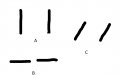
If two coils are arranged as in diagram below then in case A and B there will be coupling between the coils. I think in case C there must be an angle where there is no coupling which would depend on the width and spacing of the coils.
If so what is this angle?
Coils.jpg
 

DickCappels

Joined Aug 21, 2008
10,661
1725780643779.png

If you have a pulse generator (and NE555 will do) and an oscilloscope (or a pair of sensitive earphones) this experiment is easy to perform. In making circuits that communicated through pulsed coils I have seen this effect (orthogonal coils have little or no coupling) many times.
 

Papabravo

Joined Feb 24, 2006
22,058
If two coils are arranged as in diagram below then in case A and B there will be coupling between the coils. I think in case C there must be an angle where there is no coupling which would depend on the width and spacing of the coils.
If so what is this angle?
View attachment 331183
Vector fields are tricky and arrangement C will have a non-zero coupling between the fields. Parallel vector field couple and perpendicular field do not couple. Draw the vectors!
 

nsaspook

Joined Aug 27, 2009
16,250
If two coils are arranged as in diagram below then in case A and B there will be coupling between the coils. I think in case C there must be an angle where there is no coupling which would depend on the width and spacing of the coils.
If so what is this angle?
View attachment 331183
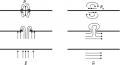
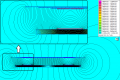
These objects are not uniform in 3d space, they will have some coupling due to fringe fields (the distributed elements of the circuit) in any possible alignment in the near field.
1725817279643.png
1725817869009.png
You can minimize the effect with design in things like a circuit board with shielding and shunting.

Remember, those field lines of force don't exist as physical lines. They are a visual representation of the field.
https://van.physics.illinois.edu/ask/listing/27163
First of all, electric, gravitational, AND magentic fields are all completely smooth. The "field lines" taught in many classes and used by physicists to visualize field strengths are purely to guide the eye; they don't have physical meaning. (Even so, they are useful lines to draw, and even contain weakly quantitative behavior, since the field strength is proportional to the density of field lines. Just remember that between any two such field lines, the field strength is just as strong as on the lines themselves. The field is smooth.)

1725819025957.png
1725819145021.png
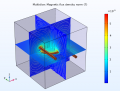
https://www.comsol.com/support/learning-center/article/Modeling-Electromagnetic-Coils-8251/112
 
Last edited:

Tesla23

Joined May 10, 2009
558
Or if the two flat coils are arranged as below would there be no coupling?
View attachment 331186
You are right, there will be some overlap position where there is no coupling. This easy to see, assume a current in one and look at the voltage induced in the second. The sign of this voltage changes from when the coils fully overlap to when they are fully separated (just draw a few field lines). Somewhere in between the voltage must be zero, hence no coupling.
 

Ya’akov

Joined Jan 27, 2019
10,226
The best way to position the coils to ensure no coupling is to put each in a different national capital city, in a mu metal box. It can also help to isolate the leads from and source of electrical power.

(I know, but for some reason I felt compelled to post it anyway. Sorry.)
 

Ya’akov

Joined Jan 27, 2019
10,226
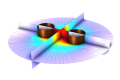
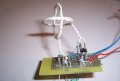
This is the thing I am trying to replicate. I wondered about (many others also result in a zero coupling).
a-geometry-based-grid-dip-meter-emulation
" I have retained the "armillary sphere" coil configuration: it is the simplest and most obvious (many others also result in a zero coupling), but it looks well suited for the intended purpose. "
View attachment 331262
Reminds me of a "tickler" and the other arrangements of coils in the very early receivers.
 

nsaspook

Joined Aug 27, 2009
16,250
This is the thing I am trying to replicate. I wondered about (many others also result in a zero coupling).
a-geometry-based-grid-dip-meter-emulation
" I have retained the "armillary sphere" coil configuration: it is the simplest and most obvious (many others also result in a zero coupling), but it looks well suited for the intended purpose. "
View attachment 331262
Yes, I'm being padantic. Those configurations don't have zero coupling points, they have NULL (dip) minimal coupling positions.
1725890451970.pngholt-IMG162.jpg
f6djqdx6yww71.jpg
 

MisterBill2

Joined Jan 23, 2018
27,173
To go a bit farther than the previous post, "Minimum coupling is not at all the same as ZERO coupling."And even 60 dB down from a thousand watts is still enough signal to be easily heard many miles away.
 

vu2nan

Joined Sep 11, 2014
357
If two coils have their axes at right angles then there is no coupling between them.
I have a vague memory that there is (at least) one other way for which an angle of 69° is in my mind.
Is such an angle a 'thing'?
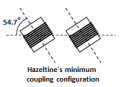
That would be Hazeltine's minimum coupling configuration.

The angle is 54.7 ° as shown below.

1740112696750.png

It's applicable even to multiple coils.

Courtesy : Researchgate.net

Nandu.
 
Last edited:

Thread Starter

AlbertHall

Joined Jun 4, 2014
12,619
Inductive balance metal detectors use two 'D' shaped coil with the flat sides slightly overlapping and adjusted for minimum coupling.
Why do they not do the same but with circular coils - why the 'D' shape is used?
 

MisterBill2

Joined Jan 23, 2018
27,173
Inductive balance metal detectors use two 'D' shaped coil with the flat sides slightly overlapping and adjusted for minimum coupling.
Why do they not do the same but with circular coils - why the 'D' shape is used?
What is not obvious is that undoubtedly a whole lot of research and testing has been involved. In addition, there may also be a compromise between manufacturing considerations and actual performance, as well as some unanticipated results from effects that are not obvious based on theories.
So it seems reasonable that the answer will not be provided, and that the product developers will do their very best to not reveal the answer. This is what is called "a trade secret", legally protected information.
 
Top