Portable Thermoelectric Cooler

Thread Starter

agraco

Joined Dec 21, 2017
5
Hi. My daughter and me are trying to build a portable cooler for a kid who cannot sweat. We have found all the parts but are now getting stuck on understanding concepts of volts and amps. Specifically, we don't know how to select a battery that will power the device without damaging it.

Cooler unit: (did not purchase yet)
max amp: 6
max volt: 2.1

fan:
volt range: 3-5
amp: 0.16

Potential battery: (did not purchase yet)
output: 5V, 2.1 A

Because the amps and volts don't align between the two devices, I don't know how to ensure compatibility.

Duration of the device: 45 minutes would be plenty. It has to be small enough that the child won't mind using it...so the trick will be to carry around extra batteries.

thank you,
 

wayneh

Joined Sep 9, 2010
18,085
Hi. My daughter and me are trying to build a portable cooler for a kid who cannot sweat. We have found all the parts but are now getting stuck on understanding concepts of volts and amps. Specifically, we don't know how to select a battery that will power the device without damaging it.

Cooler unit: (did not purchase yet)
max amp: 6
max volt: 2.1

fan:
volt range: 3-5
amp: 0.16

Potential battery: (did not purchase yet)
output: 5V, 2.1 A

Because the amps and volts don't align between the two devices, I don't know how to ensure compatibility.

Duration of the device: 45 minutes would be plenty. It has to be small enough that the child won't mind using it...so the trick will be to carry around extra batteries.

thank you,
I think you may have misunderstood the specifications of the cooler. It might have a voltage drop of 2V, but a typical TEC uses a 12V supply. I'm sure there are plenty of exceptions but either way, it's important to get as many details as possible.

But even more importantly, I'm skeptical of this approach overall. A TEC can get cool on one side, that's true. But all the heat it removes from the cold side, plus all the energy it consumes from the battery, must be dissipated from the hot side. So for instance a TEC rated at 100W will consume 100W from the battery as it moves 10W from the cold side to the hot side. It will need to shed 110W from the hot side. This means you usually need a large heat sink and fan on the hot side, something like a CPU cooler used in computers. The heat flow at the cold side is much less but you'd probably want a fan there as well.

The combined power draw by the cooler and the fan(s) is a lot for a portable device. Even with high power-density laptop batteries, you'll need a heavy battery pack to achieve even a modest amount of cooling. Plugging into a running car is feasible, but even a car battery will drain fairly quickly if the engine isn't running.

I'm not trying to be a turd in the punchbowl, but rather encourage you to work through the details and be prepared for some engineering challenges. A water mister and a fan might be a far cheaper and easier solution.
 

MrChips

Joined Oct 2, 2009
34,626
There is no harm in trying. You will need at least a 2000mAh battery.
A common Li-ion battery is the 18650 3.6V 2200mAh. Put two of these in series to get 7.2V. Try it and see if it does the job for you. You will need a Li-ion charger.


MrChips

Joined Oct 2, 2009
34,626
TS has provided a link to a $20 TEC.
A popular TEC1-12706 can be bought for $2.
You don't have to run the TEC at full power. Try it first with a single 18650 battery @ 3.6V and see what happens.
 

wayneh

Joined Sep 9, 2010
18,085
TS has provided a link to a $20 TEC.
A popular TEC1-12706 can be bought for $2.
You don't have to run the TEC at full power. Try it first with a single 18650 battery @ 3.6V and see what happens.
One thing that will happen is that the hot side will become quite hot. The worst-case scenario is destruction of that expensive TEC. Well I suppose burns, smoke and a fire would be worse but that's unlikely. Just be prepared to check the hot side to make sure it's not overheating.
 

MrChips

Joined Oct 2, 2009
34,626
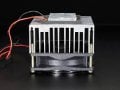
You will need two heat sinks and two fans, one for the hot side and another for the cold side, i.e. you will sandwich the TEC as follows:

fan - heat sink - TEC - heat sink - fan
 

WBahn

Joined Mar 31, 2012
32,702
Hi. My daughter and me are trying to build a portable cooler for a kid who cannot sweat. We have found all the parts but are now getting stuck on understanding concepts of volts and amps. Specifically, we don't know how to select a battery that will power the device without damaging it.

Cooler unit: (did not purchase yet)
max amp: 6
max volt: 2.1

fan:
volt range: 3-5
amp: 0.16

Potential battery: (did not purchase yet)
output: 5V, 2.1 A

Because the amps and volts don't align between the two devices, I don't know how to ensure compatibility.

Duration of the device: 45 minutes would be plenty. It has to be small enough that the child won't mind using it...so the trick will be to carry around extra batteries.

thank you,
How are you going to use this to cool the kid?

How much heat do you need to pull away from the kid?

Sitting still a typical human produces something like 100 W of heat. What are the conditions that the kid needs be cooled under? A cooler that can move about 10 W of heat may not do much good. Are you planning on using more than one of these?

How are you going to vent the considerable amount of heat away from the kid?

If you wanted to remove 100 W from the kid, then you are going to have to get something like 250 W of electrical energy (turned to heat) in addition to the 100 W extracted from the kid. Think of sitting the kid next to a furnace that somehow extracts a fraction of the heat it is putting out from the kid, but you need to vent ALL of that heat in such a way that none of it makes it back to the kid. Not an easy task, especially if you want the kid walking around and doing things while carrying all of this.

If you are concerned about the weight of the batteries, how about the weight of the heat sinks and insulation?

Even if you just use one of these to get about 10 W of cooling, you will need to consume about 25 W of electrical energy to do it. For 45 min of operation, you are talking about 67 kJ of energy, which is about 18 Wh. Each of the power packs you linked to has roughly the 5 Ah of charge so about 25 Wh. Allowing for inefficiencies of conversion, the energy works out about right. However, you will need three such packs to get the 6 A you need. But remember that that only gets you 10 W of cooling.

Have you looked at other, lower tech solutions? If the problem is that the kid can't sweat, then how about artificial sweat? Perhaps a mister or something that seeps water into a loose-woven garment that can evaporate and cool him?
 

Thread Starter

agraco

Joined Dec 21, 2017
5
thanks to everyone who replied. Some quick responses.

1. The amount of heat I need to remove from the kid is small. Just enough toparticipate in outdoor activities, if only to walk around for a few moments in the sweltering heat.

2. the posts about testing it with small batteries is very helpful. I got a small 3.6 volt peltier in the email that requires 6 amps. It "works" with a standard AA, but I have two 18650 batteries on the way. This will allow the device to last 40 minutes which is plenty for the events that we have.

3. I had not thought of sandwiching the peltier between two fans. Thanks

4. The idea of using a single fan (for the hot side) is so that the peltier can be stuck to a piece of metal which would be pressed to the skin at the wrist.

5. Currently researching how to use a timer 555 and a sensor 741. If anyone has a simple overview of how to connect the 18650 battery to these sensors that would be helpful. (I know I need them before the device can actually be used without supervision)

thanks everyone
 

WBahn

Joined Mar 31, 2012
32,702
I'm rather skeptical that a cool wrist strap is going to make the difference being someone being able to walk around in the sweltering heat for fort minutes and not. Imagine walking around with a jar of cold water in your pocket -- would sticking your hand in the cold water make that much difference to you on a hot day?
 

Thread Starter

agraco

Joined Dec 21, 2017
5
I am not a scientific person but I am trying to introduce my child to science. She has brought forward a problem and we are going through the process of discovery to see if there is something that can be done. Your ability to see the end point will help me manage her expectations.

That said, here is where the idea came from: I read an article many years ago that Olympic athletes use a custom wrist device to cool down faster. The device takes advantage of the blood vessels that are so close to the surface. I think it would be pretty cool to replicate a device, even if it does not last 40 minutes.

thanks

I'm rather skeptical that a cool wrist strap is going to make the difference being someone being able to walk around in the sweltering heat for fort minutes and not. Imagine walking around with a jar of cold water in your pocket -- would sticking your hand in the cold water make that much difference to you on a hot day?
 

MrChips

Joined Oct 2, 2009
34,626
What a great way to introduce a child to science! There is nothing to lose and so much to gain by just trying.

I took a TEC1-12706 and applied 3.6V. It took about 0.7A.
At 7.2V it drew 1.8A. Cools nicely.

The question is, does it pull enough cooling power to make a difference on a human body on a hot day?
You may need a number of these to start experiencing a cooling effect.
 

-live wire-

Joined Dec 22, 2017
959
You could use some drone motors, batteries that are rated for it, and propellers with protective things around them as a portable fan. You can probably find them on Amazon or some droning place. All you need once you have those components is a simple on/off switch. Also, I am talking about more heavy-duty drone parts. If you have ever flown a drone, you know how much force those motors generate, and how much air they can blow. This would be good if your objective is to cool him or her off effectively.

Also, you might want to learn a little bit about POWER (watts, amp hours, all that stuff). Here is some useful information and equations that will help you with your project:

V=IR. The voltage is the current (amps) times the resistance(ohms). Your voltage usually remains constant, and it will for the most part with your batteries. It will drop down to almost nothing when they are completely drained. The resistance depends on the load (thing you are powering). So, if you have a battery powering a low resistance load, like a fan motor, you will have high current.

Lets say the resistance is 3 ohms (very little). Your current is 1.5V/3 ohms, which is .5 amps. Now, lets say you have a 1 amp-hour battery. That means you could power a 1 amp load for 1 hour. But, your load draws only .5 amps. So, your load gets powered for 1a-h/.5 amps=2 hours. Now, keep in mind that all these calculations are for ideal components, and the hypothetical values for current, amp-hours, that stuff, are going to be greater than the actual values.

Power is expressed in watts, and is V*I (voltage times current). Assuming you have a constant voltage source, like a battery, the main thing that changes is current, based on resistance. So, the lower the resistance, and therefore the higher the current, the more power is consumed. It is good to know what exactly a watt means and how to find the wattage, as it is necessary in evaluating many circuits, and making sure your components don't start smoking or worse.

Hopefully this information will be helpful in making this project to help cool him/her.
 

Thread Starter

agraco

Joined Dec 21, 2017
5
What a great way to introduce a child to science! There is nothing to lose and so much to gain by just trying.

I took a TEC1-12706 and applied 3.6V. It took about 0.7A.
At 7.2V it drew 1.8A. Cools nicely.
.
Oh. I did not realize that I could use a 3.7 volt battery to operate a 12 volt TEC.

I went out of my way to find, at higher cost, a 3.8 volt TEC (see the blue link at the very top of the thread). Anyways, I just plugged in my 3.8 volt TEC to the 18650 and burned myself. :/ The hot/cold effect was extremely fast.

Now I understand why I need a timer 555 to regulate the power and the sensor 741 to switch the thing off or this will burn someone else.

marx: thanks for that overview of power as a function of v and i.
 

MrChips

Joined Oct 2, 2009
34,626
You are about to destroy your expensive TEC real fast, if you have not done so already.
Put a heat sink and a fan on the hot side. You have to get the heat away otherwise, poof, your TEC is toast.
 

be80be

Joined Jul 5, 2008
2,394
This is bad idea all the way around if you want to do what your saying make a cooler that has the fan and heatsink on it.
Then run the cold side using a closed loop of water from a backpack.
 

Thread Starter

agraco

Joined Dec 21, 2017
5
You are about to destroy your expensive TEC real fast, if you have not done so already.
Put a heat sink and a fan on the hot side. You have to get the heat away otherwise, poof, your TEC is toast.
Thanks for that warning...We have not destroyed the TEC...yet. It is not clear if the heat sink and fan will be enough to dissipate the heat.I noticed that it takes a full 30 seconds for the fan to get up to full speed.

The TEC is 1.5 CM, the heat sink is 2 cm - this was deliberate. My daughter read somewhere that a heatsink should be larger than whatever it is sinking. I have no clue if this is true.

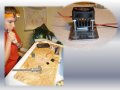
The attached image is where she is. Tomorrow the paste should be dry and the battery can be hooked up.

Happy Holidays
 

Attachments

Sensacell

Joined Jun 19, 2012
3,767
That heat-sink looks really small, I have a feeling it's all just going to get very hot and angry.
Usually, the heat-sink required totally dwarfs the peltier unit.

These things are so terribly inefficient, only good where the amount of cooling required is minuscule and there is ample power available - none of which are true in your case.


heaTs.jpg
 
Top