Portable audio amp doesn’t work through Y-cord (wrong way)

Status
Not open for further replies.

R.E.

Joined Jul 29, 2017
56
Aviation electronics, splicing into and messing with the comm system = terrible idea and fines, there are laws specifically written for this.
This sounds like the dude that wanted me to fix the radio system in his plane, I'm not licensed to do so and he was very persistent.

Tried to play it off as no big deal, turns out he was hiding the plane from creditors and couldn't take it to a certified aviation tech because it would be found immediately.

Big I'm out too.
 

Thread Starter

lionshead

Joined Mar 10, 2018
17
Aviation electronics, splicing into and messing with the comm system = terrible idea and fines, there are laws specifically written for this.
This sounds like the dude that wanted me to fix the radio system in his plane, I'm not licensed to do so and he was very persistent.

Tried to play it off as no big deal, turns out he was hiding the plane from creditors and couldn't take it to a certified aviation tech because it would be found immediately.

Big I'm out too.
Fair enough.

Just to clarify - We’re not cutting/splicing anything. And no one is hiding from banks or FAA. We’re just trying to fight fatigue on very long flights by ourselves. Music keeps your eyes up and on the instruments...otherwise people read books or play sudoku.

The manufacturer knows we’re doing this and isn’t opposed. Our bosses want copies of the amps, too.
 

Thread Starter

lionshead

Joined Mar 10, 2018
17
So y’all...I know this whole thing is weird. Totally get it if you don’t want to sandbox with me. If you knew what we’re flying you’d be totally distracted by that, too.

Truly, I just need to figure out why my volume is dropping when y-cabled with the ICS and headphones. I know it’s not ideal (or correct). I know it should be done through other avenues. That’s just not how things have shaken out...

It’s a tough puzzle. I’m only an aeronautical engineer/Pilot. I’m not EE...I’m having to research everything.

Does anyone have something they can point me at to expound on this problem? You know, so you aren’t the one aiding and abeding? ;)
 

R.E.

Joined Jul 29, 2017
56
So y’all...I know this whole thing is weird. Totally get it if you don’t want to sandbox with me. If you knew what we’re flying you’d be totally distracted by that, too.

Truly, I just need to figure out why my volume is dropping when y-cabled with the ICS and headphones. I know it’s not ideal (or correct). I know it should be done through other avenues. That’s just not how things have shaken out...

It’s a tough puzzle. I’m only an aeronautical engineer/Pilot. I’m not EE...I’m having to research everything.

Does anyone have something they can point me at to expound on this problem? You know, so you aren’t the one aiding and abeding? ;)
Someone mentioned mixer, go that route and things will become much easier and safer. Then look at a VOX or Ducker circuit to override the currently playing music when there is avionic radio activity... critical for safety. If your going to make 100 then you should look at hiring someone with experience or your going to have problems, (which was mentioned as well).
 

R.E.

Joined Jul 29, 2017
56
I found this https://www.pilotmall.com/category/cell-music-adapter
Not sure what your uber connector is no one has gotten a photo or model number of the equipment you are working with, so everyone's crystal balls are probably in the shop. Safe, uses Bluetooth so lower levels than the cellphone themselves and isolated systems, built in VOX for ATF. Buy them in bulk and mark them up like everyone else does.

If I were a pilot I would do this;
https://www.pilotmall.com/product/B...ith-Bluetooth-Aircraft-Power/monthly-specials

Oh wow this site has lots of toys;
http://www.pilot-usa.com/blulink/blulink-ga-adapter.html
 
Last edited:

ebeowulf17

Joined Aug 12, 2014
3,307
So y’all...I know this whole thing is weird. Totally get it if you don’t want to sandbox with me. If you knew what we’re flying you’d be totally distracted by that, too.

Truly, I just need to figure out why my volume is dropping when y-cabled with the ICS and headphones. I know it’s not ideal (or correct). I know it should be done through other avenues. That’s just not how things have shaken out...

It’s a tough puzzle. I’m only an aeronautical engineer/Pilot. I’m not EE...I’m having to research everything.

Does anyone have something they can point me at to expound on this problem? You know, so you aren’t the one aiding and abeding? ;)
I should start by saying I'm still new-ish at all of this, so I could be off on the wrong track, but I think I have a vague conceptual understanding of why things aren't working for you.

I think what's happening is that the amps coming from your intercom system are dwarfing, dominating, gobbling up the puny iPhone signal. I'm not sure of the right terminology, but I suspect this has to do with the output impedances.

Normally if you wanted to mix two signals passively, you'd use resistive dividers - specifically in this case you'd put resistance between the intercom amp and the headset, and also put resistors between the iPhone and the headset. This is rarely done on the power side of things because it's so inefficient and requires more power from both sources... but it would allow each source to amplify its own signal without directly fighting the other source, and the headset would play a mix of the two.

In your case you're attempting passive mixing, but without any known, controlled resistances inline. So now (I think,) the source impedance of each system becomes the resistance value that controls the balance. If the intercom has significantly lower source impedance, the iPhone can't push the signal around effectively. Basically the intercom and the iPhone are playing tug of war to control what signal makes it to the headset... and the iPhone is never gonna win that fight!

I can't think of any good solutions offhand, and I'm also a little wary of providing advice on how to alter systems that perhaps shouldn't be altered. I'm only chiming in because I see no harm in trying to understand the electronics explanation for why your attempts so far have been mostly unsuccessful. If this helps at all with that, great! If not, sorry for the distraction.
 

Thread Starter

lionshead

Joined Mar 10, 2018
17
Great recommendations R.E. I like the way you think. If there was a simple something that I could buy I definitely would.

Bluetooth is a no-go, unfortunately. Actually, it is prohibited. Nevertheless, some people have used Bluetooth earbuds. They only last a few hours. Plus, since our headphones are installed in helmets, the earbuds are really difficult to install/remove (especially with glasses).

____
As far as no pictures, this headset has the same components: http://www.davidclarkcompany.com/files/literature/H10-76 Data Sheet (2015).pdf

All the parts of my amp were linked in the first post. The audio source is headphone jack from an iPhone or Android (or from a dongle if no 3.5mm jack).

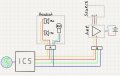
Let me know if there are any specific other components that might help clarify my question. I don’t have any data on the ICS itself. My block diagram was attached a few posts back.

___
The circuit (what I was calling a “Y-connector”) has two sources that are used at different times. The only time they’re both ON is when you are first contacted by radio. Then you kill the music source completely. The ICS may be on but without sound when idle...I’m not sure.

The thing I’m really curious about if why the ICS is causing the volume to drop. The LM386 PCB doesn’t affect the audio level from the ICS when it is connected...why only the other way around. Could this be as simple as resistance in the wires? Or a high/low pass capacitor at the end of the ICS internals?

And why would the LM386 PCB work with a 100k pot voltage divider but not less? The iPhone’s headphone amp isn’t expecting to see anywhere near that in impedance...but is there something different in the way a resistor might affect the iPhone’s sensing mechanism? Weirder still, the LM386 is working with lower resistance pots...just not when the headset and ICS are connected in parallel.

Again, the ICS is not taking the audio signal as an input. It is another source that is t in use at the time.
 

Thread Starter

lionshead

Joined Mar 10, 2018
17
In your case you're attempting passive mixing, but without any known, controlled resistances inline. So now (I think,) the source impedance of each system becomes the resistance value that controls the balance. If the intercom has significantly lower source impedance, the iPhone can't push the signal around effectively. Basically the intercom and the iPhone are playing tug of war to control what signal makes it to the headset... and the iPhone is never gonna win that fight!
Thanks! That sounds like it might just be the culprit. I’m pretty new at audio and my intuition about impedance interaction is...nill. Zilch. I understand what it is in a single component, but as far as source and speaker interactions go...I only know what I’ve gleaned from audiophile pages and misled google searches. From what I think I understand, the source needs to be around 100 times less than the speaker?

So I need to find an amp that can drive the speaker but also has an impedance that matches the (unknown) ICS?

If I know the impedance that the ICS is intended to drive (10ohm), can I make a reasonable guess about the source (0.1 ohm)? Or could it be significantly lower?

If I could find out the ICS source impedance, could I model it on the bench with another source of similar impedance? Or would I also have to match voltage and current?

Am I right to assume the the LM386 (whatever amp) is now the source whose impedance matters?

Is there any easy way to adjust source impedance?

ebeowulf17, do you have any good material I could read to learn more? And thanks again for the suggestion!
 

ebeowulf17

Joined Aug 12, 2014
3,307
Thanks! That sounds like it might just be the culprit. I’m pretty new at audio and my intuition about impedance interaction is...nill. Zilch. I understand what it is in a single component, but as far as source and speaker interactions go...I only know what I’ve gleaned from audiophile pages and misled google searches. From what I think I understand, the source needs to be around 100 times less than the speaker?

So I need to find an amp that can drive the speaker but also has an impedance that matches the (unknown) ICS?

If I know the impedance that the ICS is intended to drive (10ohm), can I make a reasonable guess about the source (0.1 ohm)? Or could it be significantly lower?

If I could find out the ICS source impedance, could I model it on the bench with another source of similar impedance? Or would I also have to match voltage and current?

Am I right to assume the the LM386 (whatever amp) is now the source whose impedance matters?

Is there any easy way to adjust source impedance?

ebeowulf17, do you have any good material I could read to learn more? And thanks again for the suggestion!
Sorry, what I've shared so far is just an educated guess. Audio circuits are not my strong suit, not by a lot.

Having said that, if my guess about your situation is right (and that's a big if,) simply matching the two source impedances would still be sketchy. If both impedances are very low, then both amps are doing a large amount of work, moving an awful lot of current, just fighting each other, not moving the speaker. I really don't think there's a good way to do this without more connectors and more access to different wires.

Having the two amps fight each other seems like a site fire way to burn up one or both of the amps. Basically, if one side is trying to drive the signal high at the same time the other side is trying to drive it low, and there isn't a significant source of resistance in between them, you've essentially created a temporary short circuit through the two amps! The speaker is not in between them providing resistance to prevent it. Without something in between to distribute things, I can't imagine this going well.

But again, can't emphasize this enough, I'm pretty new at all this.
 

Thread Starter

lionshead

Joined Mar 10, 2018
17
Random thought...what would happen if the music amp powered the headphones in reverse? Into the negative channel. The speakers wouldn’t know the difference unless both sources were operating. Then the speakers might act as a load before seeing the positive output from the ICS.

Probably showing my ignorance here. If it wasn’t completing a circuit through the ICS there wouldn’t be any issue. The neg (ground?) side of the ICS might just eat all current as the path of least resistance.
 

R.E.

Joined Jul 29, 2017
56
Random thought...what would happen if the music amp powered the headphones in reverse? Into the negative channel. The speakers wouldn’t know the difference unless both sources were operating. Then the speakers might act as a load before seeing the positive output from the ICS.

Probably showing my ignorance here. If it wasn’t completing a circuit through the ICS there wouldn’t be any issue. The neg (ground?) side of the ICS might just eat all current as the path of least resistance.
No don't do that, look at units called mixers and research impedance matching. You can take the low impedance ICS audio out to a mixer, then add your iPhone mp3 player to another channel and "mix" the two outputs together and output to the headset.

Found some info that will help and explains everything;
"USA Military Specification - 9.5-ohm total earphone impedance. Microphone is a 5-ohm dynamic microphone. USA U174/U NATO plug."
 
Last edited:

sghioto

Joined Dec 31, 2017
8,634
No don't do that, look at units called mixers and research impedance matching. You can take the low impedance ICS audio out to a mixer, then add your iPhone mp3 player to another channel and "mix" the two outputs together and output to the headset.
R.E. been down that road already, see post #10 and 12
SG
 

R.E.

Joined Jul 29, 2017
56
R.E. been down that road already, see post #10 and 12
SG
Your not going to be able to achieve what you want to do without a mixer and impedance matching. Using a mixer is way safer than what you guys are doing and your effing with military radios. Wiring adapters, resistors, and some random amp off of ebay isn't going to cut the mustard. If your going to do something do it right.

Every audio interface and adapter for your headset requires an impedance network to make them work. You will need to do the same.
I can't help any more if you keep shooting down every idea, your not getting it.
 

Thread Starter

lionshead

Joined Mar 10, 2018
17
Yeah, I know what you’re saying about a mixer is right. But I’m not going to be able to stop people from cramming a patch cable into the extra jack if I can’t offer them a better solution. It’s the same old “it hasn’t hurt me yet, so it’s not going to today” mentality.

I was hoping that since it’s possible to get sound through the extra jack there might be a way to do it safely. I’m hardly the first person to get stumped on this. It sounds like no one else can think up a way, either.

Before I give up, could the several meters of connecting wire and multiple connecting terminals not act as resistor for passive mixing? I mean, I have no way of quantifying it...
 

R.E.

Joined Jul 29, 2017
56
Yeah, I know what you’re saying about a mixer is right. But I’m not going to be able to stop people from cramming a patch cable into the extra jack if I can’t offer them a better solution. It’s the same old “it hasn’t hurt me yet, so it’s not going to today” mentality.

I was hoping that since it’s possible to get sound through the extra jack there might be a way to do it safely. I’m hardly the first person to get stumped on this. It sounds like no one else can think up a way, either.

Before I give up, could the several meters of connecting wire and multiple connecting terminals not act as resistor for passive mixing? I mean, I have no way of quantifying it...
No.
 
Status
Not open for further replies.
Top