Poly Phase power, and ground

Thread Starter

GW2500

Joined Feb 23, 2018
3
upload_2018-2-23_0-57-18.png

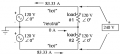
Hello I'm new to this site and have been learning from this site. Thanks, this place is great. I clearly have a fundamental misunderstanding that I would very much appretiate if someone could clarify. This picture is from this website on the topic of polyphase power systems, now this in an intermediate diagram eventually progressing to a 3 phase power system. What I don't understand is, assuming we're going with actual current flow, why the top generator wouldn't, for this specific moment in it's polarity, short to ground? Why would it go through the load when it has a clear path to ground. And for that matter why would the current after going through load #2 not also go down the neutral wire and short to ground?

I'm running on the assumption that electricity will always take the path of least resistance and also that electricity will always want to go to ground if it can.

One other quick thing, in the neutral wire, the loads are balanced so there is no current. Is that b/c all current by-passes it, or b/c the voltage force from the top generator and voltage force from the bottom generator butt heads in the neutral wire, creating an impasse?

Thanks very much in advance for any help.
 

WBahn

Joined Mar 31, 2012
32,829
First off, don't read more into that "path of least resistance" mantra than is there. At best, read it as current favor the path of least resistance meaning that more current will take that path than other paths having higher resistance (assuming the voltage drop across all paths are the same). In general,some current will flow in all available paths to some greater or lesser degree.

Make the circuit a DC circuit having two 12 V batteries connected in series. The have the combined 24 V applied to two 1 Ω resistors connected in series. What current will flow? 12 A.

What will be the voltage potential between the junction of the two batteries and the junction of the two resistors? 0 V.

So what will happen if you connect a wire between those two points? Nothing. There's no voltage across it and so no current will flow in it.

Notice that I haven't said one word about "ground".

Put the ground symbol anywhere you want on that diagram and you change absolutely nothing except the number we use when we talk about the voltage at a particular point in the circuit, since all the ground symbol does it specify which point in the circuit we choose to call zero volts. So saying something like all current want to go to ground becomes clearly meaningless.
 

Thread Starter

GW2500

Joined Feb 23, 2018
3
Thank you sir, I believe I understand what your saying about ground can often, or maybe always (?), be just a point of reference to measure voltage potential from. So if the ground was placed on positive voltage side of the top generator, during that moment in polarity, would that create a short to ground? And sorry just one more question. If there was a load imbalance, the difference of current would be carried in the neutral wire. Would that difference, of current, go to ground or back into the generator?
 

WBahn

Joined Mar 31, 2012
32,829
Thank you sir, I believe I understand what your saying about ground can often, or maybe always (?), be just a point of reference to measure voltage potential from. So if the ground was placed on positive voltage side of the top generator, during that moment in polarity, would that create a short to ground?
No. How can changing the label we associate with a node create a short in the circuit? Would calling your German Shepherd dog a Beagle change its breed?

And sorry just one more question. If there was a load imbalance, the difference of current would be carried in the neutral wire. Would that difference, of current, go to ground or back into the generator?
It has to go back to where it came from. In that diagram, the ground is connected at just one point, so NO current can flow to or from whatever that "ground" happens to be connected to. It will stay in the wire. IF the neutral wire were removed and IF the common point of the load were grounded and IF the common point of the generators were grounded, THEN current could flow through the "ground".

The use of the term "ground" is actually pretty sloppy in many cases. In some instances, possibly including this one, it means a physical connection to the Earth. In many other circuit diagrams it means nothing more than a convenient way to show a connection to a widely distributed node within the circuit in order to avoid cluttering the diagram. In those cases it should really be called a "common" and a slightly different symbol should be used, but that's not how things work in the real world because most people only need to talk about one or the other and so they use the "ground" symbol and name for both.
 
Top