Facebook
 Google
 GitHub
 Linkedin


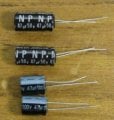
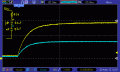
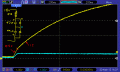
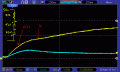
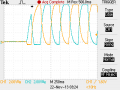
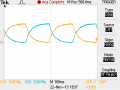
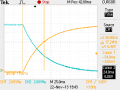
Yep, Ct depends on the cap's reversed diode (or zener) voltage vs the amplitude of the waveform.
But technically (ie with ideal polarised caps) the proper formula is Ct = C.
I know what real life tests do but I'm still very curious what a simulator shows. The simulator would need to model a value for the reverse zener voltage.
This reminds me of a recent thread where a nonpolarised cap was specced to be used in the feedback circuit of an audio amp chip. We were discussing whether that AC waveform needs a nonpolarised cap or if a standard polarised electro would do. Seeing that that signal is <=1v p/p it looks like any polarised electro should be fine?