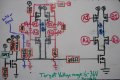
Duly noted! I need to figure the actual values for these components in more detail. I have downloaded some software that should help test it virtually. Here is the new diagram I have come up with. The base circuit toggles path 1 or path 2 and then he H-bridges toggle to reverse the motor(I have them all set to toggle on one signal, but it could be divided if someone needed that.
So the main circuitry is in black, and the control path for the H bridges is in red. Purple represents the control lead. The idea here is to toggle the whole thing high or low, but there's also an overvoltage circuit that when he zeners break down it opens the current to a resistive load parallel to the capacitor that serves to capacitively isolate the high and low sides to prevent current flow when not in use. So its like a resistive voltage dampening shunt. Does that make sense? I was thinking a capacitor with a low storage capacity but fast switching would be ideal. Basically like the type they already put on a lot of AC motors. Since its steady DC on the signal path, the capacitor won't let it just be a high resistance short, but it should bias in favor of whatever side is dominant right? Am I wording that correctly?
Without giving away too much. Its a permanent magnet brushless DC motor that can do limited stepper functions, servo functions, and general purpose uses. Its a true DC motor and requires an input very similar to a SPDT switch. In fact, that's how I know it works because I've run a prototype with manual switching. I'm currently creating a circuit for that output,, but it needs an H bridge on each outgoing line for reversing and programmed movement functions.
The circuit pictured here would be one of two that connect to the output end of the base circuit. I could just reverse the motor with a physical latching DPDT switch, but I want something that can react more quickly and reliably.
The description of operation exactly describes a four-wire stepper motor operation, as well as a phase-shifted synchronous motor. If it were powered by two sine waves 90 degrees out of phase it would exactly duplicate a "SloSyn" motor, which is a very useful product that has been around for several decades. Four-wire stepper motors have two coils that have their current reversed to produce rotating motion. They are very common in printers, and a vast array of other products.
So I can predict that the concept is valid and very useful indeed. But possibly not original enough to get a patent and license it for profit.
The description of operation exactly describes a four-wire stepper motor operation, as well as a phase-shifted synchronous motor. If it were powered by two sine waves 90 degrees out of phase it would exactly duplicate a "SloSyn" motor, which is a very useful product that has been around for several decades. Four-wire stepper motors have two coils that have their current reversed to produce rotating motion. They are very common in printers, and a vast array of other products.
So I can predict that the concept is valid and very useful indeed. But possibly not original enough to get a patent and license it for profit.
Those are all very interesting, but none of them are like what I am doing at all functionally. The current reversing in my motor is only for reversing.

 Facebook
 Google
 GitHub
 Linkedin