Polarised capactor with DC and superimposed AC.

Thread Starter

Dave Lowther

Joined Sep 8, 2016
332
I should know this but I don't, or have forgotten.
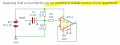
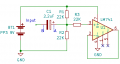
Supposing I had a circuit like this. I'm not intending to actually use this, it's just hypothetical:
1714931627617.png
If I applied an audio signal to the input, and there was no DC offset on the input signal, would the capacitor fail to work correctly if the peak input is more positive than the voltage on the + side of C1?
 

ronsimpson

Joined Oct 7, 2019
4,647
We don't know for certain, but the "input" should be at an average voltage of 0 and have a signal that is above and below ground.
The average of pint A is 4.5V or 1/2 of the 9V supply. Under normal conditions there will be 4.5V dc across the capacitor. The ac will flow through the cap and not be added to the 4.5V.

If the input voltage was 5V pk, or 10Vp-p the voltage on B will be centered on 4.5V and swing to -0.5 and +9.5. This will not damage the capacitor. It will distortion the amplifier.

Looks good.
 

Thread Starter

Dave Lowther

Joined Sep 8, 2016
332
Thanks for the reply Ron.
the "input" should be at an average voltage of 0
That helps me clarify my question. Perhaps I should have asked:
For audio frquencies, is it only the average voltage across the capacitor that matters with regard to not violating the rule about respecting the polarity of the capacitor? Obviously there's a sufficiently low subsonic frequency that might as well be DC and would damage the capacitor when the input went above the voltage of point A.
This question stems from a debate I'm having elsewhere. Although this specific aspect isn't being discussed there, it made me realise I didn't know the answer to my question above.
The amplifier clipping, or being damaged by excess voltage swings isn't really relevant, it's just the capacitor that I'm asking about.
 

crutschow

Joined Mar 14, 2008
38,322
If I applied an audio signal to the input, and there was no DC offset on the input signal, would the capacitor fail to work correctly if the peak input is more positive than the voltage on the + side of C1?
No, because the voltage on the plus side is following the input voltage, so will always be more positive on the capacitors plus side.

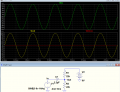
See LTspice sim below:
The output (yellow trace) goes above 9V, but the voltage across the capacitor (red trace) stays nearly constantly at the 4.5V bias voltage.
(I didn't show the op amp, since it's configured as a high impedance input follower so has no effect on the input waveform, although the op amp output will be clipped).

1714933395463.png
 

MisterBill2

Joined Jan 23, 2018
27,184
The connection will work very well if the audio signal is referenced to the system common (negative), because the positive side of the cap is connected to a point more positive.
 

Audioguru again

Joined Oct 21, 2019
6,826
Why are you using an antique opamp (the 741 opamp is 55 years old) is noisy, has a fairly low input resistance (300k minimum) and needs a high supply voltage (its specs are with a 30V supply)?

With a modern low noise opamp, its higher input resistance will allow 220k biasing resistors and a non-polar 0.22uF input film capacitor.
 

Thread Starter

Dave Lowther

Joined Sep 8, 2016
332
Why are you using an antique opamp
Thanks for your interest. I'm not intending to use it. My opening post contained:
1715353867872.png
There was a discussion elsewhere (not in this forum) where a lot of people thought that C1 had to be non-polarised, not because of audio quality considerations, but because of DC issues. Someone insisted that both ends of C1 were both connected to Gnd via some reistance and hence C1 had zero volts DC across it. I offered to build the above on a breadboard and measure the voltage across C1 with the input terminated to Gnd with 1K Ohm. That post ended the discussion without me getting a response to my offer.

With a modern low noise opamp, its higher input resistance will allow 220k biasing resistors and a non-polar 0.22uF input film capacitor.
Agreed. In the real world I use either LM4562s or NE5532s and tend to avoid electrolytics in the audio path, but I am aware of Douglas Self's work on analysing how electrolytics can be used in such cases without introducing distortion.
 

MisterBill2

Joined Jan 23, 2018
27,184
Consider that IF the input were from a low impedance dynamic microphone that even then the maximum possible DC voltage would be 4.5 volts, and that is not enough to cause a problem, unless perhaps the capacitor was only rated for 5 volts DC. Any other source, such as a tuner or a preamp, or a consumer tape deck, will probably have a series capacitor to the output to avoid damage from the unknown devices that sometimes get connected.
Certainly the comment about the 741 opamp was also correct.
 

crutschow

Joined Mar 14, 2008
38,322
I am aware of Douglas Self's work on analysing how electrolytics can be used in such cases without introducing distortion.
As long as the electrolytic has minimal AC voltage across it (as used for a DC block) then then the small current through it can't cause significant audible distortion due to any ESR, or variation of capacitance with voltage (except of course for the few audionuts who have that magical "golden ear").
 

MisterBill2

Joined Jan 23, 2018
27,184
Those folks are amazing!! They can sense a 1dB deviation from a totally flat frequency response and also clearly hear the 0.1% DISTORTION AFFECTING A SAXOPHONE SOLO.
Even more impressive is their ability to hear the difference in the sound between a"10 foot gold plated electro-less copper" speaker connection and one done with cheap #12 lamp cord also 10 feet long.
 

crutschow

Joined Mar 14, 2008
38,322
Those folks are amazing!!
Also can hear the difference in sound between a standard power cord and a super-duper, expensive, shielded, oxygen-free copper, power cord.
(Somehow the effect of all the romex cable carrying the power to the plug has no effect, only the last 6' of cord is important.)
 

Audioguru again

Joined Oct 21, 2019
6,826
I have liked wide bandwidth and low distortion all my 79 years old life. Therefore I hated AM radios, telephone audio and acid rock.
Sure I could hear when high audio frequency harmonics and voice consonants were missing and I could hear low level distortion, because I protected my hearing from guns and other loud noises.

I have normal for my age high frequencies hearing loss. My 10 years old hearing aids are now set to their maximum high frequencies boost before feedback so I am sorry to miss sounds above 10kHz.
 

MisterBill2

Joined Jan 23, 2018
27,184
A.G.s fortunate, others of us were not. Things happen that we certainly would rather not happen.
So not all of us are so fortunate as A.G.
But we carry on and do our best. And routinely are left out of things.
And while many make some effort for those folks who suffer from more visible damage, it seems that a lot of people will not do anything at all, such as speaking up a bit, for those folks whose damage is not so visible.
Do they really get their jollies off being just a bit inconsiderate?? Or are they just a bit lazy??
(Sorry about my tirade, folks, but AG just stepped on a sore point of mine.)
 
Last edited:

Audioguru again

Joined Oct 21, 2019
6,826
I am sorry for people born with poor hearing. Without my hearing aids, speech sounds only in vowels then people pity me.
My hearing aids allow me to hear the phone and smoke detectors ringing.
I am also sorry for all the guys who lost their hearing by being forced to go to war that I never experienced.
My government, unlike other governments, also helped me pay for my very expensive hearing aids.
 
Top