PNP BRT transistor - emitter grounded?

Thread Starter

Goxeman

Joined Feb 28, 2017
176

ericgibbs

Joined Jan 29, 2010
21,448
hi G,
The Collector of the PNP would be connected to a negative supply voltage, possibly via a resistor.
The Emitter would go to Ground which would be positive voltage from the power supply.
E
 

Thread Starter

Goxeman

Joined Feb 28, 2017
176
hi G,
The Collector of the PNP would be connected to a negative supply voltage, possibly via a resistor.
The Emitter would go to Ground which would be positive voltage from the power supply.
E
Thanks E from your answer,

Lets assume positive an theory case in which voltage is 3V and negative (ground) is 0V. Wouldnt it be standard that for a PNP transistor, the emitter is connected to the 3V, being the collector 3V when connecting the base to 0V to saturate the transistor? Besides the internal resistors would be current on the base and to guarantee that the transistor is cut-off when we are not supplying 0V to the base.

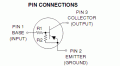
The exposed case would fit with the datasheet or your explanation in which the emitter is connected to 0V ground???
 

ericgibbs

Joined Jan 29, 2010
21,448
Hi Gox,
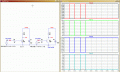
Does this LTS simulation, showing a PNP and NPN make it easier to follow.?
NOTE: the Voltage polarities on the Circuit and Plots
E
 

Attachments

Thread Starter

Goxeman

Joined Feb 28, 2017
176
I got my answer in another thread, as ericgibbs said, the emitter would be connected to VCC (3V) the positive of the power supply

https://forum.allaboutcircuits.com/...s-ground-in-pre-biased-pnp-transistor.145719/

What I just didnt understand why did ericgibbs say that the collector would be connected to a negative supply voltage, do you mean the base instead of the collector? The collector would be the OUT of the transistor to be connected to the positive of the load.

Thanks for reading
 

ericgibbs

Joined Jan 29, 2010
21,448
What I just didnt understand why did ericgibbs say that the collector would be connected to a negative supply voltage, do you mean the base instead of the collector? The collector would be the OUT of the transistor to be connected to the positive of the load.
hi,
Have you taken the time to study the plots I have just posted.?
When referring to transistors it is important that you define NPN or PNP

E
This is what I actually said:
The Collector of the PNP would be connected to a negative supply voltage, possibly via a resistor.
The Emitter would go to Ground which would be positive voltage from the power supply.
 
Last edited:

Thread Starter

Goxeman

Joined Feb 28, 2017
176
hi,
Have you taken the time to study the plots I have just posted.?
When referring to transistors it is important that you define NPN or PNP

E
I was posting at the time that you did so the thread wasnt refresed. Here we are just talking about PNP transistor as the title says

After checking your plots, I totally understand the NPN transistor part but not the PNP part. In the PNP part you connect Vc2 load negative directly to the supply negative through a resistor (until here agreed), then the positive of the supply (+10VDC) to the emitter of the PNP transistor (this also agreed) but why do you show then in blue also Gnd Ref 0V? Also agree that to activate the transistor you supply a lower voltage than +10VDC to the base of the PNP transistor

Thanks for reading
 

ericgibbs

Joined Jan 29, 2010
21,448
hi,
In LTSpice it is required that a Ref Node, [the triangle symbol] which the simulation uses as a Common Reference point/node.

Confusion sometimes comes in understanding what is meant by Ground, it does not mean an Earth connection.
Most people refer to Ground as the Common 0V line of the circuits power supply lines.

Consider you were using a test meter to check the voltages on a circuit, you would connect one lead to the 0V Common of the circuit supply and measure other points on the circuit using the other probe on your test meter, so all the measurements you take are referenced to a Common point/node.

OK.?

E
 

Thread Starter

Goxeman

Joined Feb 28, 2017
176
Thank you ericgibbs, as you say that was my confusion.

As you say I was considering ground as earth/negative/common negative point of 0V of reference of the whole circuit, but for the datasheet ground means the common reference point which in this case is the positive of the supply.

One way or another I think that it would be even easier even if in the datasheet they skept the word "ground"
 

ericgibbs

Joined Jan 29, 2010
21,448
One way or another I think that it would be even easier even if in the datasheet they skept the word "ground
hi,
Another way to appreciate the 'Ground' term, is on a car.
The Negative end of the battery is connected to the car chassis, the chassis is then referred to as Ground, which it is not.
Its the batteries Common negative supply.

E
 

GopherT

Joined Nov 23, 2012
8,009
The Negative end of the battery is connected to the car chassis, the chassis is then referred to as Ground, which it is not.
"which it is not"? Not a chassis ground? It certainly is a chassis ground - at least it is in every car I have ever worked on. The negative battery terminal is conveniently bolted to the engine block and one or more grounding straps are connected from the engine to the chassis.
 

GopherT

Joined Nov 23, 2012
8,009
hi GT,
The problem the TS had, was he thought 'Ground' on his diagram meant 'Earth'.

E
No, you still misunderstand him (or you are having trouble clearly communicating if you do understand him). The OP thought the word "ground" in the datasheet meant 0V and that the emitter on the described part (a PNP device per the datasheet) was to be connected To 0V.

He now understands that the datasheet verbiage was likely a cut-and-paste error or would have better communicated the design if the word "ground" is replaced by +3v (in his application).
 

ericgibbs

Joined Jan 29, 2010
21,448
This what the TS said:
As you say I was considering ground as earth/negative/common negative point of 0V of reference of the whole circuit, but for the datasheet ground means the common reference point which in this case is the positive of the supply.

I would agree with you GT, the terms Common, Ground and Earth can be confusing to 'students'.

Some of the poorly written documentation on the web and elsewhere doesn't help.

A005.gif
 

GopherT

Joined Nov 23, 2012
8,009
This what the TS said:
As you say I was considering ground as earth/negative/common negative point of 0V of reference of the whole circuit, but for the datasheet ground means the common reference point which in this case is the positive of the supply.

I would agree with you GT, the terms Common, Ground and Earth can be confusing to 'students'.

Some of the poorly written documentation on the web and elsewhere doesn't help.

View attachment 146963
Yes, poorly written documentation was the whole problem -that was the OP's concern. It would be much better if you would read the documents and attempt to clarify in the future rather than adding confusion to the conversation and introducing answers about, for example, NPN Transistors (your post) when the OP was clearly asking about PNP (see, it is there in the title).
 
Top