What do you want to use it for? Is it for general purpose and heavy duty soldering, constructing and modifying through-hole circuit boards, surface-mount rework or something else? Knowing that would make it much easier to recommend an appropriate tool.
What do you want to use it for? Is it for general purpose and heavy duty soldering, constructing and modifying through-hole circuit boards, surface-mount rework or something else? Knowing that would make it much easier to recommend an appropriate tool.
I have an Antex 660C in my home workshop, but the one I use when mobile is a FNIRSI HS-01, which is USB PD powered. Chances are you have a 65W USB PD somewhere so a cheap HS-01 from Aliexpress is an option. But TBH any temperature controlled soldering iron will do for basic electronics work, and it's tips. tip care, and getting old style leaded solder for rework that makes the biggest difference. And I wouldn't be without my Engineer SS-02 solder sucker either as it's great for most through hole.
I want the complete Kit. You know the accessories and all... like the sleeve cutter and so many colourful tools which I have once glanced in my friends Kit bag. Sorry only know the colours of that but not the names...
Forget about kits. Pick and choose some good components.
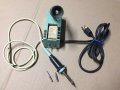
I'd invest in one from a known brand (I use Weller mostly) and don't buy their cheapest model (I use a Weller TCP) because you'll be using it for a long time. Weller has some irons that look like they'd be crappy and I've heard that the current tips are also crappy.
This model uses ferromagnetic tips that set the temperature to 600/700/800F. The tips are iron coated for long life. I used a conical point tip for about 50 years before it needed to be replaced. Also had to replace the heater at around the same time.
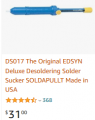
To remove solder, I use an Edsyn Soldapullt:
You can get knockoffs cheaper, but I can't vouch for their effectiveness.
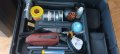
Here is my mobile kit. HS-01 iron, 65W mains PSU and 20W battery bank, iron stand plus water bottle, flux, braid, various tweezers, six different kinds of solder (leaded, lead free, high silver content for jewellery, ChipQuik), various tip cleaners, brown bag contains good solder sucker, different iron tips, and syringe of surface mount flux, and the pot with the yellow top is an old fish food container with a hole down which I drop dead components, cut off through hole leads, and boogers of unwanted solder. Elsewhere in the box is a home made bench supply with every power adapter you can imagine, a GM328 component tester, a DSO150 scope, a thermal camera, a cheap and nasty signal generator, a tiny audio amp, and a 3D printed box holding notebook speakers. It's basically electronics trouble shooting and fixing in one DeWalt TSTAK box. The thermal camera probably represents 75% of the purchase price of the whole lot.
Anything by Weller or Hakko should be good and not too expensive (avoid the cheapest models of any brand). The Hakko FX-888D iron is what I use and it works well, then the no-name 858D hot air station works good as well. If your budget is low, you can get the all-in-one no-name like the 852D+ or 862D+ and those will work OK, not top shelf but can get the job done. Don't forget that you're also going to need supplies to be successful. Good solder, flux, brush, isopropyl alcohol to clean up flux, solder wick, etc.. You'll also likely want a few different tips of different sizes and shape for your iron, and non-magnetic tweezers. At some point you may also want magnification if you're working on small parts.
I had a customer trying to take measurements with a Pulsivo multi-meter, it was not at all accurate. There are some decent inexpensive multi meters, but I would not personally buy a Pulsivo.
Accuracy can be important but it often isn't. The meter that's by my hand when doing diagnostics is an Aliexpress Maxrieny one because it's "auto everything" so turns on ready to do continuity or voltage, and also AC voltage detection. It doesn't do current (which makes it safer on the bench TBH) and it doesn't have diode mode, so I also need another meter, but I use the cheapo one 99% of the time.
I don't think I'd generally buy a big kit of parts and I'd instead just buy stuff as I find I need it. Everyone's use case is different (and I'm biased towards speed of use and portability) so there is no one size fits all.
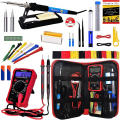
The holder in that kit is retarded. Contrast it with what is on the Weller I posted. The latter makes it easier to grab the iron and start soldering. With the one you showed, you'd have to contort your arm to bring the iron out of the holder in a position you could actually use it. It also looks lightweight enough that it's going to move around. That's not something you want with something that can burn you badly in very little time. I can remove my iron from the holder without even looking at it. You couldn't do that with the one you posted.
Why are there so many cable ties? I'd much rather have something that I'm more likely to need (e.g. wire cutters/strippers, needlenose pliers, heat sink tweezers)
Accuracy can be important but it often isn't. The meter that's by my hand when doing diagnostics is an Aliexpress Maxrieny one because it's "auto everything" so turns on ready to do continuity or voltage, and also AC voltage detection. It doesn't do current (which makes it safer on the bench TBH) and it doesn't have diode mode, so I also need another meter, but I use the cheapo one 99% of the time.
I don't think I'd generally buy a big kit of parts and I'd instead just buy stuff as I find I need it. Everyone's use case is different (and I'm biased towards speed of use and portability) so there is no one size fits all.
Regarding accuracy; in my own experience, if I'm working on low voltage electronics I like accuracy. Especially if you're working with 3.3V or lower voltage parts. If the reading is off a little bit, it can send you down a rabbit hole of chasing the wrong problem. Or creating a problem. It doesn't need to be 5-digit accurate, but being off by 0.1V can be significant. If you just want to know if there's enough power to light an LED or trip a relay then sure, ballpark is fine.

 Facebook
 Google
 GitHub
 Linkedin