HP... thanks for the comment... whatever it meant... but could you please "pedestrianize" a bit with me, and elaborate on the meaning of the acronyms that you've just used?
Good Lord... I would've never figured that one out by myself... think of it as a foreign brain trying to figure out the English acronym for "Objetos del Cinturón de Kuiper" (OdCdK .... wtf? ) ... thanks for the mind-flashlight.
HP... thanks for the comment... whatever it meant... but could you please "pedestrianize" a bit with me, and elaborate on the meaning of the acronyms that you've just used?
Merely expression of my oh-so-humble opinion that scientific discovery and cataloguing of Kuiper belt objects can't compare with Nibiru/PX 'lore' in the ways of sensation, hysteria and utter nonsense (i.e. 'fun')...
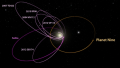
... "it is now harder to imagine our solar system without a Planet Nine than with one."
But the reason it may not yet have been found is due to that same distance.
While searching for the mysterious Planet X that some astronomers believe lurks on the edge of our solar system, researchers instead found an extremely distant object they dubbed "the Goblin." And this object provides compelling evidence for the existence of Planet X.
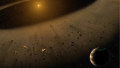
Astronomers just found an object that lies 140 astronomical units (AU) from the sun. That's 140 times the Earth-sun distance, which is about 93 million miles. In case you want some more perspective: Pluto orbits the sun at an average distance of about 39.5 AU.
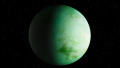
This rendering shows the distant view from teh hypothesized Planet Nine back toward the sun. The planet is thought to be gaseous, similar to Uranus and Neptune. Caltech / R. Hurt (IPAC)
Sigh... Inasmuch as discovery of KBOs is hardly 'novel', I 'spose' they must 'spice it up' a bit for the rising generations -- Alas, poor Science! I knew it well...
A PLANET NINE expert has astonishingly revealed to know the orbit of the elusive Planet 9 despite there being no known observations of the hypothesised planet.
The possible existence of Planet Nine and its impact on distant objects in the solar system has fascinated researchers for some time. But a new study suggests that the theoretical object may not be a giant planet hiding behind Neptune — but rather a primordial black hole
... the claim looks increasingly shaky, after a team of astronomers reported last week that the orbits of a handful of distant lumps of rock are not bunched together by the gravity of “Planet Nine,” as its proponents believe, but only seem clustered because that’s where telescopes happened to be looking.
... some astronomers have suggested that it doesn’t exist, and that the clustering of objects noted by Brown and Batygin is the result of “observation bias” — since fewer than a dozen objects have been seen, their clustering might be a statistical fluke that wouldn’t be seen among the hundreds thought to exist.
For their latest study, however, Brown and Batygin have added several recent observations of objects, and they’ve calculated that the clustering is almost certainly real — in fact, they found there is only a 0.4 percent chance that it’s a fluke.
According to the team, the planet would be around 1.5-3 times the mass of the Earth and on an inclined orbit of around 30 degrees. The team suggests where to look next for evidence of the planet's existence.
Such is the conclusion of two scientists who studied the effect the wider Milky Way galaxy would have on objects in the outer edges of the solar system if gravity is described by a theory known as Modified Newtonian Dynamics (MOND).

 Facebook
 Google
 GitHub
 Linkedin