PIE is not PI

Thread Starter

BestFriend

Joined Sep 22, 2010
31
What is this obsession with Plank's Lenght anyway? And how did you end up with the conclusion that a circle with 8 point in diameter will have 26 in its perimeter. That is wrong and contradicts the whole pi-irrational theory. You can't measure exactly the number of units that fit in the perimeter, for a given diameter.

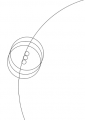
What you can do in order to approximate π better, is to analyze the perimeter in small dots, much smaller than the circles that you drew (say a quarter or a fifth in size) and even then, you should treat them as you did in your second gif. That is, make the diameter start and begin from their centers, not their edges.
Well, because Planck's length is the smallest diameter for a point, anything smaller than that means that the point does not make sense. It is equal to 1.616252(81)×10\(^{-35}\) meters. That's very very very very... small.

If we zoom into a circle, we will see that it is not perfect - like using a simple image editor try zooming in and you'll see that the distance between two opposite points are not consistent. But that is because it is constrained by the number of pixels in our LCD screen. In physics, the constraint is the Planck's length. If we even try to zoom past Planck's length, then who knows what it would look like. Maybe it'll distort the circle in such a way that it's not a circle any more. I don't really know...

Regarding the number 26, that's the number of points I can place in that circle without it overlapping. I tried to squeeze more but the imaginary midpoints won't intersect with any point in the circumference of the larger circle.

The calculation of pie is based on two numbers - circumference and diameter. I have it here in my circle. And pie turns out to be 3.25 for my circle, which is weird. But the findings does support the law of uncertainty.
 
Last edited:

Thread Starter

BestFriend

Joined Sep 22, 2010
31
I therefore conclude that observable mathematics in our universe is bounded. Pie in the smallest scale becomes a rational number. We start to be able to count the number of points along the circumference. That has always been the greatest obstacle to its irrationality - since a circle's circumference is thought to contain infinite number of points. This phenomenon even sometimes appear in a normal scale, like a beaded bracelet that forms a circle.

Now, let's move on to infinity. But first, let's meet Georg Cantor. What can you guys share to me about his work, especially regarding infinity?
 
Last edited:

Markd77

Joined Sep 7, 2009
2,806
So how many digits of Pi would you propose using for a circle of diameter 1 meter?
How many for a circle 100 meters in diameter?
How many for a circle a light year in diameter?
 

Thread Starter

BestFriend

Joined Sep 22, 2010
31
So how many digits of Pi would you propose using for a circle of diameter 1 meter?
How many for a circle 100 meters in diameter?
How many for a circle a light year in diameter?
Well, mathematicians have already created the concept of significant numbers. So we simply round the decimal point off depending on the context it is being used in.
 

Wendy

Joined Mar 24, 2008
23,809
You are trying to force concepts together that don't fit, which equals wrong thinking. Pi is as much a mathematical concept as a number, rounding does not apply except for engineering use.

Plank's Constant uses pi to define Dirac's Constant, but to use Plank's Constant to limit pi is to wag the dog with its tail, it is backwards.

You are making assumptions and trying to force the universe to fit your mold, it doesn't work that way. From the math point of view we have several folks that can argue better than I.

Pi is what it is, it need not change to fit your definitions, it has been defined very well already.
 

Thread Starter

BestFriend

Joined Sep 22, 2010
31
You are trying to force concepts together that don't fit, which equals wrong thinking. Pi is as much a mathematical concept as a number, rounding does not apply except for engineering use.

Plank's Constant uses pi to define Dirac's Constant, but to use Plank's Constant to limit pi is to wag the dog with its tail, it is backwards.

You are making assumptions and trying to force the universe to fit your mold, it doesn't work that way. From the math point of view we have several folks that can argue better than I.

Pi is what it is, it need not change to fit your definitions, it has been defined very well already.
Well, based on the image above that we both can observe, and applying the formula for pie which is circumference over diameter - then we eventually get 3.25. Now, I didn't make Pie's formula up nor did I even change it. I simply calculated it and it turned out that in smallest possible scale, Pie is a rational number.
 

Georacer

Joined Nov 25, 2009
5,182
When Eucledes formed the pi formula as circumference divided by diameter, he was refering the the Eucledean geometry, that is ideal and imaginary. And indeed, the circle is an ideal shape.

If, as you say, you try to bring the scale down to the physical minimum, that minimun refers to a real, physical world. But you spoil that physical "purity" by introducing the circle with dimensions smaller than that physical minimum. For example, how will you express the 1/50th of the circumference, since by your metric scale, that number is too small to exist.

The ideal circle that you draw, just doesn't match with the "physical" distances that you take as minimum. The circle has in it quantities that are even smaller, destroying that minimum barrier that you construct.
 

beenthere

Joined Apr 20, 2004
15,819
This discussion has gone off the rails into sophistry. I'll leave it open for the time being, but endless argument really accomplishes little but taking up time.
 

Thread Starter

BestFriend

Joined Sep 22, 2010
31
When Eucledes formed the pi formula as circumference divided by diameter, he was refering the the Eucledean geometry, that is ideal and imaginary. And indeed, the circle is an ideal shape.

If, as you say, you try to bring the scale down to the physical minimum, that minimun refers to a real, physical world. But you spoil that physical "purity" by introducing the circle with dimensions smaller than that physical minimum. For example, how will you express the 1/50th of the circumference, since by your metric scale, that number is too small to exist.

The ideal circle that you draw, just doesn't match with the "physical" distances that you take as minimum. The circle has in it quantities that are even smaller, destroying that minimum barrier that you construct.
Exactly my point! The reason why I brought the calculation of pie down to the physical finite world is because we actually use pie not in its irrational state. In normal calculations, by rounding pie off to finite digits, we actually transform it into a rational number.

For representation purposes, we've simply enlarged it - and thus introduced dots like the midpoint (which does not actually exist so feel free to remove it from the image - which you can). You can even scale it down if you want. But it would remain that in the minimum size, (or the physical wall, floor or whatever we want to call it), pie would be a rational number defined by its formula.

Now, if we increase the size of the circle and the number of points that can fit inside the circumference, you will see that we actually will approach the 'accepted' pie constant. So don't fret! Like Quantum mechanics, it's completely compatible with what is observable.
 

Thread Starter

BestFriend

Joined Sep 22, 2010
31
This discussion has gone off the rails into sophistry. I'll leave it open for the time being, but endless argument really accomplishes little but taking up time.
Arguments and discussions broaden the mind. Without conversation, and input from peers, I wouldn't even think of these examples. And I believe others won't even think of counter-arguments, flaws or examples.
 

Kermit2

Joined Feb 5, 2010
4,159
In string theory, then later in M theory. The multiple dimensions they mention, 11 I think it was, have differing direction in which they "expand". Three of the dimensions, mirror our spatial dimensions, but intstead of expanding outwardly, these dimensions have an OUTERMOST limit of plank length, and expand inwardly(get smaller) toward infinity. Meaning they have the largest dimension limit at Planks length and all dimensions DOWN in size from that(to infinitely small). They too are spatial dimensions in which we live(according to theory), they are just expanded in the negative direction to the ones we consider to be x,y and z spatial dimensions. Knowing this might be a fact(its a theory ya know) how would you explain that with every movement we make, we traverse an infinite amount of 'negative distance' by passing through/over/in and out of/ these small spatial negative dimensions?
 

Thread Starter

BestFriend

Joined Sep 22, 2010
31
In string theory, then later in M theory. The multiple dimensions they mention, 11 I think it was, have differing direction in which they "expand". Three of the dimensions, mirror our spatial dimensions, but intstead of expanding outwardly, these dimensions have an OUTERMOST limit of plank length, and expand inwardly(get smaller) toward infinity. Meaning they have the largest dimension limit at Planks length and all dimensions DOWN in size from that(to infinitely small). They too are spatial dimensions in which we live(according to theory), they are just expanded in the negative direction to the ones we consider to be x,y and z spatial dimensions. Knowing this might be a fact(its a theory ya know) how would you explain that with every movement we make, we traverse an infinite amount of 'negative distance' by passing through/over/in and out of/ these small spatial negative dimensions?
Hmmm good question. I honestly don't have the answer as I don't want to pretend to understand the string theory (still a theory though but does support some observations, so it is good to consider it).

However, instead of actually dealing with some stuff that we can't observe. Why not just replicate the minimum boundary in a larger scale? Say do the following:

WARNING: This activity requires active imagination. Not suitable for young minds. Parental Guidance is advised.

Experiment A
1. Get lots of coins (any coin will do but make sure they're of the same size) and pretend it is a point.
2. Then try to make a larger circle using the coins. Make sure that each coin is equidistant from the center. This will satisfy the definition of a circle.
3. Count the number of coins that make up the circumference.
4. Then using more coins, line it up so that you can measure the diameter of the large circle using number coins as the basic unit of measurement.
5. Note all your observations and divide the number of coins for circumference over the diameter to get a ratio.

Experiment B
1. Repeat 'Experiment A' but add more coins and make a larger circle.
2. Repeat this step until you get probably five or more ratios.

Questions:
1. What do you observe from the ratio as the circle becomes larger and larger?
2. What delicious constant does the ratio approaches when enlarging the circle? (*hint: A three letter word that starts with a 'P' and ends with 'E' which has 'I' in the middle)

Bonus assignment: Experiment C
1. Repeat experiment A but use exactly 22 coins for the circumference.
2. Delight yourself that your ratio will be 22/7! Close enough to the irrational Pie constant but actually exceeds it.
3. Now try using 355 coins! Bet you'll get 113 coins for a diameter.
 
Last edited:

beenthere

Joined Apr 20, 2004
15,819
This has become rather tedious. I believe the OP can keep this up forever by "cleverly" choosing to argue about a number - "PIE" - and sucker the membership into arguing about a real relationship - PI (∏).

A pie is a confection usually containing fruit inside a pastry crust. Pi is the relationship between a circle's circumference and its diameter.

Or perhaps the OP has some valid reason for choosing to use a deliberate misspelling of the Greek letter ∏?
 

Thread Starter

BestFriend

Joined Sep 22, 2010
31
This has become rather tedious. I believe the OP can keep this up forever by "cleverly" choosing to argue about a number - "PIE" - and sucker the membership into arguing about a real relationship - PI (∏).

A pie is a confection usually containing fruit inside a pastry crust. Pi is the relationship between a circle's circumference and its diameter.

Or perhaps the OP has some valid reason for choosing to use a deliberate misspelling of the Greek letter ∏?
haha finally! Someone spotted my deliberate injected flaw. Well done sir! Well done!
 

Thread Starter

BestFriend

Joined Sep 22, 2010
31
As for the reason in deliberately misspelling it, is strictly for personal amusement. A sense of humor in a heated discussion is a must -- like the cosmological constant introduce by Einstein.
 

retched

Joined Dec 5, 2009
5,207
Ok, about you coin in a circle thing.. SAME PROBLEM.

put you coins in a circle Now, wrap a string around the big coin circle.

Measure the coins in the same style you have been doing it, and then measure the string.

What is bigger?

Maybe you should stick with baking pie.

You are not thinking outside of the box. You are thinking IN THE WRONG BOX. Plain and simple.

Your measurements are flawed because your dots that make up your circle are supposted to TOUCH. You are using the center dot as the planck, but when you measure, you are using the outer circle, not the dot.

Your outer circle EXCEEDS the circles boundry, thereby making ANOTHER LARGER CIRCLE.

This is how you should have been placing your "dots" then ignored the outer ring when doing your measurement:


Attachments

Last edited:

Wendy

Joined Mar 24, 2008
23,809
As for the reason in deliberately misspelling it, is strictly for personal amusement. A sense of humor in a heated discussion is a must -- like the cosmological constant introduce by Einstein.
Not really, you truly haven't impressed anyone. Quite the contrary actually. It is just more of the same kind of nonsense you are inflicting.

Just curious, do you have any interest in electronics? Or is this a new forum you just got around to visiting until you get bored and move on?
 

retched

Joined Dec 5, 2009
5,207
Im guessing its the "look how I disproved PIE" thing and he bounces from forum to forum until someone believes him.

Just because you suck at math, and Einstein flunked math, doesn't make you the same.

The thing was, Einstein didn't do his work in his math class.. Thats why he failed.

You are failing because your wrong.
 

Thread Starter

BestFriend

Joined Sep 22, 2010
31
Ok, about you coin in a circle thing.. SAME PROBLEM.

put you coins in a circle Now, wrap a string around the big coin circle.

Measure the coins in the same style you have been doing it, and then measure the string.

What is bigger?

Maybe you should stick with baking pie.

You are not thinking outside of the box. You are thinking IN THE WRONG BOX. Plain and simple.

Your measurements are flawed because your dots that make up your circle are supposted to TOUCH. You are using the center dot as the planck, but when you measure, you are using the outer circle, not the dot.

Your outer circle EXCEEDS the circles boundry, thereby making ANOTHER LARGER CIRCLE.

This is how you should have been placing your "dots" then ignored the outer ring when doing your measurement:

Nope, the attached image would not work. Since the small circle itself represents the point. I simply added the point in the middle to show the center position of the point - just as you showed what I should be doing in your first correction. Please disregard the dot in the center of the small circle.
 

Thread Starter

BestFriend

Joined Sep 22, 2010
31
Im guessing its the "look how I disproved PIE" thing and he bounces from forum to forum until someone believes him.

Just because you suck at math, and Einstein flunked math, doesn't make you the same.

The thing was, Einstein didn't do his work in his math class.. Thats why he failed.

You are failing because your wrong.
Dude, take it easy and I didn't disprove pie or pi. Please reread every post of mine and you will never find that statement. And please, don't make it personal. I posted this under the forum section which states "Abstract Math" and this is I believe a forum for discussion. I actually stumbled upon this while Google-ing about space-time equation.

Regarding your bouncing, I posted this on another forum as well, but the demographics there are mainly gamers and my friends - but are simply not that interested in math. I was hoping to get some sensible discussion here, and I did get some interesting feedback... but well, I'm getting a feeling that I'm being un-welcomed here and castrated. Anyway, just say the word, and I'll be off.
 
Top