Facebook
 Google
 GitHub
 Linkedin
Well, because Planck's length is the smallest diameter for a point, anything smaller than that means that the point does not make sense. It is equal to 1.616252(81)×10\(^{-35}\) meters. That's very very very very... small.What is this obsession with Plank's Lenght anyway? And how did you end up with the conclusion that a circle with 8 point in diameter will have 26 in its perimeter. That is wrong and contradicts the whole pi-irrational theory. You can't measure exactly the number of units that fit in the perimeter, for a given diameter.
What you can do in order to approximate π better, is to analyze the perimeter in small dots, much smaller than the circles that you drew (say a quarter or a fifth in size) and even then, you should treat them as you did in your second gif. That is, make the diameter start and begin from their centers, not their edges.
If we zoom into a circle, we will see that it is not perfect - like using a simple image editor try zooming in and you'll see that the distance between two opposite points are not consistent. But that is because it is constrained by the number of pixels in our LCD screen. In physics, the constraint is the Planck's length. If we even try to zoom past Planck's length, then who knows what it would look like. Maybe it'll distort the circle in such a way that it's not a circle any more. I don't really know...
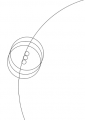
Regarding the number 26, that's the number of points I can place in that circle without it overlapping. I tried to squeeze more but the imaginary midpoints won't intersect with any point in the circumference of the larger circle.
The calculation of pie is based on two numbers - circumference and diameter. I have it here in my circle. And pie turns out to be 3.25 for my circle, which is weird. But the findings does support the law of uncertainty.
Last edited: