Physics domain analysis of Voltage drop in series resistor ?

Status
Not open for further replies.

Thread Starter

usmansa1

Joined Jan 22, 2017
40
Hi All,

I apologize if its a very basic question but this is related to my quest to know the things deeply.

The main question or objective to ask this question is to understand what is actually happening in a circuit with one resistor and how the voltage drop happened across resistor. I just need some help from expert like you to please read this and let me know if this is exactly what is happening in the circuit.

I generated a test circuit as mentioned below :-
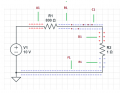
1688009007827.png

In the above test circuit we have two resistors, one is 800 ohm and the other resistor is 1 ohm, basically one ohm resistor is connected to simulate the behaviour of load in the circuit. I have also labelled the circuit diagram with A1, B1, C1, D1 and E1 etc so it will be easy for me to reference the places with charge accumulations in the figure. The main objective of this analysis is to study how the voltage is dropped against a resistor.

As per my analysis when we turned on the battery the charge will start accumulating at point A1 and B1, since A1 is close to the positive terminal of the battery therefore more positive charges will start accumulating at A1 and more negative charges are accumulated at B1, there are some positive charges are also present at B1 but most of the charge accumulation is negative and I am also concerned about accumulated charge impact therefore only negative charges are drawn, similar case happened with R2 where charges are accumulated across resistor terminal in the same way as happened in R1.

The main analysis

Negative charge accumulation at B1 and C1 exerts coulomb force (which is repulsion for negative charges) to negative charges at D1, E1 and F1. Let's call this force F2. Force generated by the battery electric field is F1. This is a non-coulomb force and this non-coulomb force is actually the main driving force of the circuit.

The force experienced by the electron at E1 is equal to F1 - F2 and this will be the cause of potential drop at R2 and this potential drop is experienced by the load which is in this case R1.
 

WBahn

Joined Mar 31, 2012
32,703
How can it be a "non-coulomb force" if it is due to a static electric field, which is nothing more than a mathematical way of describing the effects of coulomb forces?

If you want to look at things with a "physics domain analysis", then you need to very carefully describe the charge distributions thoughout the space of interest, including inside materials, on the surface of materials, specifically addressing boundary conditions, and outside of materials. This includes conductors, resistors, and your power source. You can handwave some of it away and use qualitative arguments for quite a bit of it,

Your analysis doesn't make sense. You are sayiong that F2 is a force on negative charges at three different places. Then you are saying that a force on an electron at one particular place somehow causes the potential difference between two places.

You say that F1 is the the force on a bunch of electrons from the battery's electric field. If we break the wire some place, then there would be no charge accumulation to yield your force F2, making F1 an unbalanced force and, by your reasoning, result in a potential drop across R2, despite the circuit not being closed and no current flowing in it.
 

Thread Starter

usmansa1

Joined Jan 22, 2017
40
Hey mate i understand your concern but its just an over simplified version as i am at basic level, and I may not be an expert level of which you are talking about so I apologize if my question creates any mis-understanding. I know the battery force may also be coulomb force but i thought from a general perspective to differentiate between forces applied by the battery and forces due to accumulation of -ive charges, Moreover F2 is considered as general force which is due to accumulation of charges due to presence of resistor, not necessarily at three different places. When i asked for one electron i was just taking reference, lets say if we connect something, like any load between D1 and E1 then what voltage would be experienced at that load. Voltage can be translated into force by using the electric field, so in other words what force is being experienced at that place, and why we experienced such a weak force in the presence of resistor ? and my analysis is this because the accumulation of charges near resistor R1 will also generate the force that is against the electric field of the battery. That is what I am asking, if this is not right i am more than glad to learn what is right infect that is why i posted it here to get the right definition. please let me know what you think now ? also i dont intend to take it to deep quantum physics level, lets keep it to general physics level
 

Ya’akov

Joined Jan 27, 2019
10,226
A problem you are going to have is that you can’t pick and choose the physical aspects of the system you happen to be interested in. If you want to simplify you are going to have to accept the error that goes along with that.

Electron flow is only part of the picture and may be considered an effect of the actions of the E and B fields in the space around the conductors as much as it is a cause. If you really want to understand deeply then you are going to have to learn about some very inconvenient and non-mechanical things that don’t follow the rules of everyday physics.

It a water analogy for electricity was a deep one, you might be able to go about the analysis the way you are attempting, but it’s not. It would be like trying to learn a language and insisting you want a simplified version—vocabulary only—but you still want to understand what are objects and subjects in a sentence.

You can’t even describe the behavior of the electric circuit accurately without the parts you are trying to leave out.

I would highly recommend you watch the physics lectures of Walter Lewin on YouTube. They include the MIT 802.x Electricity and Magnetism lectures, complete. There is a lot of math but it isn’t required to learn the concepts, you can gloss over the parts you can’t follow as they are separated from the general discussion.

All of the lectures (801.X Classical Mechanics, as well as the 802.X) are excellent with very good demos but for e-mag you can start with the lecture below. I think it will help you pose answerable questions that might remain after you’ve audited the class.


When it comes to highly technical topics like this one, we are often at a loss as neophytes when trying to form questions that make sense. This is a general problem. To “simplify” a system it is really necessary to have an understanding of the complex version first. Attempts to create a meaningful simple model fail because we don’t know which parts are important and which are superfluous.

This just makes sense, could you tell me, without being an expert mechanic, which parts I could pull off a car’s engine that would still allow it to run even if with reduced capability? Sure, you could make a reasonable guess that really big hoses and wires are probably essential, and you‘d be right more often than not. But all the other hoses and wires look similar, and some tiny one is as likely to be critical as completely accessory.

An inexpertly “simplified” engine won’t just be less efficient or powerful, it simply won’t run. I hope you understand my point and your desire to know things deeply will motivate you to watch the lectures and then return to your own explorations which are definitely worthwhile if you really want to fully grasp things.

Good luck.
 

WBahn

Joined Mar 31, 2012
32,703
I ran across this resource, which might be useful for you.

https://www.egr.msu.edu/emrg/sites/default/files/content/module5_nonideal_behavior.pdf

I don't know where your math lies, but this looks like it does a pretty good job of walking through the development and reasoning step-by-step. Even if you don't want to slog through the math, it should give you some insight into what you are trying to explore. You might look at the prior modules, as well, if you can track them down (probably not too hard).

Your diagram and descriptions appear to assume that nothing is going on inside the resistors and that everything is because of some presumed charges that are accumulating on the wires between them. But the voltage drop is almost entirely occurring WITHIN the resistors. The electric fields in/near the wires are exceptionally weak. The better the conductivity of the wire, the weaker the e-fields. After all, voltage drop is the integration of the e-field over a path and the voltage drop across any one of the wires is extremely low (zero in the limit of perfect conductors). Within the resistors, on the other hand, there is a continuous voltage drop from one side to the other, implying that there is a strong enough electric field to result in that voltage drop along the length of the resistor.
 

MrChips

Joined Oct 2, 2009
34,628
Your analysis is flawed because there is no charge accumulation.
Charge flow is constant throughout the entire loop.
Q = I X t

Current is a function of resistance.
I = V / R

If we increase Rtotal, the current I decreases. But the current through R1 is still the same as the current through R2.

In order to reconcile these two statements, the voltage across R1 must be different from the voltage across R2 if R1 is different from R2.
 

LvW

Joined Jun 13, 2013
1,995
Perhaps my short contribution can at least partially answer your question.

* Let's start with a resistor connected to a DC voltage source. The electric field generated by the source concentrates in the conducting material and causes a force on the free electrons, which leads to the phenomenon we call "current".

* Now we mentally replace the resistor by a potentiometer with a tap. Because of the relation "voltage=E-field * length" we get two partial voltages left and right of the tap, which together again result in the source voltage (shorter length gives smaller voltage according to a smaller resistance).

* This situation does not change if we interpret both parts of the potentiometer as two separate resistors connected by an "ideal" conducting material (piece of wire).

* Fazit: In calculations we assume simplified that the current going through two resistors would "generate" corresponding voltages (V=I*R). However, physically this is wrong.
 
Last edited:

boostbuck

Joined Oct 5, 2017
1,033
Each description of the behaviour of an electrical system is a MODEL of the reality behind it.

The model of electricity as water flow is adequate for a lot of simpler understanding of behaviour, but it fails as the complexity of the electrical system increases. Then more complete (ie complex) models are needed to describe behaviours adequately. And each of these is an approximation to reality that also requires refinement as specific complexities are encountered that cause unacceptable errors in the description.
 

MrChips

Joined Oct 2, 2009
34,628
Agreed. Our entire model of how our physical world works is based on incomplete theories. Sometimes the model works well enough to suit our needs.

In this particular case, our model

I = V / R

works for our application of electrical current.
 

WBahn

Joined Mar 31, 2012
32,703
Agreed. Our entire model of how our physical world works is based on incomplete theories. Sometimes the model works well enough to suit our needs.

In this particular case, our model

I = V / R

works for our application of electrical current.
This "particular case" is someone trying to gain an understanding of the underlying mechanism of why this system behaves a certain way.

I = V / R is nothing more than a mathematical description of empirical observations in certain types of materials. It says nothing as to why this relationship exists, or even why any relationship exists.
 

MrChips

Joined Oct 2, 2009
34,628
The only theory that I am aware of is there are free electrons in a conductor that are impeded by atoms and molecules. This creates “resistance” to the motion of free electrons.
 

MrChips

Joined Oct 2, 2009
34,628
Instead of R1 being an 800Ω resistor, make R1 into 800 1Ω resistors.
Now our circuit consists of 801 1Ω resistors.

The current is the same in each resistor.
The potential difference between points A1 and F1 is 10V.

The potential difference across each resistor must be the same for each and every resistor. What does that tell us about the potential difference across each resistor?
 

LvW

Joined Jun 13, 2013
1,995
The force experienced by the electron at E1 is equal to F1 - F2 and this will be the cause of potential drop at R2 and this potential drop is experienced by the load which is in this case R1.
To me, the TO`s main misunderstanding is caused by the term "potential drop". What does it mean?
 

nsaspook

Joined Aug 27, 2009
16,250
hey mate do you have that book can you please send me the pdf copy thnaks
No.

Back to surface charges in DC circuits.
You've been asked to read this also.
https://www.tu-braunschweig.de/inde...oken=2cc8a71e4fdbf159121c6b8ef8348952a2e0c197

A semiquantitative treatment of surface charges in DC circuits
For a physicist, it is evident that the Faraday cage argument does not apply to the DC circuit. The Faraday cage is
in electrostatic equilibrium, whereas the wire is in a stationary non-equilibrium state. In their textbook, Chabay and
Sherwood lucidly illustrate the transition from the electrostatic to the DC case.1
The origin of the electric field inside a long straight wire
has been discussed by Sommerfeld.2 He found that the field
inside the conductor is generated by charges that are located
at the surface of the wire and are therefore called surface
charges. Jackson has identified three roles for these surface
charges in real circuits:3 (1) they maintain the potential
around the circuit, (2) they provide the electric field in the
space outside of the conductor, and (3) they assure the confined flow of current by generating an electric field that is
parallel to the wire. The latter role can be nicely illustrated
by a straight wire that is being bent while the current is flowing.1 In this case, a simple feedback mechanism ensures that
the electric field follows the wire even after it is bent:
charges accumulate on the inner and outer edges of the bend
until the additional field generated by the newly accumulated
surface charges forces the flowing electrons to follow the
wire. The accumulation process takes place very quickly—
effectively instantaneous from a macroscopic perspective—
and is complete as soon as the total electric field points along
the wire at any place inside the conductor. The resulting pattern of surface charges, however, is quite complicated and
cannot be determined by straightforward arguments
https://isis2.cc.oberlin.edu/physics/dstyer/Electrodynamics/VisualizingZ.pdf
Visualizing Poynting vector energy flow in electric circuits
When a battery is connected to a resistor by wires to form a circuit, current flows through
the wires. In addition, electromagnetic energy flows from the battery to the resistor (the
battery discharges and the resistor warms up). It is natural to surmise that the energy, like
the charge, flows through the wires.
According to Poynting vector theory1
this surmise, although perfectly natural, is incorrect. Electromagnetic energy is located throughout space with energy density
 
Last edited:

Thread Starter

usmansa1

Joined Jan 22, 2017
40

MrAl

Joined Jun 17, 2014
13,667
Hi All,

I apologize if its a very basic question but this is related to my quest to know the things deeply.

The main question or objective to ask this question is to understand what is actually happening in a circuit with one resistor and how the voltage drop happened across resistor. I just need some help from expert like you to please read this and let me know if this is exactly what is happening in the circuit.

I generated a test circuit as mentioned below :-

View attachment 297284

In the above test circuit we have two resistors, one is 800 ohm and the other resistor is 1 ohm, basically one ohm resistor is connected to simulate the behaviour of load in the circuit. I have also labelled the circuit diagram with A1, B1, C1, D1 and E1 etc so it will be easy for me to reference the places with charge accumulations in the figure. The main objective of this analysis is to study how the voltage is dropped against a resistor.

As per my analysis when we turned on the battery the charge will start accumulating at point A1 and B1, since A1 is close to the positive terminal of the battery therefore more positive charges will start accumulating at A1 and more negative charges are accumulated at B1, there are some positive charges are also present at B1 but most of the charge accumulation is negative and I am also concerned about accumulated charge impact therefore only negative charges are drawn, similar case happened with R2 where charges are accumulated across resistor terminal in the same way as happened in R1.

The main analysis

Negative charge accumulation at B1 and C1 exerts coulomb force (which is repulsion for negative charges) to negative charges at D1, E1 and F1. Let's call this force F2. Force generated by the battery electric field is F1. This is a non-coulomb force and this non-coulomb force is actually the main driving force of the circuit.

The force experienced by the electron at E1 is equal to F1 - F2 and this will be the cause of potential drop at R2 and this potential drop is experienced by the load which is in this case R1.

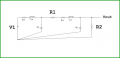
[See attachment, the resistor numbers have been corrected with the small resistors Rs and inductors Ls and capacitors Cp]


Hello there,

This question is asking to almost explain all of electromagnetic theory from many years ago up to today. That's a lot to ask really and it will be almost certain that you will find that you have to accept some known ideas as fact even if you can't prove them. So when someone hands you Ohms Law, don't be too surprised because that is the simplest way to understand these circuits. If you want to go further, you really have to look into Maxwell's Equations. However, even those come with limitations that do not include some of the findings of later scientists. To go that far you probably have to delve into quantum mechanics.

To give you some idea of what you are going to encounter while trying to keep it simpler, here is one idea.

Start with your circuit you have there and assume that each wire has some resistance, but it would actually be distributed. That means that, as another approximation, the resistance just beyond the battery positive terminal is say 0.001 Ohms, and a similar distance from that another resistor 0.001 Ohms, and another and another, until you get to R1. Now take another handful of series resistors like that and connect them between R1 and R2. To keep it a little simpler, imagine that the bottom of R2 connects directly to the negative terminal of the battery.
Next, take an equal handful of inductors with low inductance and place them in series with all of those small value resistors. This gives you two strings of low value resistors where each one has its own low value inductor.
Now take a handful of capacitors, and place one terminal of each capacitor at the right-hand junction of each resistor/inductor pair and connect all the other cap terminals to the negative terminal of the battery. This gives you a lot of series/parallel RLC sections between the battery and R1 and another set of RLC sections between R1 and R2.
If you don't understand what this looks like i can draw you a picture later.

Now you are ready to start to analyze the circuit in a way that touches on some of the most elementary physics that is more basic to the way electric circuits work.
The idea now is to analyze this circuit and find out what the main properties are.
The analysis is nothing more than a bunch of RLC circuits connected together, but the workings of it touch very nicely on the basic way a simple circuit like this works according to classical theory.

Ok, so you ready? :)

To start, say we had two small value resistors and inductors between +V1 and R1, and two caps from the junctions on the right side of each inductor to ground, and another set of two between R1 and R2. That gives us four RLC sections. and we want to solve for the voltage across each capacitor because that will help understand how the voltage seems to migrate from the battery and through the circuit. Since there are four capacitors we have four junctions.
Now we turn on the power, V1, and assume that, for now, it goes up to the full voltage in zero time. We call that a step in voltage.
First we can picture that we analyze the voltage at each junction in turn, from left to right in the drawing, but we come to the realization that the fourth capacitor closer to R2 will be the last to have it's voltage rise because the other capacitors before it have to charge first, and their charging is restricted by the caps and inductors before them, so it will take a finite time for the last capacitor to start to charge. We can do this for maybe the first microsecond, then the second, then the third, etc., until we get a full picture of how the circuit charges and behaves. After all this, we still have an approximation to what actually happens, but it's a good way to get some intuition about how a circuit like this really works.

Now that we've done that, we have to go forward with a bit more analysis.
Next, we increase the number of resistors, and at the same time we decrease their resistance, so that the total resistance between V1 and R1 is the same as before, and the same with R1 to R2. That means we add just as many inductors and capacitors meaning we have a lot more RLC sections to work with.
Let's say we increase to 10 units for each wire span. We would then analyze the circuit the same as before, but now we get a better approximation to what actually happens.

Now that we've done THAT too, we have to go forward one more time.
Next, we let the number of resistors we use go toward infinity, as well as the number of capacitors and inductors between V1 and R1 and between R1 and R2.
Once we do that, we get the exact response according to classical theory.

In that last step we would find that the solution can be found using Maxwell's Equations where we solve for what is known as the Telegrapher's Equation, and that is considered exact for classical theory.

Does that satisfy you now?

If you want to keep it simpler, you can use one RLC between V1 and R1 and one RLC between R1 and R2 and analyze that (the attachment shows this diagram). That will give you an idea of how this works electrically. The values then are somewhat easy to calculate too. The resistors are equal to the resistance of the wire run for that section, and the inductor values are those of the wire also, and the capacitance would be they typical capacitance between each node on the right side of each inductor and the minus terminal of V1. That would be a simpler fourth order RLC circuit where the solution is not hard to find using regular circuit analysis.

The very small resistor values are really expressed in terms of Ohms per unit length, inductors in Henries per unit length, and capacitors in Farads per unit length. When we use just one per section that amounts to lumping them all together to form what we sometimes call a lumped element model.
 

Attachments

Last edited:
Status
Not open for further replies.
Top