physic/machanic: relationship between the angle and time of a tilted falling object

WBahn

Joined Mar 31, 2012
33,178
it should be:

Rich (BB code):
g(1-sinθ)=(2/3)h(dθ/dt)^2
Close, but not quite. Look carefully at the role of L and h.

This is a mistake that units checking won't catch. Asking if the answer makes since, however, might. It depends on whether you asked the right limiting question. It's not obvious to me that they would. The couple of obvious checks I would have tried didn't reveal anything obviously unreasonable. For instance, I asked what the linear velocity of the center of mass would be when the stick is horizontal and compared that to the velocity of an object just dropped from the same height. I expect the answer to be less than for the free falling object and, even with the error, it was. Not by as much as it should have been, but not by enough that it would have caught my attention.
 

Thread Starter

bug13

Joined Feb 13, 2012
2,002
Your explanation has already gave me a good introduction to this approach, but this approach requires me to do more reading than just reading google for half and hour.

I will properly leave it after my test, as I don't want to jump into it without a good understand of it first :)

All he is doing is applying the equivalent of F=ma in the rotational world. ...
 

WBahn

Joined Mar 31, 2012
33,178
now I don't seem to know how to make θ as the subject.:mad:
That's okay, neither do I.

Sometimes you can figure out a clever way to solve a nonlinear diffy-Q. Sometimes you can find functions, such as Bessel functions, that are nothing more than made up functions that solve a particular functional relationship. When you think about it, that's all the trig functions are.

I had a physics teacher that did a nice job of removing the mystery from all kinds of functions when we got into material that had Bessel functions as solutions. Paraphrasing, he said: What is a sine function? It's nothing more than a one-dimendional wiggle function. It's the sum of an infinite series. It's used commonly enough that you have a button on your calculator that performs the summation and returns the result. What's a Bessel function? It's a two-dimentional wiggle function! It's the sum of an infinite series. If it were used frequently enough, you could have a button on your calculator that computes the sum and returns it.

Differential equations of the type we are working with here are sufficiently common that I wouldn't be surprised to find out that a "Kablooie function of the seventh kind" is a solution to it.

But unless we happen to know about Kablooie functions, we are stuck with something more brute force. This typically means resorting to numerical methods, although in this case we could probably use Calculus of Variations. I only say this because, when I took intermediate mechanics a quarter of a century ago, we got to solve for the motion of a simple pendulum (and maybe a physical pendulum, as well) for angles sufficiently large that the small angle approximateion (that θ~=sin(θ)) couldn't be used. IIRC, we used Calculus of Variations to solve it. You might try Googling "Physical Pendulum".
 

Thread Starter

bug13

Joined Feb 13, 2012
2,002
I come up with the same equation after a couple try, here is my step:

Rich (BB code):
mgh(1-sinθ)=(1/2)Iω^2
I=(1/3)mL^2=(1/3)m(2h)^2=(4/3)mh^2
ω=dθ/dt
put them together, I get:

Rich (BB code):
mgh(1-sinθ)=(1/2)((4/3)mh^2)(dθ/dt)^2
g(1-sinθ)=(2/3)h(dθ/dt)^2
can you point out what have I miss please.


Close, but not quite. Look carefully at the role of L and h.

This is a mistake that units checking won't catch. Asking if the answer makes since, however, might. It depends on whether you asked the right limiting question. It's not obvious to me that they would. The couple of obvious checks I would have tried didn't reveal anything obviously unreasonable. For instance, I asked what the linear velocity of the center of mass would be when the stick is horizontal and compared that to the velocity of an object just dropped from the same height. I expect the answer to be less than for the free falling object and, even with the error, it was. Not by as much as it should have been, but not by enough that it would have caught my attention.
 

WBahn

Joined Mar 31, 2012
33,178
I come up with the same equation after a couple try, here is my step:

Rich (BB code):
mgh(1-sinθ)=(1/2)Iω^2
I=(1/3)mL^2=(1/3)m(2h)^2=(4/3)mh^2
ω=dθ/dt
put them together, I get:

Rich (BB code):
mgh(1-sinθ)=(1/2)((4/3)mh^2)(dθ/dt)^2
g(1-sinθ)=(2/3)h(dθ/dt)^2
can you point out what have I miss please.
You are correct. When I wrote that I was mistakenly looking at the solution from the kinematic approach which, at the spot I was looking at it, a factor that is the same except it has an L instead of an h. I got too rushed to get the response posted and didn't look carefully enough to realize I was looking at part of a different solution. My apologies, but at least it's good practice at concluding that your work is right and the "book" solution is wrong.
 

Thread Starter

bug13

Joined Feb 13, 2012
2,002
Lol that's all good, you guided me to the solution is much appreciated, and those two tips will properly save my ass a lot of time in the future, that's the important part :)

You are correct. When I wrote that I was mistakenly looking ...
 
Last edited:

Thread Starter

bug13

Joined Feb 13, 2012
2,002
Do you use excel to plot the graph, or other software? at this stage of my learning, knowing how to do it is more important than getting the answer :)

as of the solution from the Wolframalpah, that's the look :eek::confused: I got when I saw it lol

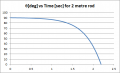
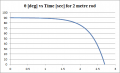
I've attempted a numerical solution for a 2 metre long falling rod. I have the plot of angle θ vs time as attached.
 

WBahn

Joined Mar 31, 2012
33,178
I've attempted a numerical solution for a 2 metre long falling rod. I have the plot of angle θ vs time as attached.
I got a similar graph, but I can place the time at which the rod reaches the ground almost anywhere I want depending on my initial conditions. What did you use for yours?

The reason is that, at the nominal initial conditions of PI/2 and zero speed, the stick is in unstable equilibrium and will stay there until perturbed. So we have to perturb it either with an small initial velocity or a small initial displacement. I chose to give it zero speed but to put the initial angle at some fraction (like 99%) of PI/2.

Angle (%)|Time (s)
99.0|1.73
99.5|1.99
99.9|2.59

With a small perturbation, the system is essentially metastable and, seemingly, takes an arbitrary amount of time to "make up its mind" and commit to falling. This is actually a reasonably good analogy (not perfect, but not bad) for a flip flop in a metastable state.
 

t_n_k

Joined Mar 6, 2009
5,455
I revised the approximation method to use mean angular velocity per angular step [~200 equal increments]. Angular velocity at each incremental step was based on the difference PE<=>KE equality at the total angle change. Initially for the first graph I used the terminal (rather than mean) velocity at each incremental angle step to estimate the incremental and thence the required aggregate time change at the current angle θ value.

The revised version probably better matches WBahn's result.
 

Attachments

Top