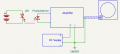
Photodetector circuit connection

Thread Starter

jinum

Joined Jul 30, 2025
1
I am building a photodetector to measure PPG signals (voltage variation). I am powering the LED from a 5V external battery, the transimpedance circuit using a separate DC power source and measuring the output PPG signal using oscilloscope. In this case, do I need to connect the grounds of the battery, DC power source and the oscilloscope together to get better output with less noise.
 

Alec_t

Joined Sep 17, 2013
15,103
Welcome to AAC.
Please post a schematic with labelled circuit components.
Grounding, screening and circuit layout could all be critical for measuring small signal variations reliably.
 

Irving

Joined Jan 30, 2016
4,997
Welcome to AAC.

You'll get a quicker/better response if you give more detail in your query. Not many people will know the acronym PPG - photoplethysmography - using reflected (infrared) light off the skin to measure blood volume variations. A typical setup uses an illuminating LED, a photodetector, amplification followed by an analogue to digital conversion and digital analysis of the signal and its first and second derivatives.

Noise is a key issue in such measurements; mechanical from the relative motions of the illuminator, skin area, and photodetector (including 'microphonics' within the illuminator and detector), and electrical through variation in light output due to supply variations and thermal noise in the illuminator, external light on the photodetector, thermal noise in detector and amplifier and induced noise EMI from external equipment.

Close attention to the grounding and interconnection is important.

Grounding of the light source to the photodetector isn't necessary or critical, though protecting the source from external influences is important. Independent battery power to the source is helpful in avoiding induced external variation.

On the receiving side, appropriate connection of the photodetector to the amplifier is crucial; a current-based rather than voltage-based interface will help avoid problems due to induced noise, and careful selection of components to reduce or reject injection of power supply noise into the system will help. A single star ground point will help avoid induced noise from ground loops.

1753875080484.png
 
Last edited:

MisterBill2

Joined Jan 23, 2018
27,186
I suggest not grounding the photo-detector, but certainly using a well shielded two conductor cable with a minimum triboelectric capability. THE SHIELD should connect the housing of the photodetector to the shield ground of the scope, although your application may require a separate amplifier.
I am guessing that the detector will be a high impedance device delivering a small signal.
 
Top