phase angle AC Diagram

Thread Starter

antiantianti

Joined Aug 4, 2016
45
Hi

The question is to compute the phase angle and the answer was is arc tan ( V L / V R) according to the diagram on the picture
but how did they find this fornula or the proof of this formula what what phase angle is exactly meant.
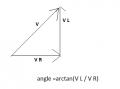
l.png
 
Last edited by a moderator:

WBahn

Joined Mar 31, 2012
32,783
It's called trigonometry.

Go back to the definition of a phasor.

V·sin(ωt + θ) ⇔ V∠θ

Now consider the addition of two phasors that are 90° out of phase.

V·sin(ωt + θ) = Vr·sin(ωt) + Vl·sin(ωt + 90°)

What are V and θ in terms of Vr and Vl?
 

MrAl

Joined Jun 17, 2014
13,691
Hi

The question is to compute the phase angle and the answer was is arc tan ( V L / V R) according to the diagram on the picture
but how did they find this fornula or the proof of this formula what what phase angle is exactly meant.

View attachment 124213
Hi,

Is that diagram and your assumptions about it correct?
I ask because we dont usually see L alone in a formula like that we at least see an 'omega' with it like w*L for example (w=omega), and also V*R/(V*L) simplifies to R/L and V*L/(V*R) to L/R. The 'omega' conveys the frequency information.

For example with R and L in series excited by a voltage V i get for the current phase:
Ph=atan2(-w*L,R)

which you might be able to reduce to:
Ph=-atan(w*L/R)

but we still get the 'w' in there.
Alternately we could do Ph=-atan(xL/R) where xL is the reactance of L at frequency w.


It would be good if you can show the schematic.
 

WBahn

Joined Mar 31, 2012
32,783
I'm pretty sure it's not V times L, but V sub L -- i.e., the voltage across the inductor. Similarly, the other phasor is V sub R, the voltage across the resistor. V is then the total voltage of V_L and V_R (which I wrote as Vl and Vr). Since they are being added, the circuit is for a series resistor/inductor branch.

But I agree, a schematic is always nice and would make this a lot clearer.
 

MrAl

Joined Jun 17, 2014
13,691
Hi,

Yes i agree that's the most likely way it was done. Thanks for mentioning that.
In that case, we have VR and VL as the two voltages not two multiplications of V times something.

Also in that case, we might check the sign of the phase, but often they dont pay attention to the sign and assume we know if it is lagging or leading based on the component either L or C.
 
Top