Peltier boost ... could this idea work?

drjohsmith

Joined Dec 13, 2021
1,602
I understand everyone's POV (that the "hot side" is disproportionately warmer than the cold side) - however - the thermoelectric effect is caused by the *flow of current* - like a water-wheel turning in a river - it's NOT removing ALL the motion of the water (electrons) - so what I'm saying, is to recycle the left-over current flow.
The old water analagy only works so far.

The current that flows,does so because of the voltage from the power supply,
If there is 4 amps flowing, then thats due to the volatge your providing, and the resistance of the load.
If you put another load, be that a capacitor or what ever in parallel, then the current will go up, as some is going into the extra load as well.

If you put a second load in series, then your dividing the voltage across your loads, in proportion to their "resistance"
with less voltage across each load, the load you want, the peltie, will take less power and not heat / cool so well.
 

KeithWalker

Joined Jul 10, 2017
3,607
Testing my TEC1-12706 peltier, I notice that it seems to be wasting a lot of the energy it has been supplied? - let me explain:-

@KeithWalker - obviously nothing to do with what I was asking, and completely (well, exactly 99.9% to be precise) wrong suggestion.
Why is it a wrong suggestion? Where do you think the wasted energy is going?
If there really is 12VDC available from the supply but the voltage only measures 10.75V half way through the wiring, what do you think is dropping the voltage? The resistance of the wiring of course (see Ohm's Law). You can't capture that loss with capacitors or anything else. Just use thicker wires and minimize losses.
 

Sensacell

Joined Jun 19, 2012
3,785
No I don't exaggerate (at least not about electronics).
It's a fundamental electrical law.
(You obviously are unfamiliar with several. For example there is no such thing as "left over current flow). :rolleyes:

The reason for only half the energy going to the cap is that the current from the power supply to charge the capacitor is delivered at a constant voltage, but the capacitor starts at 0V and then increases as it charges.
The difference between those two voltages is dissipated in the resistance (independent of its value) between the power supply and the capacitor as it charges.
If you do the calculations you will find that the energy dissipated happens to be equal to the energy stored on the capacitor.

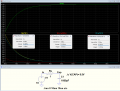
Below is a simulation to illustrate this relation for a voltage charge source (Rs is the simulated power supply resistance).

The yellow trace shows the power generated by the supply during the time the capacitor charges.
The integral of this is the total energy supplied, which is 100mJ here.

The red trace shows the power dissipated by the resistor.
Its integral is 50mJ, half of that generated by the supply.

The blue trace shows the power delivered to the capacitor.
Its integral is also 50mJ, half of the generated by the supply.

This relation is unaffected by the sized of the resistance, except for how long it takes for the capacitor to charge.

In theory you can charge a capacitor with no loss if you place an inductor in series with the capacitor, and stop the charge when the capacitor reaches its max voltage (which will be twice the supply voltage).
Alternately, an efficient constant-current switching regulator will also charge it without that loss.

View attachment 291082
This is a nice demo, I makes me wonder how any switched capacitor voltage converter can ever be more than 50% efficient?
I have seen them touted as more that 90% efficient, I just cannot wrap my head around how this is possible?
 

drjohsmith

Joined Dec 13, 2021
1,602
This is a nice demo, I makes me wonder how any switched capacitor voltage converter can ever be more than 50% efficient?
I have seen them touted as more that 90% efficient, I just cannot wrap my head around how this is possible?
A switch mode PSU is a very different system to what the op is discussing .
In a smps , a inductor is used to store power. A relatively short relatively high current pulse "inflates" the magnetic field on the inductor.
The inductor then discharges into the load .
By varying the period one puts the current into the inductor , you vary how much energy is stored in the inductor .
As the load on the inductor varies , the width of the charge pulse is changed to keep the output voltage constant.
As it's a short charge pulse ,the fets used to switch are in saturation on off, so max efficiency.
No magic. Just engineering
 

Ya’akov

Joined Jan 27, 2019
10,237
In the case of electrical power utilization the losses (waste) are always relative to the reduction of entropy desired by the devices maker. Unlike human law, the laws of thermodynamics don’t have a cleverness loophole. You can only be as efficient as the equations suggest.

If you want to create net entropy, you can be 100% efficient. If you want to reduce entropy, you already start out in the hole. If you want to heat everything up you‘re in luck—but if you only want to heat specific things up, or worse, cool things down, you can only do it at a cost of creating more entropy than order
Now to be clear, I don’t think you were trying to get to 100% efficiency.

So, as the poet Allen Ginsburg said:
There is a game.
You can't win.
You can't break even.
You can't even get out of the game.
This isn’t meant as a general condemnation. It is reasonable to think you could improve things with some clever hacks. That‘s worth considering.

But there are two things also to consider:

1. Why wouldn’t any of the very clever people who have made doing that their life’s work have missed what you saw? This isn’t to say you couldn’t have some unusual perspective and spot something they missed, but what are the chances?

2. What is the source of the losses in the system you are trying to improve? Since they are already going to be accounted for, attacking one of them is going to be the right direction (e.g. bigger wires) rather than some speculative source of loss. It is almost certainly because the above mentioned clever folks already knew the sources of loss, and so weren’t chasing phantoms.

Don’t let this stop you from trying to improve things, but do make sure you have all the relevant information before proposing a solution. It turns out you were trying to eliminate something that doesn’t exist and that is very hard indeed.
 

KeithWalker

Joined Jul 10, 2017
3,607
Testing my TEC1-12706 peltier, I notice that it seems to be wasting a lot of the energy it has been supplied? - let me explain:-
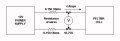
I set my lab bench supply at 12v 5amps, powered it up, and the voltage dropped to 10v and my supply showed it consuming 4amps
Chris.
You are claiming that the peltier is inefficient because of the voltage drop measured half way between the supply and peltier cell.
The voltage drop is not caused by the peltier but by the current flowing through the wiring which is thin and has some resistance. Making this measurement will tell you nothing about the efficiency of the peltier cell which is: heat exchange energy out / electrical energy in. What it does tell you is the amount of electrical energy wasted as heat in the wiring between the supply and the meter. That energy loss can only be reduced by using thicker, shorter wire that has lower resistance. It can not be recovered by any ingenious method using capacitors.
Pcell.jpg
 

crutschow

Joined Mar 14, 2008
38,515
I makes me wonder how any switched capacitor voltage converter can ever be more than 50% efficient?
It's related to how much the capacitor is charged and discharged.
If it's only a small amount of voltage change, as is typical in a switched capacitor converter, then the losses are much less.
(The reason would seem that the voltage drop across the conducting resistance is much less so the V²/R loss is less)

Sim below, where the starting capacitor voltage is 85% of the source voltage:
Now the source energy supplied (yellow trace) is 14.9mJ, but the resistor loss is only 1.1mJ (red trace), transferring 13.8mJ (green trace) to the capacitor), for an efficiency of about 93%.

1680271734773.png
 

vanderghast

Joined Jun 14, 2018
70
This is a nice demo, I makes me wonder how any switched capacitor voltage converter can ever be more than 50% efficient?
I have seen them touted as more that 90% efficient, I just cannot wrap my head around how this is possible?
It is 50% when you compare the energy stored in the cap, from 0 volt in the cap to the actual stored voltage in the cap.
It can be close to 100% if you compare the difference in energy from 0.99999 times the actual stored voltage to the actual stored voltage.

To compute the 50%:
The energy stored in the cap is 0.5 C V^2 with V = the voltage across the cap.
The instantaneous energy supplied by the battery in a RC circuit, is i * Vc * dt where i is the instantaneous current, Vc is the battery constant voltage and dt is a short period of time. We can get that i = (Vc /R) (exp(-t/(R*C)) ) at time t.
If you integrate (sum) the energy supplied by the battery from time t = 0 to the time t = infinity, you will get a result independent of R and equals to C V^2.
If you are not able to integrate analytically, you can use a spreadsheet by approximation with a finite sum of multiple time slices. (Performing a numerical integration)

Doing so, you will see that you supplied twice the energy compared to the energy stored in the capacitor. (So the 50% of efficiency).
If you use cap from 100% to just 85% of Vc, then, to recharge the cap back to 100% Vc, you will have a better efficiency, but it is still 50% compared to what you supplied from no voltage stored in the cap to the cap charged to Vc.

The battery cannot supply an infinite current, so there is a minimum real value for R for the equation of the current to be correct.

Where the lost energy goes? Into heat.
Note that Kirchoff's equations do NOT consider the conservation of energy in ANY way. As trivial as it is, resistors produce heat, and we don't consider any of this loss of energy in trivial formulations. Real batteries have internal resistance.
 

gray5596

Joined May 30, 2010
2
Testing my TEC1-12706 peltier, I notice that it seems to be wasting a lot of the energy it has been supplied? - let me explain:-

I set my lab bench supply at 12v 5amps, powered it up, and the voltage dropped to 10v and my supply showed it consuming 4amps

The TEC had monster heatsinks on both sides, and I only ran the test for about 10s each.

My question:-

WHAT IF I built a high-speed switching circuit that used that "left over" 10v @ 4amps to charge up (say) 2 capacitors in parallel, then connect them in series with the peltier input (plus 12v power supply) to drive it (while, at the same time, charging a second-set of capacitors in parallel again), and keep swapping those sets of caps back and forth etc ?

(am I overthinking that? Maybe just charge 1 cap, then put it in series with the power supply to charge a second cap, and keep swapping those caps?

e.g. would that (or some other idea) be able to "reclaim" that lost energy (coming from my solar panels) to pump more of the available energy into the cooling effect?

If my idea has any merit, what kind of practical circuit would maximize the recovery of this energy (taking into account drops and losses of switching/boost circuits, the "diminishing returns" of the dynamic voltages/behavior of all that, and other stuff I've probably overlooked) ?

Chris.
View attachment 291072
I checked the website and it showed this module pulls 6.4 amps at 12 volts, not 5 amps. If I understand what you're doing, it appears your power supply is lowering the voltage until it gets under 5 amps which is normal when current limit a power supply.

1680285074415.png
 

allenbt

Joined Feb 22, 2016
2
@KeithWalker - obviously nothing to do with what I was asking, and completely (well, exactly 99.9% to be precise) wrong suggestion.

It did raise an interesting point though - so re-testing by replacing the peltier with a short-circuit, the supply drops to 1volt at 4.995 amps, so yeah, there's some totally-insignificant loss in the wires (0.1%), but it's the peltier-effect that's using up the missing energy (of course - you cant get heat and cold for free...).

Been 50 years since I took electronics, but it seems to me if your PS is current limited to 5 amps, it has to drop voltage until it reduces current to 5 amps. At that point R= E/I, so the resistance of the shorting setup is 0.2 ohms. Your total resistance with the peltier is 3 ohms. So I would say you are dissipating about 7% of your power source in wire resistance.
 

KeithWalker

Joined Jul 10, 2017
3,607
It did raise an interesting point though - so re-testing by replacing the peltier with a short-circuit, the supply drops to 1volt at 4.995 amps, so yeah, there's some totally-insignificant loss in the wires (0.1%), but it's the peltier-effect that's using up the missing energy (of course - you cant get heat and cold for free...).
It raised a very interesting point: what missing energy are you talking about? The only energy not getting to the peltier is what is being dissipated by the resistance of the wiring. I really think you should re-visit Ohm's law!
Pcell.jpg
 

AnalogKid

Joined Aug 1, 2013
12,139
What would happen if I stuck a 500uF non-polarized electrolytic crossover capacitor in series with the 12v power supply, and switched it's polarity at 1.6khz (i.e. so it can deliver 40watts).
The absolute-ultra-maximum-total energy that you can store in a 500 uF cap charged up to 12 V is 0.036 W. In order for such a part to deliver 40 W to anything, one might think that some magical circuit could charge it up to 12 V and then switch it to the load, where it discharges 100% of its stored energy before being switched back to the energy source. Assuming both the charge and discharge times are the same, the switching frequency would be in the multi-kilohertz range.

But if one thought that, one would be wrong.

A capacitor cannot discharge instantaneously, so for most of the discharge phase of a cycle it is delivering current at way less that 12 V potential. That's a big problem, but not as big as the inevitable power loss in the switching components.

Also, I did not use the term "magical circuit" facetiously. "Magical thinking" is a very real thing, unlike the results of such thinking.

ak
 
Top