OK, so how did we drift away from PCB cutting to EDM? Think we need to get back on track. Cutting PCB's with abrasive means will raise a lot of hazardous dust. In part - the glass fibers and in another part - airborne resin particles. Neither of which are good for the lungs. So wear a mask of some sort.
Yeah, I've seen that. As noted in the video, though, he's cutting FR4 board, which doesn't chip. Phenolic board chips very easily; you have to cut deep enough and preferably from both sides to get a good break. The carbide tipped cutter I posted above does a good job on phenolic, because it actually removes material instead of just scoring like a box cutter would.
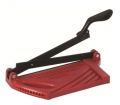
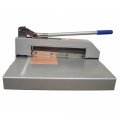
Here's the latest news. I bought myself one of these flooring cutters, and it's working quite well for cutting my PCBs.
The only caveat is that due to the blade's geometry, one of the sides of the cut has a smoother finish than the other. In fact, if one cuts real slow then the side outside the machine tends to buckle under the cut due to the PCB's fibers being displaced. And thus a long and thin flake is produced on that side of the cut. But the quicker and stronger that one applies pressure to the lever while cutting (and I mean reflex-fast) the better the finish on both sides of the cut.
This machine has only one blade on the top, and it stops when it makes full contact with an aluminum profile below it. I can already see that this profile is suffering the effects of the blade and will eventually become a problem.
What I'm going to do (eventually, when this machine wears out and no longer works to my satisfaction) is design a mechanism with blades both on top and bottom. I plan to use box cutter blades of the disposable type so that they can easily be replaced when there's need. I'm thinking about a mechanism that would let me adjust the blades position so that they are perfectly aligned and parallel. And also with an adjustable stop so that they can come as close as possible to each other but never really touching, ideally leaving a gap of 0.001" or less between them when the lever is all the way down. I wager that the cut then will have a gorgeous surface finish on both sides.
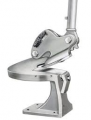
I use a shear like this ($30 at Home Depot):
Mine is an earlier version. Most shears for manual use have the blade present to the material being cut at a slight angle to reduce cutting forces. None of my shears have any sort of stop that the top blade hits. There are, of course, stops to control blade travel. I suspect the parallel fence on your cutter is a safety shield or holddown. Of course, the blade could present parallel to reduce twisting of soft materials.
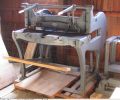
My ancient Peck Stow and Wilcox (aka PEXTO) has adjustable blades. It's a C-throat shear and manual. You want some clearance between the top and bottom blades. I forget the actual amount. It is a few thousanths. I use oiled paper to set mine. A also don't use that good shear for PCB's.
Any posability of getting a model number for the shear? I'm on a metal working forum too and we try to find all the different type of old sheet metal working equipment. Can't say I've ever heard of a Pexto C throat shear, sound like how a Beverly shear could be described.
I've tried to use shears before, several times. But although they work more or less fine most of the time, it is almost impossible to get a good straight cut out of them. This because (as you've already mentioned) the blades cut at an angle, and therefore the cut travels from one end of the piece to the other and thus exerts a force on the board in the direction of the cut which makes it tend to move. Many times I tried to hold on to the piece being cut as firmly as I could, but it always moved while doing the cut, resulting in an arched or non-linear edge.
The flooring cutter on the other hand, has two huge advantages:
The blade is always perfectly perpendicular to the material and cuts it all at once, both acting as a cutter and as a press that keeps the material from moving.
The blade can be brought down on the PCB very carefully before cutting, making it the hell of a lot easier to align the entire length of the material with the blade.
The latter point is probably the most important. The cuts thus obtained are far more accurate and reliable than those obtained using a normal shear, in my experience.
Do you mean it is dangerous like asbestos or just a "nuisance dust?" If the later, then an ordinary face mask like we are required to wear today should be sufficient.
Any posability of getting a model number for the shear? I'm on a metal working forum too and we try to find all the different type of old sheet metal working equipment. Can't say I've ever heard of a Pexto C throat shear, sound like how a Beverly shear could be described.
No model number that I know of. It's too cold now to spend a lot of time in the barn looking for one. It may be hidden. I am not sure whether it is cast iron or cast steel.
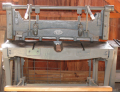
I got it in 1984. It was in good shape mechanically, so I cleaned it up, stripped , and repainted it. Only had to make one small repair to one of the trunnions that the stomp bar connects to. It has the depth guide in back, but nothing in front. I make do with some CR bar stock. Got the blades sharpened, and it works great. In the left picture, you can see the steel flats I added as braces to the bottom. Many of this model will have a cracked bed that has been repaired by brazing. It is usually in the semicircular recess in the center. Mine does not. The braces are to help ensure that doesn't happen. The thing I really like about it is that it can also be used for slitting. In my earlier shop in MN, it got a fair bit of use with aluminum. Now, I use it only once or twice a year.
I would not be so eager to switch. Soldering phenolic resins can lead to their pyrolysis and release of "dangerous" gases (e.g., formaldehyde).*
From a pathology perspective, asbestos is a particularly dangerous particulate that causes mesothelioma. Other dusts, including dusts from fiberglass and carbon fiber composites, are not as dangerous and were/are classified as "nuisance" dusts. That certainly doesn't mean you shouldn't wear a dust mask, particularly for frequent exposure or where ventilation is poor.
*In the early 1990's, formaldehyde was shown to cause nasopharyngeal carcinoma (relatively rare) in mice exposed to very high concentrations (1000x the accepted level at the time). Because of that data, allowable limits for formaldehyde were reduced. The rationale for that regulation was and still is debated. I don't believe any cases in humans were ever traced to formaldehyde exposure at the old allowable limits. Formaldehyde can be detected by human smell at very low levels.
The only caveat is that due to the blade's geometry, one of the sides of the cut has a smoother finish than the other. In fact, if one cuts real slow then the side outside the machine tends to buckle under the cut due to the PCB's fibers being displaced. And thus a long and thin flake is produced on that side of the cut. But the quicker and stronger that one applies pressure to the lever while cutting (and I mean reflex-fast) the better the finish on both sides of the cut.
I think the speed of the cut is true of many shears. The blades on my PEXTO are almost square to the face. Many are actually square, which allows the blade to be reversed. The blades on your laminate cutter are tapered like a knife. The part being cut off is intended to be waste. That is also the case with my inexpensive vinyl tile cutter.
@jpanhalt, thanks for the picture, it looks like a standard Pexto stomp shear, not what I was expecting. This is what I thought you meant by the C frame remark - These are the most sought after sheet metal shears, can cut almost any shape you can imagine. And since they use a gear segment on the handle they are very easy to use on thicker sheet metal too.
What I meant by slitting is you can notch from either side, and if you feed from the right side, it will slit an endless sheet. The former was useful in making things like engine baffles for air cooled engines. Of course, a skilled worker with good hand shears can do the same. It was all relatively thin, 2024T3 aluminum. Edges were finished with vixon files.

 Facebook
 Google
 GitHub
 Linkedin