Passive crossover

Thread Starter

Joblopes

Joined Nov 24, 2025
4
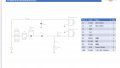
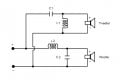
I saw this schematic for a passive crossover online and I'd like to know if everything is correct or if you would change anything.

It will work for a 45W RMS tweeter and a 280W RMS speaker.
 

Attachments

BobTPH

Joined Jun 5, 2013
11,463
A crossover must be designed for the specific woofer and tweeter drivers it is used with. Was this designed for the drivers you have, or is it simply a circuit you found for some other drivers?
 

BobTPH

Joined Jun 5, 2013
11,463
No it is for diferent with more power
Then get a free program and design a crossover for your drivers.

In addition to the impedance, you have to know the efficiency of each drivers and the frequency response curves. I believe the additional resistors in the one you posted are to get a flatter response based in the target drivers.

The simple circuit posted above is all you need if the two drivers you have (near) the same efficiency and are both (reasonably) flat across the chosen crossover frequency. Those things should be addressed before choosing the drivers.
 

Thread Starter

Joblopes

Joined Nov 24, 2025
4
Then get a free program and design a crossover for your drivers.

In addition to the impedance, you have to know the efficiency of each drivers and the frequency response curves. I believe the additional resistors in the one you posted are to get a flatter response based in the target drivers.

The simple circuit posted above is all you need if the two drivers you have (near) the same efficiency and are both (reasonably) flat across the chosen crossover frequency. Those things should be addressed before choosing the drivers.
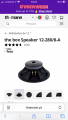
I already have the speaker this ones.
And what do you meen by freekency ? it Will be for a full range speakers
 

Attachments

crutschow

Joined Mar 14, 2008
38,316
If the speaker efficiencies don't match, you may have to put an L-Pad attenuator in series with the one that has the higher efficiency to give a relatively flat frequency response.

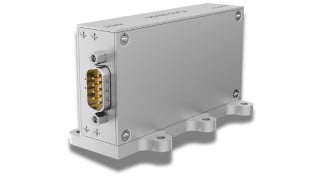
The easiest way to do a crossover is to buy one already assembled such as here.
 
Last edited:

MrChips

Joined Oct 2, 2009
34,627
The cone of a large diameter, high power driver will "break up" and distort when driven at high output.
At the very least, use a 2-way crossover.

When you consider that most music content is in the mid-range frequencies, it makes sense to go with a 3-way systems.
It all depends on the application, e.g. home hi-fi entertainment, on stage guitar amplification, PA system, etc.
 

crutschow

Joined Mar 14, 2008
38,316
The simplest 2-way crossover for low-cost designs is a capacitor in series with the tweeter, and an inductor in series with the low-frequency driver (calculator here).
That will likely be sufficient for casual music listening.
 
Last edited:

PeteHL

Joined Dec 17, 2014
562
The cone of a large diameter, high power driver will "break up" and distort when driven at high output.
At the very least, use a 2-way crossover.

When you consider that most music content is in the mid-range frequencies, it makes sense to go with a 3-way systems.
It all depends on the application, e.g. home hi-fi entertainment, on stage guitar amplification, PA system, etc.
"First, I recommend avoiding anything more complex than a 2-way system whenever possible. Always be reluctant to add another crossover."

https://www.trueaudio.com/st_xov_1.htm
 

crutschow

Joined Mar 14, 2008
38,316
What is a musical subwoofer?
Ok, grammar police. :rolleyes:
By musical I meant one that can reproduce the musical low end with a flat frequency and good transient response, which typically means a sealed-box type subwoofer.
The more common ported (bass reflex) types generate a louder bass with generally poorer transient response and a peak in the response at the resonant frequency (boomy bass). That may be okay for TV/movie sound effects, but not so good for reproducing music.

I have a cheap 8" ported subwoofer that I use with my computer speakers to listen to music.
It had a rather "muddy" sound for the music bass until I literally stuffed a sock in the reflex port.
That reduced the bass volume some (which I compensated with the sub volume control) but greatly improved the clarity of the bass.
 

PeteHL

Joined Dec 17, 2014
562
I think a good combination for music is a tweeter and midrange (going down to about 100Hz) with appropriate 2-way crossover, and with a musical subwoofer (sealed box type, not bass reflex) for good low end below 100Hz.
Sure, I would agree with that. For frequency < 100 Hz, it is very difficult to determine the location of the source producing that sound especially in a listening room that is typically smaller. So the subwoofer can be a great distance away from the stereo pair without adversely affecting reproduction. However I really like the reproduction of the speaker that I currently listen to which is a two-way, a 12 inch woofer and a 3 inch paper cone mid to high-frequency driver, crossover frequency is 1 kHz.
 
Top