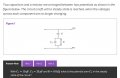
Parallel C&R in series with C — how to solve?

Thread Starter

profmatt

Joined Nov 29, 2017
2
E337FC0A-9329-4A3B-B063-6A8D59E708B7.jpeg

This question is aimed at A level students (17-18 years old) and apparently requires no more than basic formulas (such as C = Q/V, KCL, KVL, etc).

I’d really like to have an understanding of what physically happens in this circuit.

At equilibrium, I believe the charge stored in C1 will be the same as that in C2. The circuit (is it even a circuit?) may be a potential divider, but the concept of the resistance of a capacitor is not one explored at A level. I’m not clear what role the resistor plays. I know how to find the total capacitance of capacitors in series.

The hints available were nothing more than reminders of, for example, KCL and KVL.
 

shteii01

Joined Feb 19, 2010
4,644
It is trick question.
1. You have DC voltage.
2. You have steady state condition. The voltage does not fluctuate. The capacitors are fully charged at this point.

Here is the trick. A fully charged capacitor act as an OPEN circuit. This means that there is no path for current to flow (you can replace C1 with an OPEN), which means that there is no current passing through R. Which means that voltage across R is (apply Ohm's Law) Vr=0*R=0 volts. Since R is in parallel with C2, voltage across R is voltage across C2. Therefore voltage across C2 is 0 volts.
 

WBahn

Joined Mar 31, 2012
32,929
Let's assume that the system is in steady state with a non-zero voltage across C2.

What are the implications of this?

1) There must be a non-zero voltage across R (since R and C2 are in parallel and being in parallel means that they have the same voltage across them).

2) A non-zero voltage across R means that there is a current flowing in R1. (Ohms' Law)

3) If there is a current flowing in R that means that it must be coming from either C1 or C2 (or both). (KCL applied to the junction of the three)

4) If there is current in a capacitor, the charge on that capacitor is changing. (Q = ∫i⋅dt or Q=IΔT if non-calculus)

5) A changing charge on a capacitor means a changing voltage. (Q = CV)

6) A changing voltage means that it is not in steady state. (Steady state was explicitly defined as no changing voltages across any component).

Thus we have a contradiction -- a consequence of our assumption that the system is in steady state with a non-zero voltage across C2 is that the system is not in steady state. Therefore our one and only assumption must be wrong -- it must not be possible for the system to be in steady state with a non-zero voltage across C2.
 

Picbuster

Joined Dec 2, 2013
1,059
View attachment 140504

This question is aimed at A level students (17-18 years old) and apparently requires no more than basic formulas (such as C = Q/V, KCL, KVL, etc).

I’d really like to have an understanding of what physically happens in this circuit.

At equilibrium, I believe the charge stored in C1 will be the same as that in C2. The circuit (is it even a circuit?) may be a potential divider, but the concept of the resistance of a capacitor is not one explored at A level. I’m not clear what role the resistor plays. I know how to find the total capacitance of capacitors in series.

The hints available were nothing more than reminders of, for example, KCL and KVL.
First of all define when a stable situation occurs.
To do that you should start with uncharged capacitors and connect the DC power.
What happened to the voltage over the capacitors?
Next thing; what does the resistor doing to a capacitor in parallel?

Make a diagram of the voltages and think about it and produce the correct answer.

Good luck
Picbuster
PS: we can solve your problems but want you to use your brains.
 

MrAl

Joined Jun 17, 2014
13,720
View attachment 140504

This question is aimed at A level students (17-18 years old) and apparently requires no more than basic formulas (such as C = Q/V, KCL, KVL, etc).

I’d really like to have an understanding of what physically happens in this circuit.

At equilibrium, I believe the charge stored in C1 will be the same as that in C2. The circuit (is it even a circuit?) may be a potential divider, but the concept of the resistance of a capacitor is not one explored at A level. I’m not clear what role the resistor plays. I know how to find the total capacitance of capacitors in series.

The hints available were nothing more than reminders of, for example, KCL and KVL.
Hi,

Well sorry to say that the charge stored at equilibrium is not equal between caps.

This circuit is tricky for almost anyone during the first instant when the power supply is turned on, but after the power has been applied for a long time we have several things we can say about capacitors and resistors that makes it very easy to see what will happen.

First, during DC steady state capacitors look like open circuits. That means that at steady state the resistor no longer conducts any current.
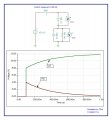
Second, during the first instant both caps will have some energy and that means both will have voltage across them, but the resistor is in parallel with one cap and in series with the other cap so it discharges one and charges the other. This will continue until the resistor no longer draws any current.
Notice that we dont need any real circuit analysis here, we just have to think about how caps and resistors work with DC.

Does that help you to figure out what the end result is?

We can go in to a deeper circuit analysis if you like and prove what happens.

Another simple view is that when the power supply is turned on for the first time the edge of the voltage going from 0v to 12v has a high frequency component, and that high frequency component causes a lot of current flow in the two caps and so they both charge to some degree based on their cap values. After some time the 12v is steady and then the resistor starts to discharge C2 and continue to charge C1.
 

Thread Starter

profmatt

Joined Nov 29, 2017
2
I’m very grateful for the useful and helpful contributions thus far.

I can see that “steady state” implies 0V across C2, and that seems almost trivial. (I’m somewhat cross that this didn’t occur to me.)

In terms of the homework question, the job is done.

But I’m still trying to picture what actually happens and how things end up in that steady state. I’m beginning to suspect that differential equations might need to get involved. From @MrAl ’s description it reminds me a bit of a bath that is being filled but is also leaking. The C1 bath eventually fills up, the C2 bath eventually drains. (Does it ever start to fill?)

I like to try to picture what’s happening in terms of electrons and where they go. Capacitors are tricky because electrons don’t cross them, so it becomes less easy to think in terms of flows of electrons.

Although the data supplied in the question were not necessary to answer it, does that necessarily mean they were irrelevant? Would a steady state always be reached, or might some combination of values result in different long term behaviour?
 

WBahn

Joined Mar 31, 2012
32,929
You can still think of capacitors in terms of the current flowing in them. As an electron enters one terminal, an electron leaves the other terminal, so if the capacitor is in a black box, that indistinguishable from a current flowing through a resistor (looking at just the current and ignoring the voltage). The fact that the electron that leaves isn't the same electron that leaves is undetectable -- in fact, it isn't the same electron in the case of a resistor, either.

As others have pointed out, the fact that the supply voltage is just given as a fixed 12 V makes it a bit tough to talk about what happens as the system goes from uncharged to steady state. The most reasonable way to address this is to put a switch and a resistor, Rs, in series with the supply and turn it on at t=0 and then ask what happens over time. If you choose a resistor for Rs that is much smaller than R, then you will see both capacitors charge to nearly the same charge just as if R was removed, and then you would see the charge bleed off of C2 through R and, at the same time as the voltage across C2 drops, the current in R would also have a component coming in from C1 as it charged up toward the full supply voltage that it has in steady state. The other extreme is to make Rs much larger than R. In that case the voltage across C2 never builds beyond a very small value since any current that flows through C1 essentially flows immediately out through R.

A problem to consider is what value does R2 need to be so that the peak voltage across C2 is half the supply voltage.
 

MrAl

Joined Jun 17, 2014
13,720
I’m very grateful for the useful and helpful contributions thus far.

I can see that “steady state” implies 0V across C2, and that seems almost trivial. (I’m somewhat cross that this didn’t occur to me.)

In terms of the homework question, the job is done.

But I’m still trying to picture what actually happens and how things end up in that steady state. I’m beginning to suspect that differential equations might need to get involved. From @MrAl ’s description it reminds me a bit of a bath that is being filled but is also leaking. The C1 bath eventually fills up, the C2 bath eventually drains. (Does it ever start to fill?)

I like to try to picture what’s happening in terms of electrons and where they go. Capacitors are tricky because electrons don’t cross them, so it becomes less easy to think in terms of flows of electrons.

Although the data supplied in the question were not necessary to answer it, does that necessarily mean they were irrelevant? Would a steady state always be reached, or might some combination of values result in different long term behaviour?
Hello,

I see your dilemma here. You are trying to visualize what happens physically within the circuit based on electrical quantities by creating an analogy with something you already know much about.

To do thjis it is best to turn to the known analogies that take us from electrical systems to other systems such as mechanical or fluid flow. To use the bath tub analogy you could move to the fluid analogy. To understand it in this way you model the caps as the bathtubs and use pipe to model the wires and a very narrow pipe to model the resistor. You also have to consider the pressure differentials across all elelents as that translates to the voltage in the electrical system.

You dont need calculus if you think of it as time progresses in small increments, but it helps. For example:
fluid capacitance is Q=C*dP/dt
fluid resistance is Q=P/R

where
Q is volumetric rate of flow,
P is pressure difference,
R is a constant, C is a constant,
and the fluid source in this case is a pressure difference which is constant and so never changes, and is trying to force the same pressure in the rest of the system in order for the system to reach equilibrium.

You can note the similarities to the electrical circuit through Ohm's Law and a defining equation for a capacitor.

We can convert:
Q=C*dP/dt

into:
dP/dt=Q/C

and what this means is if we have a flow Q through a tub the pressure difference across that tub is constant. If we have two different tubs in series then the pressure across the first is:
DP1=dP1/dt=Q/C1
and across the second is:
DP2=dP2/dt=Q/C2

and you can see that for any flow rate Q if C2 is larger than C1 then the pressure difference DP1 is larger than DP2 so the first cap has a larger voltage across it than the second 'cap'.

So at the end of that phase we see C2 has 1/2 the voltage that C1 has. DUring this phase we dont think about the resistor yet because it has an insignificant effect due to the small current it conducts (very little water flow as compared to the initial water flow caused by the pressure source which will be very very high).

Next we see the 'resistor' which is a small diameter pipe across the second tub C2 keep some small flow rate going. The flow for C2 is OUT of the tub, while the flow for C1 is still INTO the tub, so C1 keeps charging while C2 looses it's charge.
After some time all of the applied pressure difference (the voltage source) appears all across C1 and none across C2.

There are numerical solutions to these kinds of problems that very nicely show how this works step by step. If you are interested we can talk about that too.

The full analysis using impedances is actually fairly simple for this circuit if you are interested in that too.
 
Last edited:
Top